The Cathedral brought Santiago into being, but the city quickly grew beyond the shrine. This walk follows the Santiago of fishmongers, university students, enclosed convents and neighborhood churches. Allow half a day, longer if you stop for lunch in the market or enter the Museum of the Galician People.
The market: Santiago at work
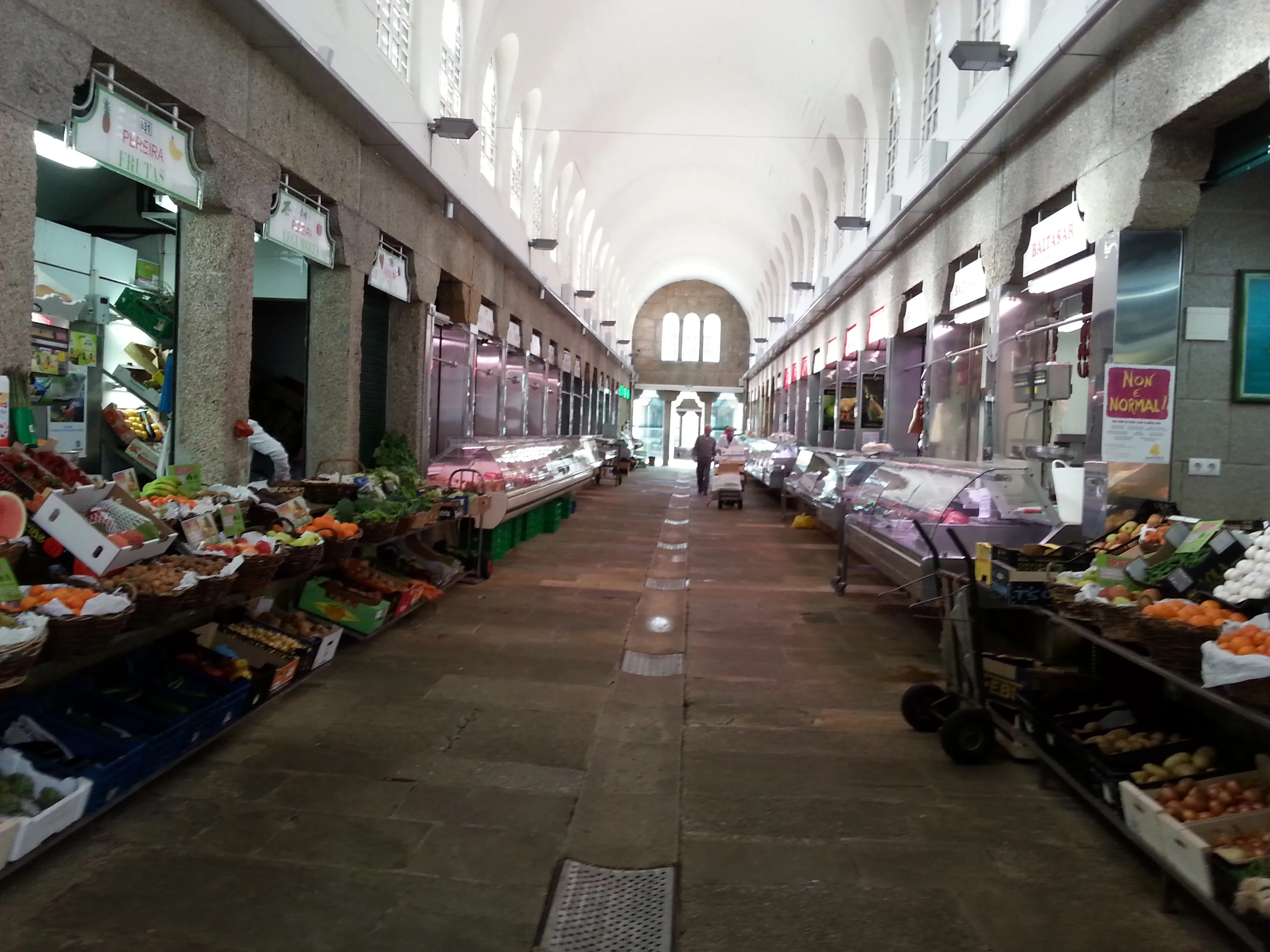
Begin at the Mercado de Abastos, the city’s food market and its most visited place after the Cathedral. Trading moved here in the nineteenth century; the present granite halls were designed by Joaquín Vaquero Palacios and completed in 1941. Eight long market buildings occupy the former grounds of the palace of the Counts of Altamira, and the narrow aisles between them feel like streets within the city.
Come in the morning for counters of hake, monkfish, turbot, octopus, mussels and percebes; butcher shops with Galician beef and pork; wheels of local cheese; bread, flowers and vegetables brought in from surrounding farms. Small producers traditionally occupy spaces around the buildings, especially on the busiest market days. Thursday and Saturday have the greatest bustle, and 9:30 am to 12:30 pm is the best period for seeing the market in full motion.
The market opens Monday to Saturday in the morning, with the stalls generally trading from 8 am to 2 pm. Nave 5 is devoted to prepared food and usually opens from 11:30 am to 5 pm. You can eat at its counters, visit one of the restaurants around Rúa das Ameas or buy shellfish in the market and have Mariscomanía cook it. This is a working food market, so let people order, avoid blocking the narrow passages and ask before photographing a vendor at close range.
Santiago’s oldest church
Across the square stands San Fiz de Solovio, the church with the oldest roots in Santiago. Tradition places the hermit Paio here when mysterious lights led him to the Apostle’s tomb in the ninth century. Almanzor’s army destroyed the early chapel in 997; Archbishop Diego Gelmírez rebuilt it in the twelfth century. The Romanesque doorway survives, with a polychrome Gothic tympanum of the Adoration of the Magi dated 1316. The body of the church and its widely imitated bell tower are eighteenth-century Baroque work by Simón Rodríguez.
San Fiz is normally visitable Tuesday, Thursday and Saturday from 10:30 am to 1 pm. Its hours can change for worship and special events, but the doorway and tympanum reward a stop even when the interior is closed.
Continue to Arco de Mazarelos, the only surviving gate of Santiago’s medieval wall. Wine from the Ulla valley entered through here, which is why the old approach was known as the wine gate. Beyond it, the monumental buildings of the University explain another Santiago identity. The university traces its origins to 1495 and still fills the old center with students, libraries and faculty buildings.
Convents, gardens and quieter streets
Walk east along Rúa de San Pedro, the street by which French Way pilgrims enter the historic city. Workshops, small restaurants and neighborhood shops make it one of the best places to feel Santiago beyond the monumental core.
At the top is San Domingos de Bonaval, a former Dominican convent founded in the thirteenth century and rebuilt over later centuries. Its most memorable architectural feature is Domingo de Andrade’s triple spiral staircase: three independent flights coil through the same stone space. The complex now houses the Museum of the Galician People, with galleries devoted to the sea, countryside, trades, clothing, music and the social history of Galicia.
Behind it, Bonaval Park occupies former convent gardens and cemetery land. Álvaro Siza and Isabel Aguirre retained terraces, water channels, old walls and burial plots while opening views across the city’s roofs. It is quiet, slightly mysterious and particularly beautiful in late-afternoon light.
Farther north, Santa Clara presents one of Galicia’s great Baroque theatrical façades. Simón Rodríguez built it as a deep stone screen whose curves, cylinders and shadows are far more exuberant than the enclosed convent behind it. Nearby Convento do Carme is calmer and more restrained. These remain religious houses, and their limited public access is part of their living purpose.
From the old city to the Alameda
Return through Praza de Cervantes, once the city’s medieval forum and later its food market, then follow the arcades of Rúa do Vilar and Rúa Nova. Look above the shops: iron balconies, coats of arms, carved corbels and glass galleries tell the story of houses repeatedly adapted rather than preserved as museum pieces.
At the southern edge of the old town, the Alameda provides the classic view back toward the Cathedral towers. Find the statue of Las Marías, Coralia and Maruxa Fandiño, the sisters who walked these streets in bright clothes during the Franco dictatorship and became beloved figures of the city. Continue around the park to the eucalyptus-lined paths, the bandstand and the small chapel of Santa Susana.
A city beyond one monument
Rúa do Vilar, Rúa Nova and the lanes between them reward slow attention: arcades, shopfronts, carved stone, university life and residents carrying out ordinary errands. The Alameda offers the celebrated Cathedral view, but it also introduces Las Marías and Santiago’s twentieth-century memory.
The complete walk links food, faith, education and ordinary city life in a few compact kilometers. Go early enough to see the market alive, enter San Fiz on one of its opening mornings, have lunch around Abastos and save Bonaval or the Alameda for the softer light of the afternoon.