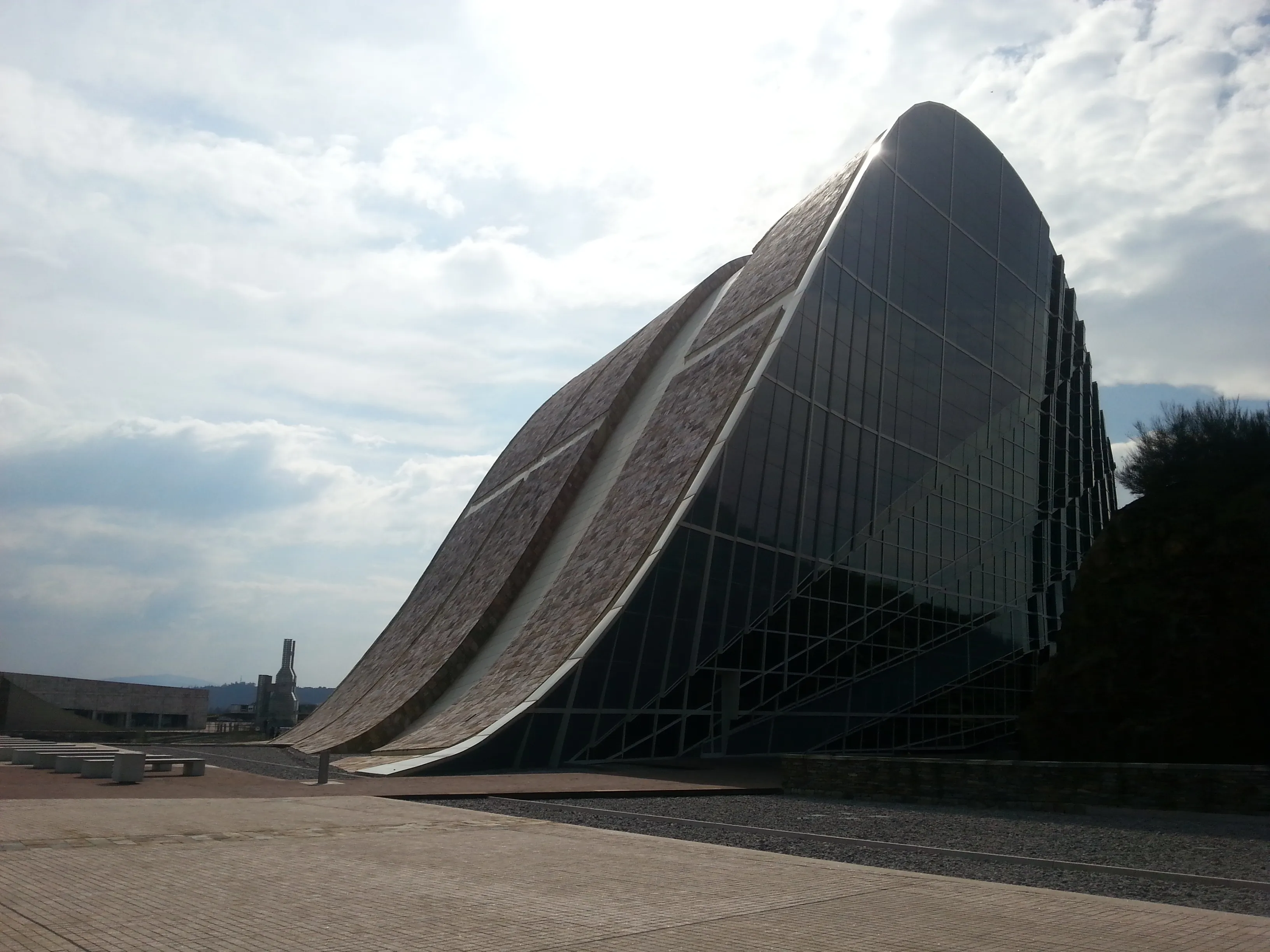
The Cidade da Cultura de Galicia rises above Santiago on Mount Gaiás, its pale stone roofs folding into the hillside like an artificial landscape. Designed by American architect Peter Eisenman after an international competition in 1999, the complex offers the sharpest possible contrast with the Cathedral and medieval streets below.
Eisenman’s design began with two overlapping maps: the scallop-shell street plan of historic Santiago and the contours of the hill. He distorted their lines into curving roofs, deep cuts, interior streets and a vast central plaza. The cladding uses Galician quartzite, while long glass surfaces bring light into buildings that appear partly carved from the ground.
The original project was larger than the complex eventually built. Construction began in 2001, and the first buildings opened in 2011. Plans for the opera house and international art centre were halted as costs rose. The unfinished areas have since been transformed into useful public spaces rather than left as empty construction sites. The Theatre Garden, Literary Garden, Lake Park, Whale Park and the expanding Forest of Galicia have made Gaiás a cultural campus and one of Santiago’s largest landscaped public areas.
The Gaiás Centre Museum
The main visitor building is the Gaiás Centre Museum, the large structure facing the central plaza. Its exhibition halls are designed for ambitious installations, with high ceilings and enough space for sculpture, audiovisual work, historic objects and contemporary art.
The museum frequently presents exhibitions about the Camino de Santiago, Galician history and artists connected with Galicia. Previous programs have examined the origins and imagery of the Camino, major figures in twentieth- and twenty-first-century Galician art, photography, fashion, music and the relationship between Galicia and other Atlantic cultures. The program changes throughout the year, so each visit can offer a different reason to return.
Admission to the museum and its exhibitions is free. Some workshops, performances or limited-capacity experiences require advance registration. The museum opens from 10 am to 8 pm, Tuesday to Sunday; exhibitions are closed on Mondays. The information desk at the entrance can explain what is open that day and provide details of guided visits.
Free architectural tours introduce Eisenman’s design and lead through the central plaza, museum spaces and gardens. They last about one hour and require registration. Tours are generally given in Spanish and Galician.
What else is at Gaiás?
The Library and Archive of Galicia preserve books, newspapers, maps, photographs and documentary collections relating to Galicia. Visitors can enter its public areas and smaller exhibitions. The Fontán Building, completed during the later development of the campus, houses research and educational institutions. The Centre for Cultural Innovation and Centre for Creative Entrepreneurship support cultural and digital projects.
Outside, the two Hejduk Towers were designed by architect John Hejduk and reconstructed at Gaiás after his death. The surrounding paths lead through gardens, viewpoints and the Forest of Galicia, planted with thousands of native trees. From the upper paths, the old city appears across the valley with the Cathedral towers rising above it.
Walking up and taking the bus back
The Cidade da Cultura is on top of a steep hill. It is difficult to reach casually from the historic centre, and the final ascent is demanding for anyone already tired after the Camino. Walking from the Cathedral takes about 45 to 60 minutes, depending on the route and pace.
The most interesting approach crosses the old city, passes the parks of Bonaval and Belvís and continues near the Collegiate Church of Santa María de Sar before climbing through the Forest of Galicia. The route shows how quickly Santiago changes from monumental streets to riverbanks, woodland and open views.
A good plan is to walk up and return by bus. City bus line 9 serves Gaiás on weekdays and Saturday mornings. Line C11 provides connections on Saturday afternoons, Sundays and public holidays. Services are limited compared with central Santiago routes, so check the departure time when you arrive and allow enough time to return to the stop.
By taxi, the journey from the historic centre normally takes about 10 to 15 minutes. This is the simplest option for visitors with limited mobility or little time.
Place it beside the old city
Around the Cathedral, centuries of pilgrimage, worship and civic life are compressed into narrow granite streets. At Gaiás, the scale opens dramatically and contemporary Galicia becomes the subject. The museum’s exhibitions add artists, social history and modern cultural debates that receive little space in the medieval centre.
Allow at least two hours for the museum, central plaza and viewpoints, and longer if the current exhibition is substantial. The architecture makes more sense after walking through it: roofs become paths, façades disappear into the slope and the old city remains visible across the valley.