The mounted warrior who dominates a traffic circle in Burgos is immediately recognizable as El Cid. Rodrigo Díaz de Vivar was a real eleventh-century military leader. The hero known from the Cantar de Mio Cid is a literary construction shaped after his death. Burgos contains both men, and they should not be confused.
Rodrigo Díaz before the poem
Rodrigo was born around 1043 at or near Vivar, north of Burgos. He rose in the service of Sancho II of Castile and later served Sancho’s brother Alfonso VI. Court politics led to exile. Rodrigo then operated with his own following, fighting and negotiating in a frontier world where Christian and Muslim rulers formed alliances across religious lines when strategy required it.
He eventually took control of Valencia in 1094 and ruled there until his death in 1099. His Arabic honorific, sīdī or “my lord,” lies behind the name Cid. Campeador refers to a champion or master of the battlefield.
These facts resist a simple nationalist portrait. Rodrigo served Muslim as well as Christian powers and pursued lordship, survival and wealth within the divided politics of eleventh-century Iberia.
What is a chanson de geste?
The French term chanson de geste means a “song of deeds.” These long medieval narrative poems told of warriors, loyalty, feud, lineage and service to a ruler. Performers could recite sections aloud, while written versions fixed stories that had circulated and changed.
The Cantar de Mio Cid belongs to the Iberian epic tradition and shares features with French chansons de geste: formulaic language, public honour, battle narrative and a hero tested through loyalty and betrayal. Its surviving manuscript is later than the poem itself, which was probably composed around the end of the twelfth or beginning of the thirteenth century. The author is unknown.
The poem begins with exile
The surviving text opens as the Cid leaves home. He looks back at empty perches and open doors, signs that his household has been stripped. In Burgos, the king’s command has frightened residents into refusing him shelter. A young girl explains what no adult dares to say openly: helping him would bring punishment.
This opening gives the epic its engine. The hero must recover lost honour through action. He gathers followers, wins territory and wealth, and sends gifts to Alfonso VI. Reconciliation with the king leads to the marriages of his daughters to the Infantes of Carrión.
The marriages create a second crisis. The infantes abuse and abandon the women at Corpes. The Cid seeks justice in court, and legal procedure becomes as important as combat. His daughters later marry into the royal houses of Navarre and Aragon. Honour is restored publicly and dynastically.
The poem alters history. Rodrigo’s daughters had different names, and the Corpes episode is literary. Even where people and places are historical, the poet arranges them to examine reputation, good lordship and advancement by merit.
The Camino del Cid publishes the complete poem in a modern Spanish version by Alberto Montaner. It is a substantial text, but the exile from Burgos and the court scene after the outrage at Corpes can be read independently.
Finding the Cid in Burgos
The route begins outside the city at Vivar del Cid. From there, the modern Camino del Cid follows the imagined geography of exile towards Burgos and the monastery of San Pedro de Cardeña.
In Burgos, the Solar del Cid marks the site traditionally associated with his urban residence. The monumental arch of Santa María includes his figure among the city’s historical heroes. The 1954 equestrian statue by Juan Cristóbal stands near Puente de San Pablo; stone figures on the bridge introduce people connected with the story.
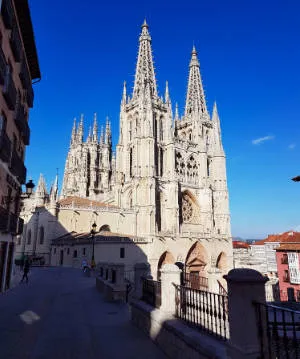
Inside Burgos Cathedral, the tomb of Rodrigo and his wife Jimena lies beneath the crossing. Their remains travelled through several burials before being placed there in 1921. The inscription encourages the visitor to encounter a national hero, while the building around it belongs to a later Gothic Burgos that Rodrigo never saw.
At San Pedro de Cardeña, tradition placed his family during exile and later made the monastery central to his posthumous legend. The historical evidence and the monastic stories do not always agree, but that tension shows how memory was manufactured and maintained.
Two roads through Burgos
The Camino Francés carries pilgrims west through the city. The Camino del Cid begins by turning the story in the opposite direction, retracing Rodrigo’s literary exile towards Valencia. For a traveler, Burgos is therefore a crossing between pilgrimage and epic geography.
Read the opening of the Cantar before visiting the statue. The vulnerable exile who cannot obtain a room in Burgos is more revealing than the bronze conqueror.
Burgos is an overnight stop on our French Way from Logroño to Burgos and the starting point for the following section towards León. We can leave time for the cathedral, the Cid sites and San Pedro de Cardeña in a private itinerary.