Santiago rewards people who look sideways. All three of these places are in the old town and can be seen on foot, but each belongs to a different Santiago: the university city, the night-time city and the city of medieval rivalries.
The Tree of Science at San Xerome
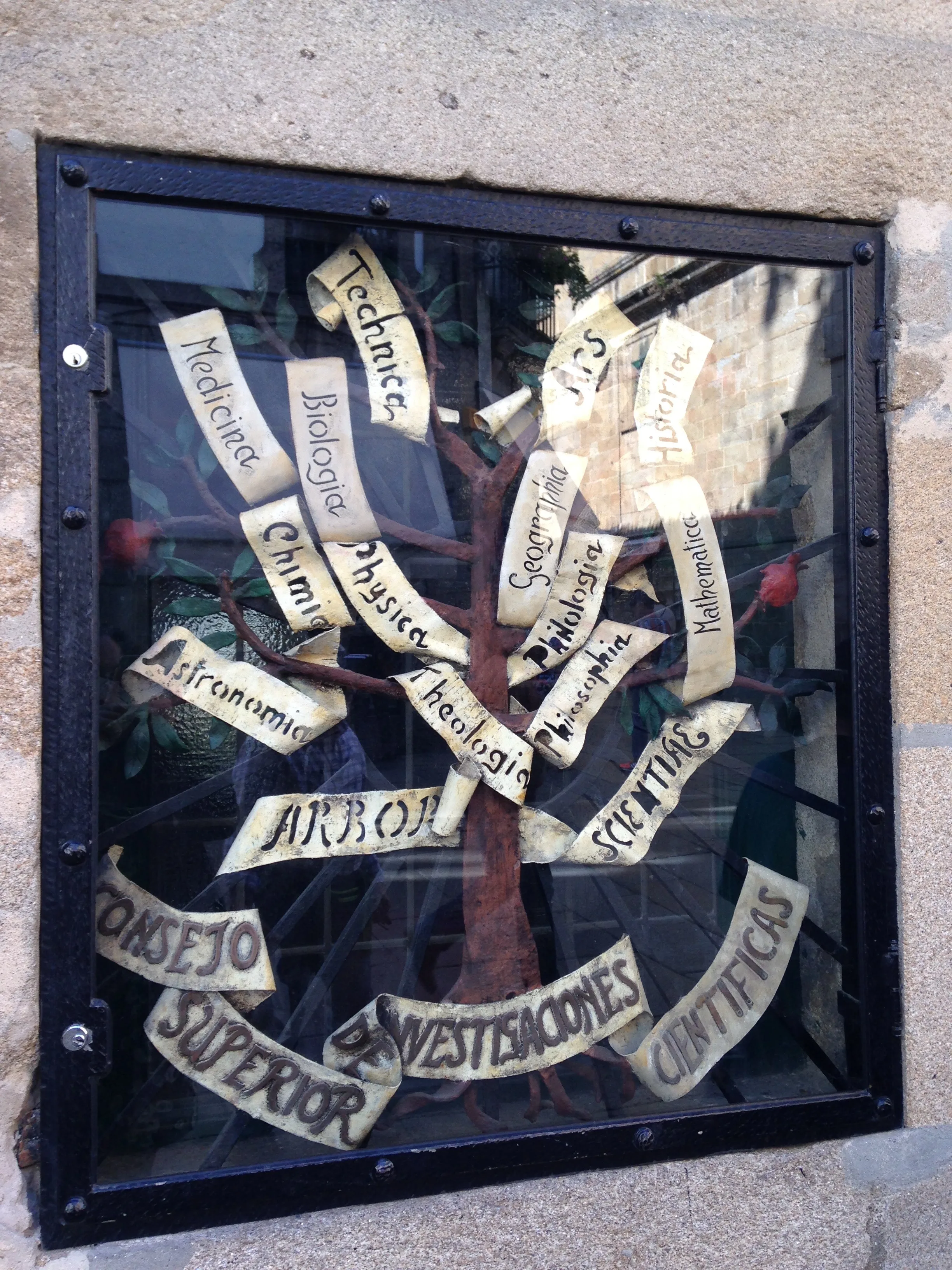
On the Obradoiro side of the Colexio de San Xerome, a glazed niche holds a metal tree whose branches carry the names of university subjects: Medicine, Biology, Mathematics, Philosophy, Physics and others. Students who have not decided what to study traditionally turn their backs to it, raise an arm and point without looking. Some versions of the ritual add three turns before the choice.
The result is treated as a game, not university admissions advice. It fits its setting rather well. San Xerome has been part of the University of Santiago since the early modern period, and its doorway incorporates sculptural pieces inherited from an older medieval college.
The photograph above shows why the object can be missed. It sits behind glass and reflections, at street level, while most visitors are looking up at the grand buildings around the square.
Why a pilgrim appears on the wall in Quintana
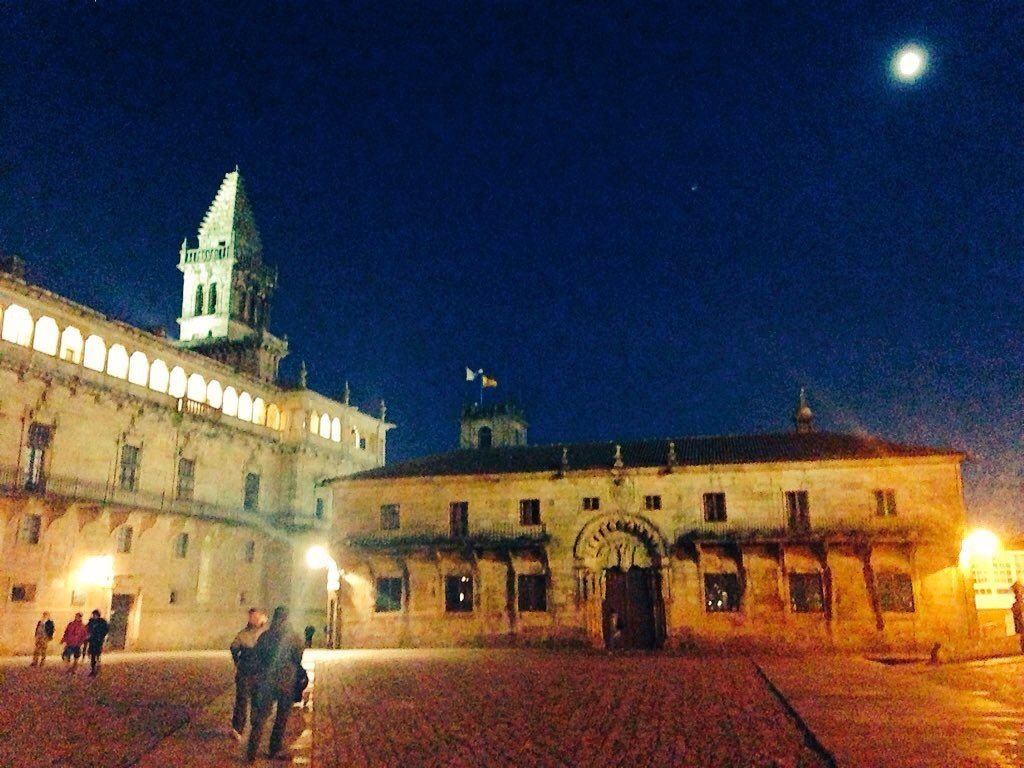
Go to Praza da Quintana after dark and look toward the Cathedral wall. A streetlamp throws the shadow of a lightning conductor and nearby architectural fittings onto the stone. Together they form a remarkably convincing figure: a pilgrim in a broad hat, holding a staff.
The physical explanation is straightforward. The stories attached to it are more varied. One popular version turns the shadow into a priest or canon who loved a nun from the convent across the square and still waits for her at night. Other tellings make it the spirit of a pilgrim. Quintana itself helps the story: part of the square was once called the Quintana dos Mortos because it occupied the area of a former cemetery.
The silhouette depends on the lamp and your viewing angle, so it is easiest to find once the square is properly dark. It is a few minutes from Obradoiro and needs no ticket.
The murder behind the lost Rúa da Balconada
Behind Casa da Balconada, between Rúa do Vilar and Rúa Nova, is a garden associated with one of Santiago’s most persistent stories. The documented event is brutal. In 1366, Archbishop Suero Gómez de Toledo and the cathedral dean were killed during a conflict involving the powerful Churruchao family and supporters of the city’s secular interests.
Later tradition supplied the romance. In this version, the archbishop’s relationship with a Churruchao woman turned political hatred into personal vengeance. The killing was placed in Rúa da Balconada, and the lane was said to have been purified with salt, sealed and erased from the city.
Historians have questioned whether the murder occurred in that lane at all, and the love affair belongs to legend rather than the secure documentary record. The present garden nevertheless keeps the name alive. Look for the area where the two principal arcaded streets nearly meet; the absence of a through street is part of what gives the tale its force.
Seeing all three in one walk
Start at the Science Tree on Praza do Obradoiro, cross through the old town toward the Balconada area, then return to Quintana after dinner when the shadow is visible. The route is short enough to add to an evening in Santiago.
For a longer walk through markets, convents and university streets, continue with Beyond the Cathedral. We can also add a private Santiago visit to the final day of a Camino planned with Ultreya Tours.