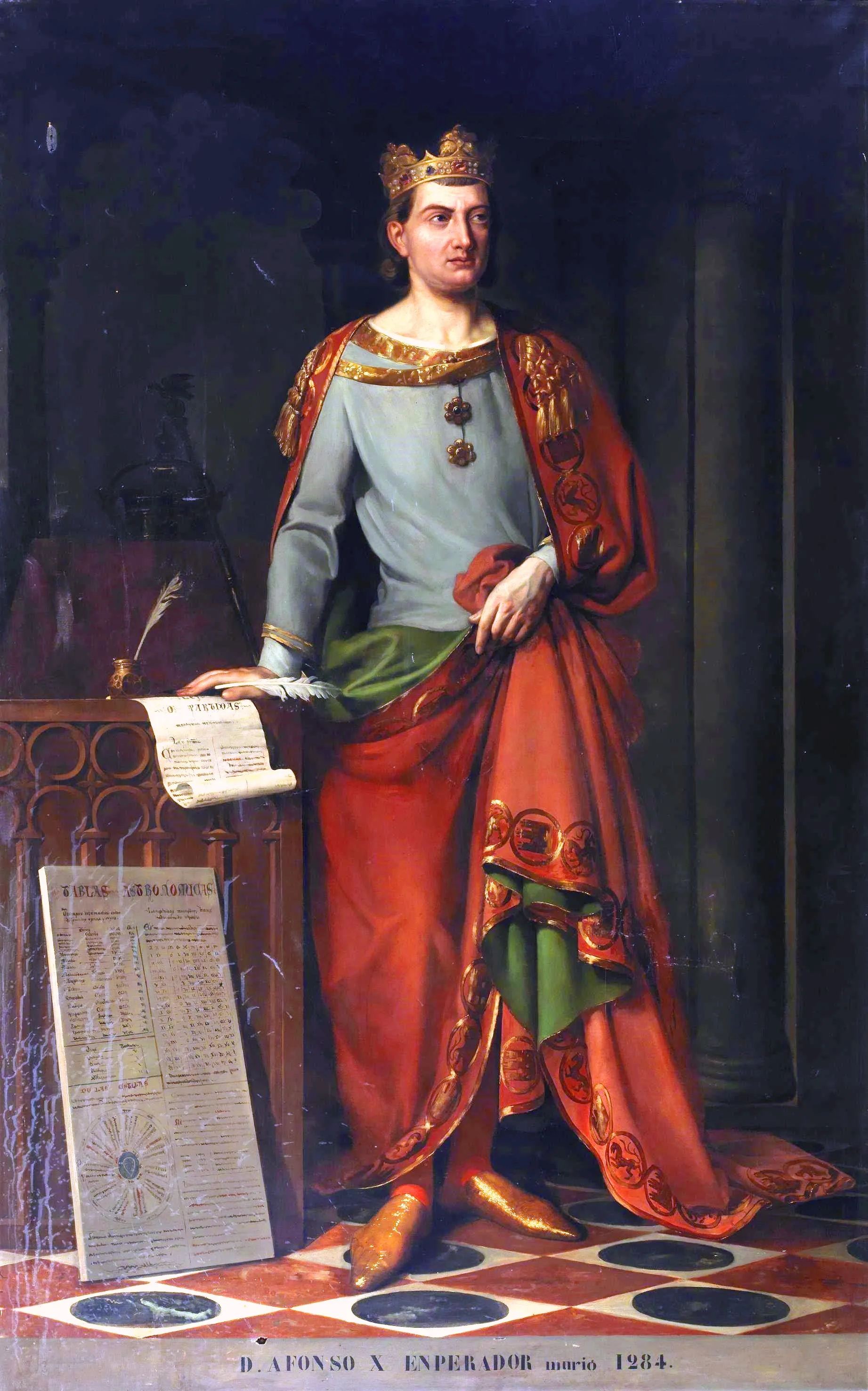
Alfonso X of Castile and León, called “the Learned,” ruled from 1252 to 1284. His court sponsored history, law, astronomy and poetry in several languages. The Cantigas de Santa María are the most visually spectacular result: more than four hundred songs in medieval Galician-Portuguese, most recounting miracles of the Virgin.
Alfonso did not single-handedly compose or paint the collection. A court workshop of poets, musicians, scribes and illuminators produced it under his direction. The use of Galician-Portuguese reflects the language’s prestige for lyric poetry in the thirteenth century.
What the manuscripts preserve
Each cantiga has verse and musical notation. The richly illustrated copies add sequential scenes resembling a medieval storyboard. They show instruments, clothing, buildings, ships, illness, markets and worship. Musicians play fiddles, harps, lutes, psalteries, pipes and percussion.
One group praises Mary at regular intervals; the others tell miracles. People are healed, captives released and travelers rescued. The stories reveal prejudice and hierarchy as well as devotion, so the pictures require critical reading rather than treatment as transparent photographs of medieval life.
Pilgrims and Villasirga
Several cantigas concern travelers on the road to Santiago. Cantiga 49 shows the Virgin guiding lost pilgrims. A major focus is Santa María la Blanca at Villalcázar de Sirga, then commonly Villasirga, on the Camino Francés. Alfonso praised its Marian image and associated miracles, helping turn the church into a pilgrimage destination in its own right.
The royal connection remains visible there. The church contains Gothic tombs associated with Alfonso’s brother, the infante Felipe, and other nobles. Its sculpted portals and fortified mass explain why pilgrims should enter rather than pass the village as a lunch stop.
Listening today
Modern performances differ because medieval notation leaves questions of rhythm, tempo, ornament and instrumentation open. Compare two recordings of the same cantiga and the contrast becomes instructive. What survives is a musical framework, not a thirteenth-century audio file.
The Cantigas show movement among shrines rather than a single road ending at Santiago. Their pilgrims become lost, frightened, sick and grateful. The songs reveal a landscape in which a journey could contain several sacred destinations and several languages at once.
Villalcázar de Sirga lies on our longer French Way routes through the Meseta. Ask us to protect enough time for Santa María la Blanca when we prepare your Camino itinerary.