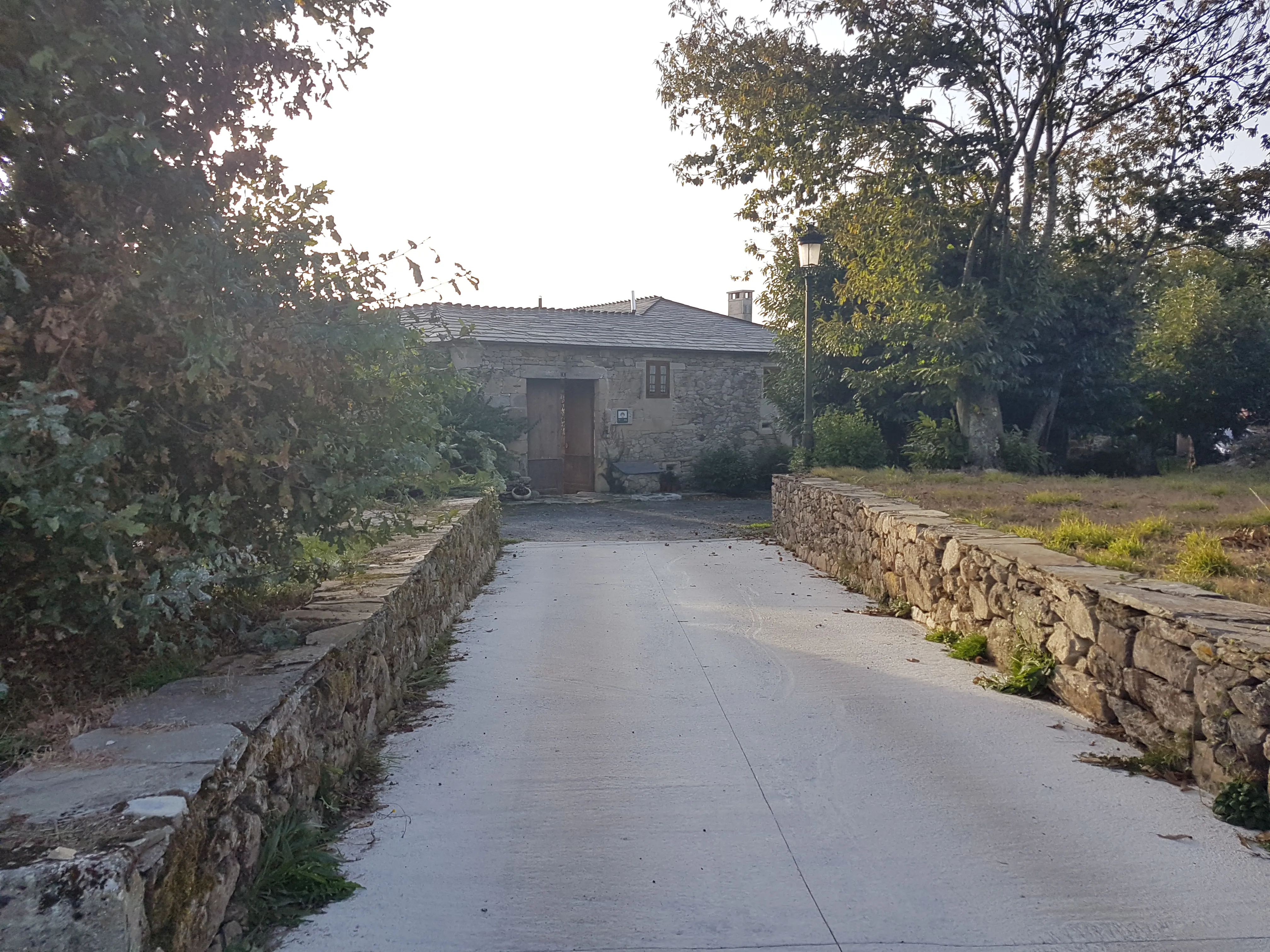
The final French Way from Sarria does not have a grand hotel at every stage. Its character comes from smaller properties: restored farmhouses, rural pazos and family-run guesthouses that know the practical rhythm of the Camino.
These properties show the character we seek in a Classic stay. The final selection depends on the walking stages, dates and room availability.
Casa Roán and Casa Grande
Casa Roán and Casa Grande are two eighteenth-century village houses in Lodoso, in the A Ulloa countryside near the Ligonde, Airexe and Lestedo section. They were working farmhouses before being restored for rural tourism, with Casa Roán’s major renovation completed in 2006.
The houses provide en-suite rooms, gardens and dinner for resident guests. Their own collection service connects walkers with agreed points on the Camino. That matters because the property is rural rather than directly on the trail.
Pazo de Sedor
Near Arzúa, Pazo de Sedor dates from the seventeenth century. It was founded by Francisco González do Vilar, also known as Francisco Pita da Veiga, who studied at the Colegio de Fonseca and served as a lawyer of the Royal Court of the Kingdom of Galicia and as a military prosecutor.
His coat of arms survives on the granite façade. Inside, the thick masonry, chestnut beams and period furniture feel like a Galician family house rather than a themed hotel; outside are the chapel, garden and swimming pool.
Sedor is close to Arzúa but not on the busy hotel strip in town. We collect guests at the agreed end of their walking stage and return them to the route the following morning. The short drive exchanges traffic and shopfronts for a quiet country evening without removing any kilometres from the Camino.
O Muíño de Pena
O Muíño de Pena, beside the River Mera in O Pino, was once a small rural industrial complex. Water drove grain mills, a saw and carpentry machinery. The site provided an essential service and also functioned as a meeting place while local people waited for grain or timber to be processed.
During the exceptionally dry summer of 1949, the owner reportedly installed an external-combustion engine so that milling could continue when neighbouring watermills could not work. The factory survived into the 1970s, latterly operating only as a mill. Restoration began in 1998, and the property reopened for rural tourism in 2003. Old machinery and tools remain in its ethnographic collection.
It sits away from the standard O Pedrouzo hotel strip, so a planned collection and return to the route are part of using it correctly.
Why a rural transfer is sometimes better
Insisting that every bedroom stand directly on the arrows sharply limits accommodation quality in small stage towns. A transfer of a few kilometres can provide a quieter room, a proper resident dinner and a property with genuine history. The following morning, guests return to the agreed walking point so no part of the route is lost.
Our French Way Classic from Sarria combines comfortable hotels with trusted local properties and private bathrooms. If one of these country houses captures your imagination, mention it when you start planning and we will look for the strongest combination for your dates.