Galicia’s mineral springs produced towns, hotels, bottling plants and outdoor bathing areas. Mondariz became internationally known for bottled water and its Gran Hotel. Guitiriz built a large resort in wooded grounds. Outariz brings hot-water bathing to the bank of the Miño, while the springs at Cuntis and Caldas de Reis rise in the center of towns shaped by centuries of visitors.
1. Mondariz-Balneario: a town created by water
Mondariz-Balneario is Spain’s smallest municipality by area, and its separate civic identity came from the resort. The modern story began when the Troncoso and Gándara springs were developed in the nineteenth century. The waters received a declaration of public utility in 1873, and bottling began in 1877.
The Peinador family turned the valley into an elite destination. The monumental Gran Hotel opened in 1898 with the scale and ceremony expected of a European spa resort. Writers and public figures came to drink the waters, walk, dine and socialize. The hotel burned in 1973, but its ruins, the spring pavilions and the modern resort still show how completely water formed the town.
Mondariz water filters through granite and is sold as a lightly mineralized natural mineral water. The drinking tradition is central here: this is the Galician spa whose name travelers are most likely to recognize from a bottle on a restaurant table.
2. Guitiriz: sulphurous water and a grand hotel
The Fonte dos Santos, also known as the spring of San Xoán de Lagostelle, established Guitiriz’s reputation for water associated historically with digestive and metabolic complaints. The water is described as hypothermal, very weakly mineralized and sulphurous, with bicarbonate, chloride and sodium among its principal ions.
The resort was inaugurated in 1908, and the hotel followed in the early twentieth century. Its wooded grounds and later railway access helped make Guitiriz an important social and economic center. During the Civil War the building served as a military hospital; a small mosque was constructed for Muslim soldiers and survives within the estate.
The complex declined in the later twentieth century and was restored in 2003. After closing again in 2017, it reopened in May 2023 as the Iberik Gran Balneario de Guitiriz. The present four-star resort has 103 rooms, a 4,000-square-meter spa and more than 40 hectares of grounds.
3. Outariz: bathing beside the Miño in Ourense
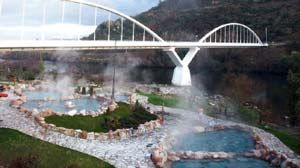
Outariz is not a grand nineteenth-century hotel. It is part of Ourense’s remarkable chain of hot springs along the River Miño. Water emerges through fissures in granite at around 60°C. It is weakly mineralized, hyperthermal, sodium-bicarbonated, fluoridated and sulphurous.
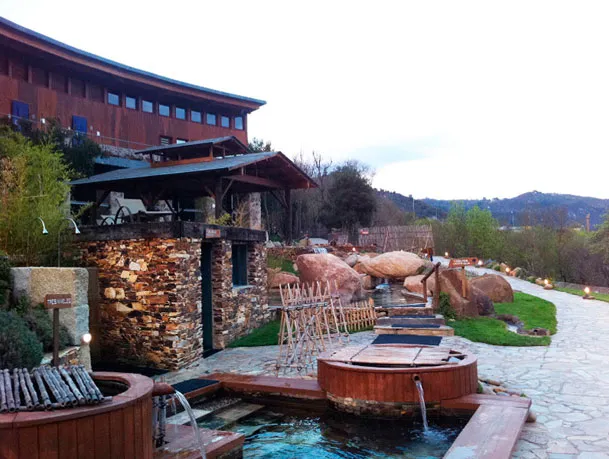
The outdoor bathing area at Outariz and Burga de Canedo occupies landscaped riverbank. Hot and cold pools allow bathers to move between temperatures, and a footbridge connects the springs with the opposite bank. The experience is informal and closely connected to the river, especially in cool weather when vapor rises above the water.
Facilities and access arrangements have changed at different moments, so consult Turismo de Ourense on the day of a visit. Hot water and a long Camino stage can be a tiring combination; rehydrate, respect the indicated bathing times and leave if you feel light-headed.
4. Cuntis: Roman coins and marble baths
Cuntis has some of the clearest evidence of a settlement growing around thermal use. Coins bearing Nero and Augustus were found in the springs, and written descriptions of the waters appeared in the eighteenth century. By the middle of the nineteenth century, close to a thousand patients a year were reported to visit.
The Balneario de la Virgen received individual marble baths, collective pools and hydrotherapy equipment in 1881; some of the old marble baths survive. Further construction followed in 1908 and during the twentieth century. A purpose-built balneotherapy center opened in 1998, connected to the historic hotel, and the Acquaform recreational circuit was added in 2004.
The waters emerge warm and are traditionally classified as sulphurous, sodium-rich and lightly mineralized. The town center, hotels and bathing facilities are so closely joined that Cuntis feels like a resort without a hard boundary between the spa and ordinary town life.
5. Caldas de Reis: hot water on the Portuguese Way
Pilgrims cross the thermal town of Caldas de Reis between Pontevedra and Padrón. The name comes from the Latin calidae, hot waters, joined later to the royal association expressed by de Reis. Steam can be seen around the public hot-water fountain in the historic center.
The Balneario Dávila dates its operation to 1780 and retains an intimate garden and traditional character. The Acuña complex stands beside the River Umia in another historic building. Local waters are hot, weakly mineralized and sulphurous, and have long been used for bathing and inhalation treatments.
Caldas offers the most natural thermal stop within a standard Camino itinerary because no separate excursion is required. A pilgrim can finish the stage, check in, and use a booked circuit or treatment before dinner. The public spring is suitable for touching the water, but it is not a public swimming pool.
Why do several names end in -riz?
Mondariz, Guitiriz and Outariz look as if -riz might mean “hot spring.” It does not. Many Galician and northern Portuguese place names preserve medieval personal names of Germanic origin in a Latin genitive form, identifying an estate with its owner. The ending -rici evolved into -riz in names such as Guitiriz and Mondariz. The overlap with thermal sites is memorable but coincidental. Cuntis and Caldas have different origins.
For the wider story, read The Thermal Spas of Galicia. If you would rather build a spa evening into a walking itinerary, see Five Spa Hotels on and around the Camino.