The Order of the Temple received control of Ponferrada in the late twelfth century and held it until the order’s suppression in the early fourteenth. Its members protected property and maintained a strategic position beside the bridge that gave the town its name, the pons ferrata or iron-reinforced bridge.
The Templars were a military religious order founded in the context of the crusader states. They took vows, accumulated estates and developed an international administration. Their wealth and direct relationship with the papacy made them powerful, but tales of occult rites and limitless treasure grew mainly from the campaign used to destroy them and from much later fiction.
A castle built in several periods
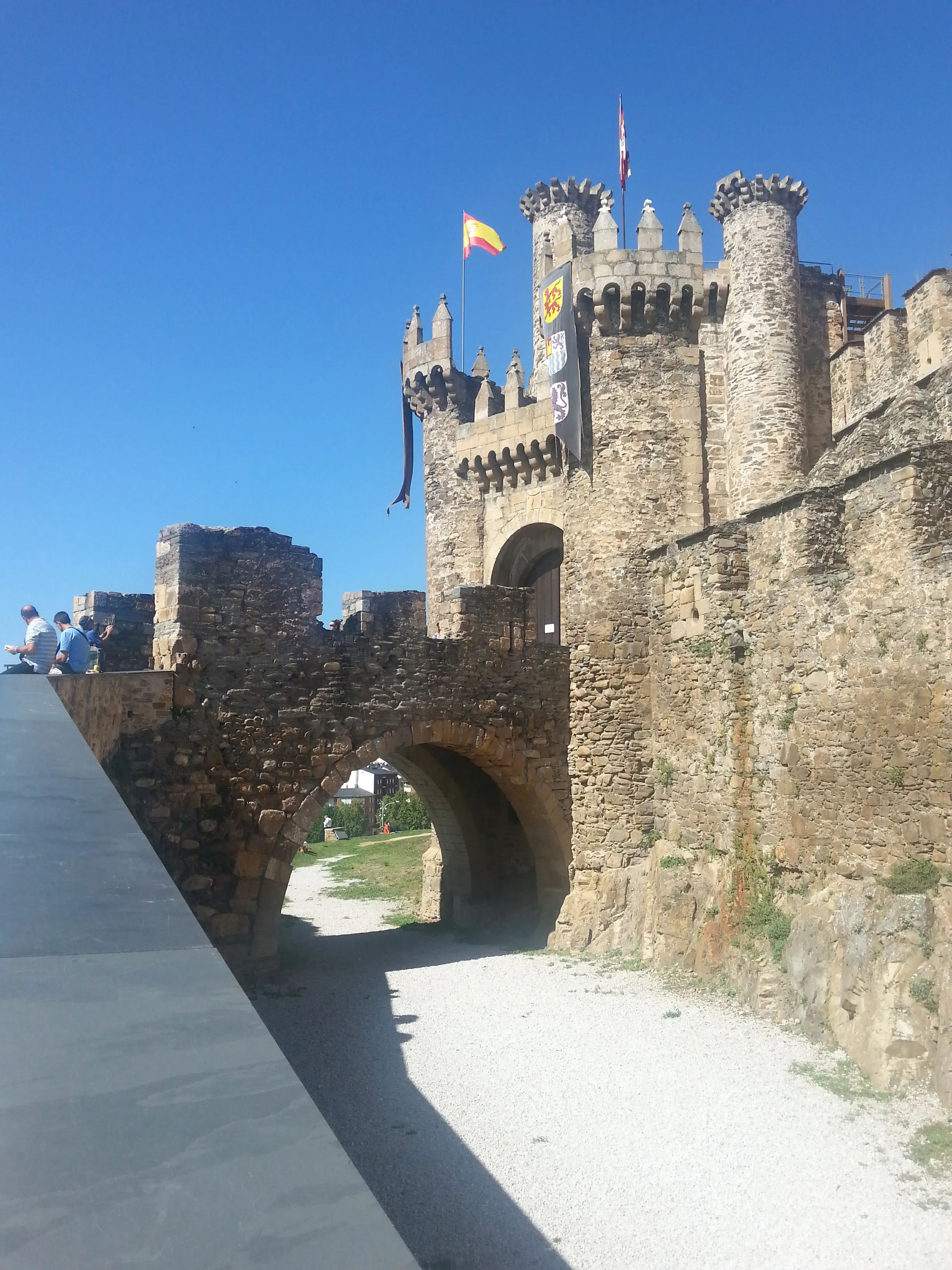
Ponferrada’s eight-thousand-square-metre enclosure is commonly called the Templar Castle. Some fabric belongs to their phase, but major towers, walls and the palace reflect fifteenth-century building under the Counts of Lemos and subsequent royal intervention. Heraldic shields help identify those later patrons.
After Pope Clement V dissolved the Templars in 1312, the castle passed through other hands. It was modified for changing warfare, damaged, quarried and eventually restored. Treating the complete complex as a single Templar construction erases most of its architectural history.
Evidence and mythology
Stories place the Ark of the Covenant, the Holy Grail and hidden Templar treasure beneath Ponferrada, but they belong to the castle’s modern mythology. Today’s festivals and costumes continue that imaginative afterlife rather than recreating a known medieval ceremony.
What you see inside
The exterior promises a complete medieval fortress. Inside, very little survives as a furnished domestic interior. The visit is mainly through open courtyards, wall walks, towers and reconstructed spaces. That emptiness makes the architecture easier to read: arrow slits, gates, changes in masonry and heraldic shields show where successive owners altered the enclosure.
The Templum Libri exhibition displays high-quality facsimiles of illuminated manuscripts and important books. Another collection, the Biblioteca Templaria, addresses the history and later reception of the order. These exhibitions are modern installations, clearly separate from the surviving medieval fabric.
Allow at least an hour, and longer if you intend to read the displays. The wall walks include stairs and exposed sections. Opening hours and free-entry periods vary seasonally, so use the castle’s official website before setting out rather than relying on an old timetable.
Paulo Coelho’s Ponferrada
Ponferrada also entered modern Camino literature through Paulo Coelho’s The Pilgrimage. One of the book’s memorable ritual scenes takes place at the castle, whose towers and enclosed courtyards give Coelho the ideal setting for allegory and esoteric instruction.
Its medieval story is substantial in its own right: a strategic Camino site used by a military order, then remade by ambitious nobles and the Crown.
Ponferrada concludes our French Way section from León and begins the route towards Santiago. We can schedule the castle around its current opening hours and add a specialist guide for private groups.