Imagine the people watching from the shore of the Ría de Arousa as unfamiliar sails appeared beyond the islands. The ships were fast, shallow enough to enter rivers and filled with warriors whose reputation had travelled ahead of them. For communities living between the Atlantic and the growing sanctuary at Santiago, the arrival of a Norse fleet must have felt like the edge of the known world breaking open.
From the ninth to the eleventh century, Vikings repeatedly reached Galicia. Some came to raid monasteries, seize wealth and take captives. Others used the Galician coast during much longer expeditions towards Portugal and the Mediterranean. Chronicles called them Normans, Norsemen or lordomani, turning generations of different crews into a terrifying recurring presence.
The Ría de Arousa was a magnificent entrance for their ships. The estuary opens broadly to the Atlantic, sheltered by islands and peninsulas, then narrows towards the mouth of the River Ulla. Beyond lay Iria Flavia and the roads to Santiago, where the shrine of Saint James was accumulating prestige and treasure. Modern visitors cross the same water among fishing boats, mussel rafts and low green islands, with the route of the raiders unfolding ahead.
The Torres de Oeste
At Catoira, the Ulla contracts into a defensible passage. Earlier Roman infrastructure had already recognized its importance. Medieval rulers and bishops strengthened the site known as the Torres de Oeste, building a fortified barrier against raiders moving upstream.
Only two towers survive substantially today, beside the remains of the chapel of Santiago. The medieval fortress was much larger, with seven towers at its height. From this position, guards could see vessels approaching the narrow river passage and organize the defence before they reached the religious centre inland.
Bishop Cresconio of Iria-Compostela strengthened defences in the eleventh century after repeated maritime threats. By then raiders described broadly as Normans could include different Scandinavian groups operating over generations rather than one stable army.
Warriors, resistance and the people left behind
Viking attacks on Galicia occurred in several waves from the ninth through eleventh centuries. Some expeditions continued towards Portugal or the Mediterranean. Chronicles emphasize violence because monasteries and churches produced many of the written records and were prime targets for portable wealth.
Galicians fought back. Bishops, nobles and local communities strengthened the river defences, watched the coast and confronted landing parties. Bishop Cresconio of Iria-Compostela rebuilt and expanded the Torres de Oeste in the eleventh century, making Catoira one of the strongest barriers protecting the approach to Santiago.
The raids also became part of family legend. Galicians sometimes point to fair hair, blue eyes or unusually northern features as a Viking inheritance. DNA cannot turn every local story into a documented genealogy, yet centuries of Atlantic movement did leave people as well as objects behind. Sailors traded, settled, took captives, formed relationships and moved between coasts. The visible diversity of modern Galicia fits a region that has always faced the sea.
Television dramas give Viking crews memorable faces and personal rivalries; the Galician chronicles mostly preserve fear, battles and the names of rulers. Standing at Catoira restores the missing landscape. You can see where ships entered, how the estuary tightened and why two stone towers could decide whether raiders continued towards Santiago.
Catoira today
The Romaría Vikinga, created in 1960, turns that history into one of Galicia’s great summer festivals. On the first Sunday of August, crews in costume arrive in replica longships, leap into the river mud and stage an exuberant attack beneath the towers. Wine flows, horns sound and thousands of spectators crowd the banks. The event has been declared a Festival of International Tourist Interest.
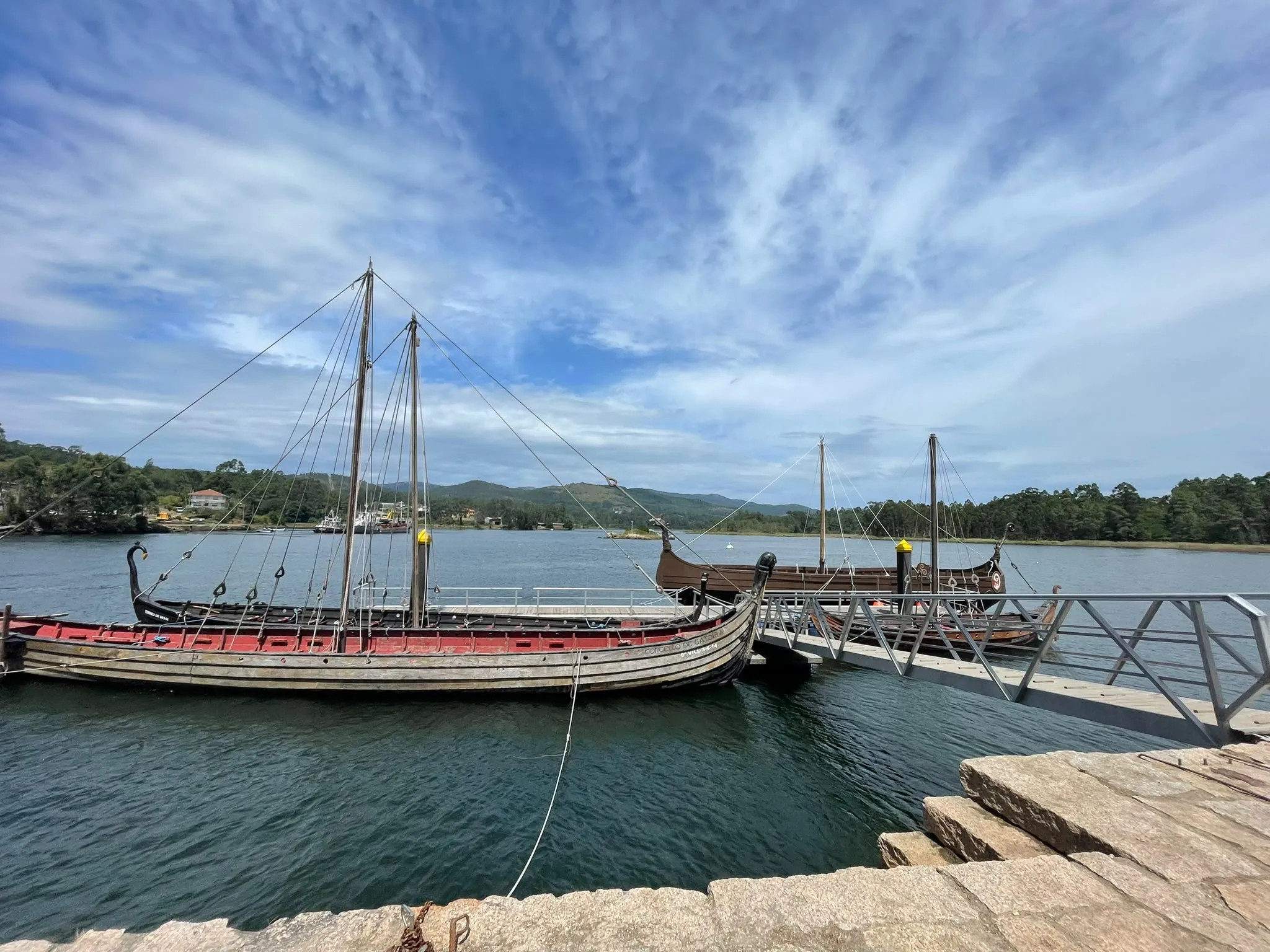
Come for the spectacle and stay for the setting. Outside festival day, the towers stand quietly among marshes and river light, with replica ships moored nearby. During the Romaría, the landscape becomes loud, theatrical and gloriously unruly—the kind of day that makes the medieval raids easy to imagine.
The Portuguese Spiritual Way crosses the Arousa estuary by boat, passes Catoira and continues up the Ulla towards Padrón. Our Spiritual Way journey can include time in Cambados, a private exploration of the estuary or a visit to the Torres de Oeste. In early August, ask us to build the Romaría Vikinga into the journey and watch the longships return.