Every Camino shares the pull of Santiago, but the experience of reaching it changes markedly from one route to another. Some Ways are sociable and richly supplied. Others feel quieter, more rural, or more demanding. A week on the final French Way has its own character, as does the Portuguese Coastal Way with its distinct landscape and rhythm beside the ocean.
The comparisons below reflect the routes in the current Ultreya Tours Camino collection. They are a starting point, not a ranking. Season, daily distance, journey format, and accommodations can alter the character of any itinerary.
Firsthand accounts often disagree about the same route. One traveler experiences a quiet coast as spacious; another misses the repeated encounters of the French Way. Treat words such as “social,” “quiet,” and “easy” as tendencies shaped by month, stage, weather, and personal expectation, not fixed ratings.
The French Way: the great unfolding journey
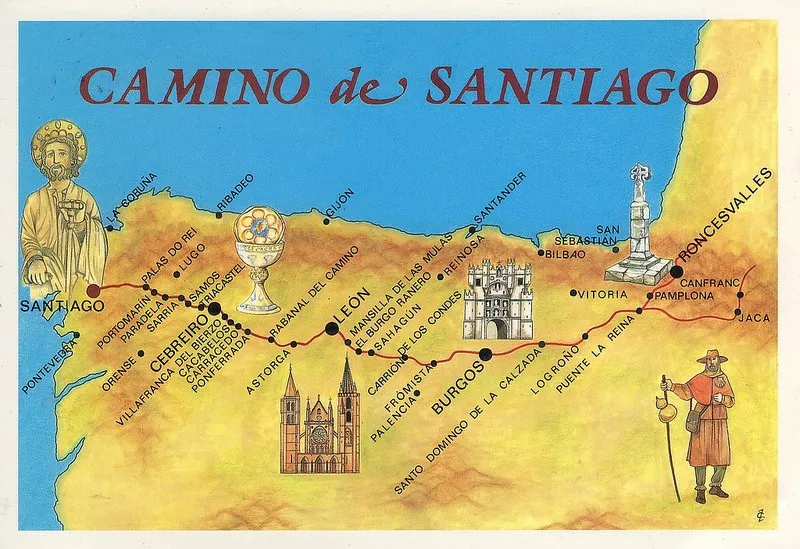
The French Way offers the broadest sweep of Camino landscapes and the most recognizable pilgrimage atmosphere. Its complete course crosses the Pyrenees, vineyard country, historic cities, the open Meseta, mountain passes, and Galicia’s green lanes. It is also the route many travelers first encounter through The Way, Paulo Coelho’s The Pilgrimage, and other books and films.
Its popularity brings practical advantages: more services, a strong pilgrim community, and a wide choice of starting points. The final stages from Sarria can fit a shorter journey and meet the walking-distance threshold for a Compostela when all official conditions are satisfied. Longer sections reveal the route’s contrasts more fully.
Choose it if you want a strong sense of shared Camino life, varied landscapes, and the widest range of walking, cycling, or private-group formats. Be prepared for busier stretches, particularly on the final approach in popular months.
The Portuguese Way: two countries, one direction
From Oporto, the central Portuguese Way moves north through towns, woodland, rural paths, and cultivated landscapes before crossing from Valença into Tui. From there, it continues through Galicia by way of places including Pontevedra, Caldas de Reis, and Padrón.
The route feels culturally layered: Portuguese and Galician food, architecture, language, and daily rhythms meet across the border. Beginning in Tui concentrates the journey into the final Galician stages; beginning in Oporto gives more time to feel the transition between countries.
Choose it for a graceful combination of historic towns, countryside, and a clear international character. The word “gentler” can be misleading: its distances and terrain still ask for preparation.
The Portuguese Coastal Way: Atlantic light and changing shorelines
The Portuguese Coastal Way leaves Oporto and follows a varied line north through seaside communities, boardwalks, beaches, working towns, and stretches where the path turns inland. It is not an uninterrupted beach walk. Wind, exposed sections, hard surfaces, and route variations can all shape the day.
After entering Galicia, coastal and central alternatives eventually draw toward the same destination. The route can feel more open and maritime than the central Portuguese Way, particularly in Portugal, while still bringing pilgrims into historic Galician towns.
Choose it if the Atlantic is part of what calls you to the Camino and you enjoy a changing balance of coast and culture. It can also be appealing by bicycle, provided the selected itinerary suits your experience and the surfaces involved.
The Portuguese Spiritual Way: water, monasteries, and the Variante Espiritual
The Portuguese Spiritual Way branches from the Portuguese route after Pontevedra and travels through the Salnés area toward Vilanova de Arousa. Its most distinctive chapter is the boat journey through the Arousa estuary and up the Ulla River, following a maritime tradition associated with the transfer of Saint James’s remains. The route then reconnects with the approach through Padrón.
This is categorized within the Portuguese Coastal family in the Ultreya Tours catalog. It combines walking with an agreed boat connection, so schedules and conditions need careful coordination.
Choose it for a quieter, reflective variation with monastic associations, coastal-inlet landscapes, and a memorable approach by water, not because it is automatically easier or available on every date.
The Sanabrés Way: inland Galicia at a quieter pace
The Sanabrés Way enters Galicia from the southeast, carrying pilgrims through the province of Ourense before turning west toward Santiago. It is known for inland landscapes, thermal and historic towns, rural communities, and fewer fellow pilgrims than the most traveled final sections.
Its quieter nature is part of the appeal, but it also means services can be more dispersed. Hills and longer-feeling rural stages reward travelers who value space and arrive well prepared.
Choose it if you are drawn to interior Galicia, cultural depth, and a less crowded route. It suits travelers comfortable with a more independent daily rhythm.
The Winter Way: river valleys and vineyard country
The Winter Way developed as an alternative to the high mountain approach into Galicia. It passes through the dramatic Sil valley, the terraced vineyards of Ribeira Sacra, and less-traveled communities before joining the Sanabrés route toward Santiago.
Its name does not make it a winter-season recommendation. Ultreya Tours Camino journeys operate from March 15 through November 15. Dates and services are checked personally before a journey is confirmed, and the route still has meaningful elevation and rural stretches.
Choose it for wine landscapes, rivers, historic towns, and a sense of discovery away from the busiest roads to Santiago.
The Finisterre Way: continuing beyond arrival
The Finisterre Way reverses the usual direction of expectation. It begins in Santiago and leads west through rural Galicia toward the Atlantic at Finisterre. Rather than building toward the Cathedral, it allows the journey to open outward after Santiago, a gradual movement from city to countryside and coast.
Because it travels away from Santiago, the Finisterre journey is not presented as Compostela-eligible. Its meaning lies elsewhere: completion, perspective, and the landscape at the edge of the Atlantic.
Choose it if reaching Santiago feels like part of your journey rather than its final sentence, or combine it with an arriving route when time allows.
Make the comparison personal
Ask how you want your days to feel. Do you want frequent encounters or more solitude? Is an Atlantic landscape essential? Does the journey between Portugal and Spain matter to you? Are you energized by changing regions over several weeks, or would a focused final section be more realistic?
Then compare those desires with the practical facts: available days, repeatable daily distances, terrain, travel dates, and walking or cycling experience. The Start Planning Questionnaire can help identify potentially suitable catalog journeys, but it does not check live availability, calculate a final price, confirm dates, or create a booking. A route becomes right only when the idea and the practical itinerary work together.