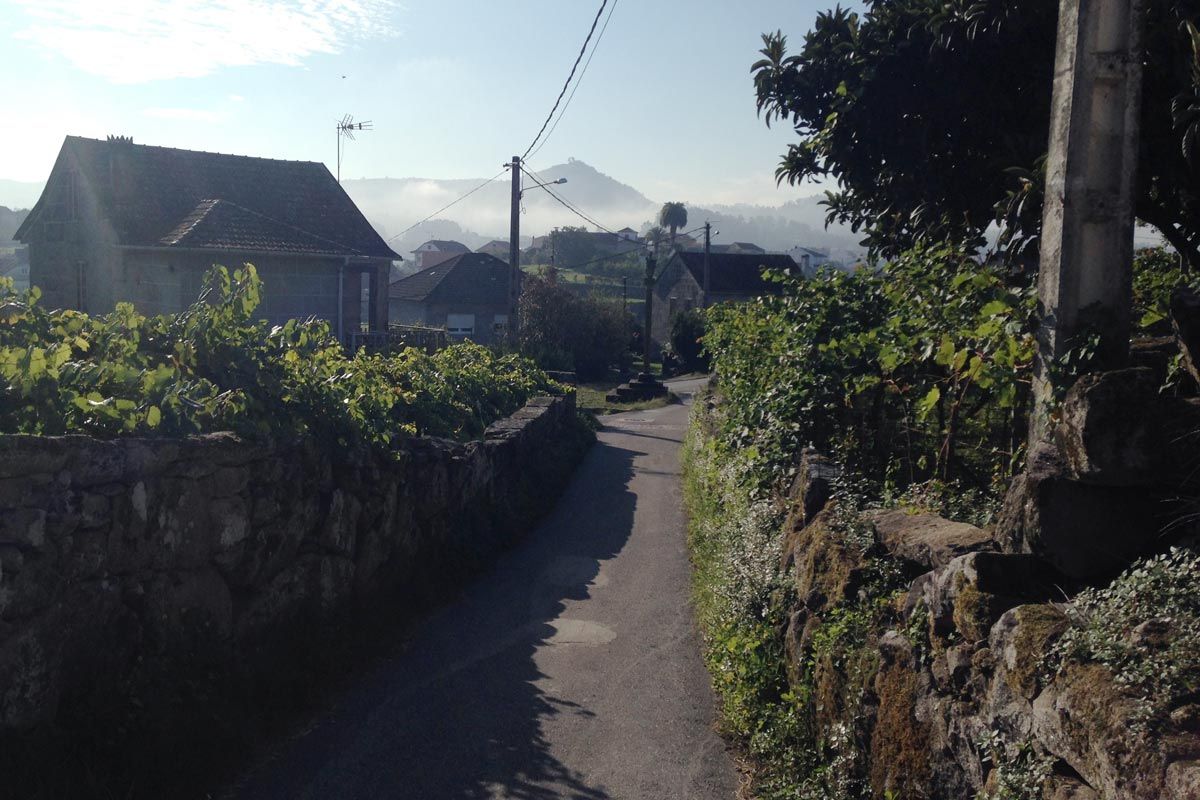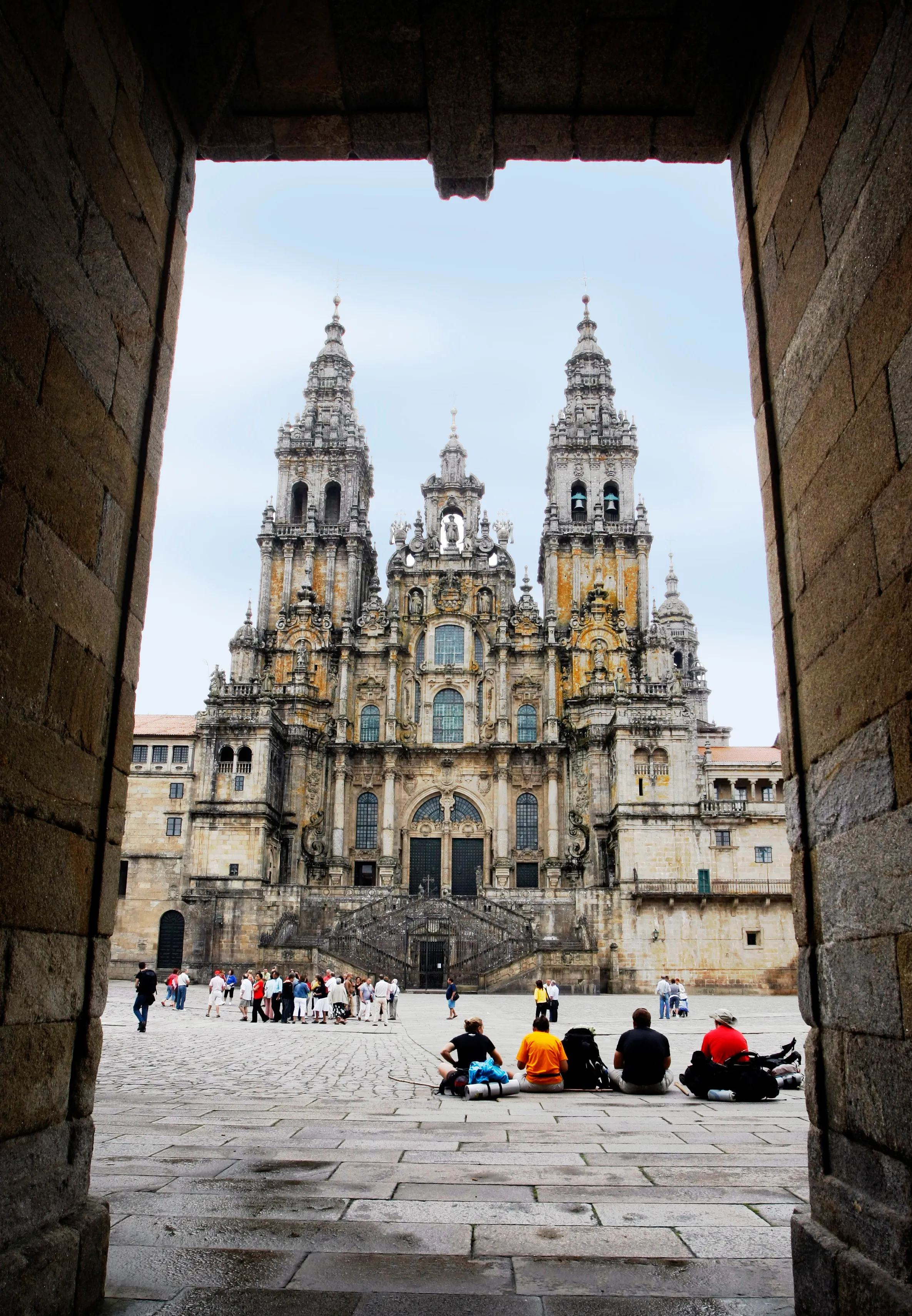
The final approach to Santiago is full of imperfect moments. Traffic returns. Streets become busier. The Cathedral may not appear at the precise instant imagined during months of preparation. Then stone towers rise above the old city, a passage opens, music may drift through an archway, and the Camino’s abstract destination becomes a place beneath your feet.
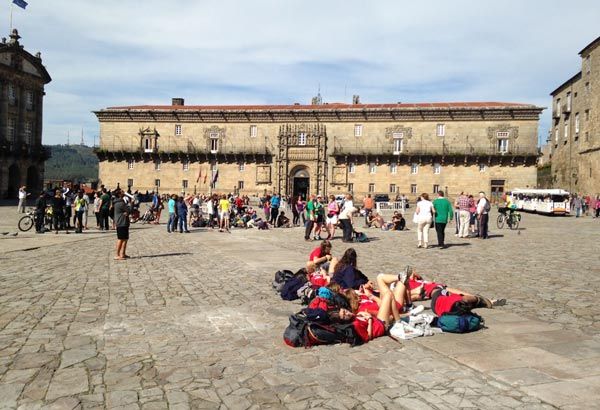
Many pilgrims enter Praza do Obradoiro and stop. Some embrace. Some sit on the paving stones. Some feel joy, relief, grief, or surprisingly little at first. Arrival does not have to resemble anyone else’s photograph.
Once you are ready to look outward again, the Cathedral and its surrounding squares explain much of Santiago’s history.
Praza do Obradoiro: the great western stage
Obradoiro is the Cathedral’s monumental western square and the symbolic end point for many Camino arrivals. The Baroque façade facing the square was created centuries after the Romanesque Cathedral behind it. Its towers frame the entrance and protect the older structure while giving Santiago one of its defining urban images.
The square’s name is associated with the workshop involved in the building campaign. Today it acts as an open room bordered by institutions whose functions reveal the city’s development.
To one side stands the Hostal dos Reis Católicos. Founded by the Catholic Monarchs as a royal hospital for pilgrims, the building embodies a long connection between pilgrimage and hospitality. It later became a Parador hotel. Its elaborate entrance and courtyards repay attention even when you are not staying there.
Across the square, the Pazo de Raxoi houses civic and regional government functions. The Colexio de San Xerome represents the university’s historical presence. Cathedral, hospital, government, and learning therefore face one another around the same space.
The other faces of the Cathedral
Walking around the Cathedral changes the view and the story.
Praza das Praterías lies on the south side. Its Romanesque portal preserves sculpture from the medieval Cathedral and offers a closer, more layered encounter than the grand western façade. The square’s name recalls the silversmiths historically associated with the area. A fountain, steps, arcades, and surrounding buildings create one of the old city’s most animated spaces.
Praza da Quintana opens along the eastern side. A broad staircase divides its upper and lower levels, often described through names associated with the living and the dead. The Holy Door is located on the Cathedral side and is opened in connection with Holy Years under the Church’s established practice. Visitors should rely on current official information rather than assume access from an old guide.
Praza da Inmaculada faces the north façade and the monastery of San Martiño Pinario. Pilgrims arriving by the French Way pass through this side of the historic center before turning toward Obradoiro. The scale of the monastery makes clear that Cathedral life belonged to a wider ecclesiastical city.
These squares are not isolated attractions. Together they allow the immense Cathedral to meet the lanes around it. Moving among them reveals different materials, periods, functions, and levels of ceremony.
Entering the Cathedral
The Cathedral is an active place of worship as well as a heritage site. Access routes, visiting hours, security requirements, liturgical schedules, and ticketed areas can change. Large backpacks are not permitted inside under current published guidance, so plan to leave luggage appropriately before visiting.
The tomb of Saint James lies beneath the main altar according to Cathedral tradition. The Romanesque interior, later chapels, Baroque elements, Pórtico da Gloria, museum, roofs, and Pazo de Xelmírez cannot all be understood in a hurried circuit. The Pórtico da Gloria is the Cathedral’s Romanesque western entrance, created under Master Mateo as a richly sculpted and originally polychrome vision of heavenly Jerusalem. Some areas require separate tickets or timed access. Check the Cathedral’s official visitor information for current arrangements.
Practices once presented as standard pilgrim rituals may no longer be allowed. Do not follow old instructions to place hands on sculpted stone or perform physical gestures around artworks. Barriers and conservation rules deserve respect.
Mass and the Botafumeiro
Pilgrim Mass is important to many arrivals. As of August 2026, the Cathedral publishes four daily Pilgrim Masses at the main altar:
- 7:30 a.m.
- 9:30 a.m.
- 12:00 noon
- 7:30 p.m.
The Cathedral also currently lists an English-language Mass at 10:30 a.m. in the Pilgrim’s Reception Office chapel every day except Wednesday. This is separate from the Pilgrim Masses at the Cathedral’s main altar.
Schedules, special celebrations, access arrangements, and language services can change, so confirm them on the Cathedral’s official liturgy page shortly before attending. Arrive with time and remember that the liturgy is worship, not a performance arranged around a travel itinerary.
The Botafumeiro is the Cathedral’s famous large censer. The Cathedral currently lists its use during these solemnities:
- The Epiphany, January 6
- Resurrection Sunday
- The Apparition of the Apostle at Clavijo, May 23
- Pentecost
- The Martyrdom of Saint James, July 25
- The Assumption of Mary, August 15
- All Saints, November 1
- Christ the King
- The Immaculate Conception, December 8
- Christmas, December 25
- The Transfer of the remains of the Apostle, December 30
Resurrection Sunday, Pentecost, and Christ the King move with the liturgical calendar rather than falling on one fixed date. The Botafumeiro may also operate for pilgrimages that have formally requested it from the Cathedral. It does not swing at every Mass, and even a listed solemnity should be checked against current Cathedral notices rather than promised as part of an ordinary visit.
The Pilgrim’s Reception Office
The Compostela is issued at the Pilgrim’s Reception Office, not handed out inside the Cathedral. Travelers who intend to apply should review the current credential, distance, stamping, motivation, registration, and collection rules in advance. Busy days can affect waiting and same-day collection.
Our guide to the credential and Compostela explains the distinction, while the official Office website remains the authority for current procedures.
Let arrival take its time
Santiago deserves more than a quick photograph before departure. Return to Obradoiro at another hour. Walk around the Cathedral after rain or near evening. Notice students crossing the old city, local residents meeting under the arcades, and new pilgrims arriving while yesterday’s arrivals have already changed clothes.
Arrival continues as you begin to see Santiago as both a pilgrimage destination and a living city. Understanding the Cathedral’s squares adds historical context to that first emotional view and gives you more reasons to stay and explore.
If your journey continues west, compare that arrival with the Finisterre Way in our route guide.