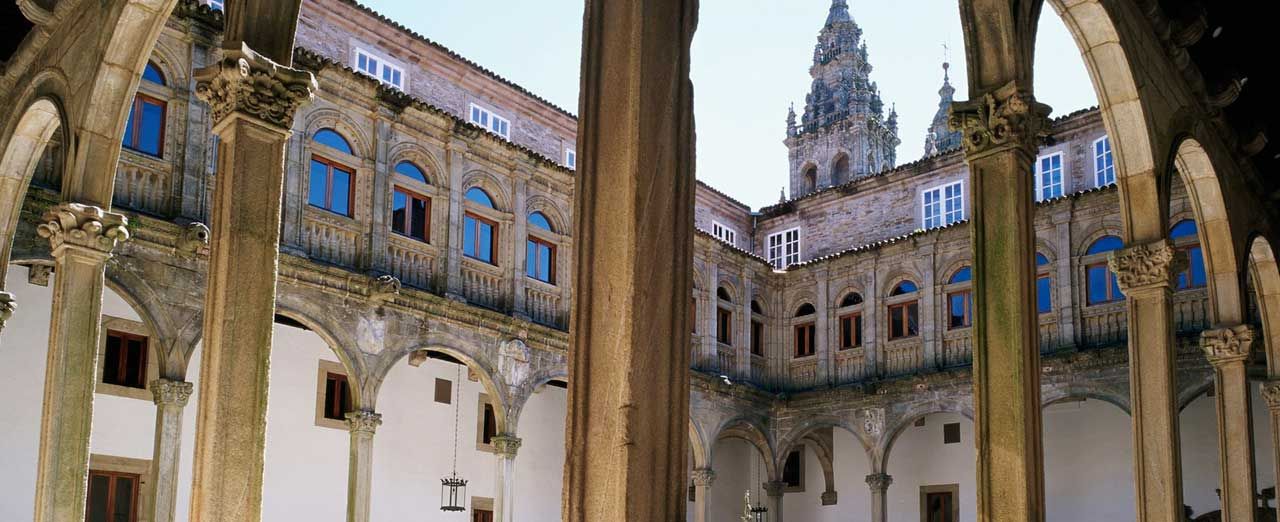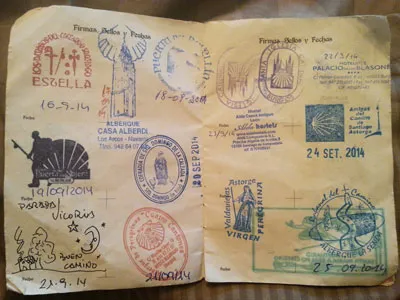
Two documents are often mentioned together on the Camino, but they serve different purposes. The pilgrim credential, frequently called the pilgrim passport, is carried and stamped along the route. The Compostela is a certificate issued in Santiago to pilgrims who meet the Cathedral’s current requirements.
The distinction matters. A credential can become a personal record of places and days even when a traveler does not request a Compostela. A completed walk or ride can be deeply significant even when its route, distance, direction, or motivation does not qualify for that particular certificate.
What the credential is
The official Credencial del Peregrino is issued through the Church and institutions authorized by it, including certain confraternities, associations, parishes, and pilgrim hostels. The Pilgrim’s Reception Office also recognizes specified credentials issued by authorized Camino organizations.
Its folding pages contain spaces for stamps, or sellos. Pilgrims collect them at accommodations, churches, monasteries, cafés, tourist offices, town halls, and other points along the Way. Each stamp places the day in a real location. Long after the journey, the credential can recall a quiet chapel, an early coffee, or the hotel reached in the rain.
Practically, the stamps also document the route when applying for the Compostela. The credential should contain the traveler’s identifying information and remain accessible during the journey. Keep it protected from rain, but do not hide it so deeply that stamping becomes inconvenient.
What the Compostela is
The Compostela is the Cathedral’s traditional certification of a pilgrimage to the tomb of Saint James made with religious or spiritual motivation under the terms stated by the Pilgrim’s Reception Office. It is not a general completion certificate for every visit to Santiago.
Under the rules published by the Pilgrim’s Reception Office at the time of writing, pilgrims must complete at least the final 100 continuous kilometers on foot or horseback, or at least 200 kilometers by bicycle, along a route recognized by its system. The final walking stage must lead into Santiago Cathedral. The Office publishes additional provisions, including a rule concerning pilgrims who begin a recognized route outside Spain and continue into Spain.
When a pilgrim completes only the required minimum distance, the official guidance says the credential must be stamped at the start and end of every stage, with the corresponding date. This demonstrates continuity: the next stage resumes where the previous one ended. A single decorative stamp per day may not be enough in that situation.
Because requirements can change or require interpretation, check the official Compostela page before traveling. The Pilgrim’s Reception Office, not a tour operator, hotel, or online forum, decides whether an application qualifies.
Receiving it in Santiago
Applications are handled by the Pilgrim’s Reception Office in Santiago, not at a hotel or directly in the Cathedral nave. The Office publishes its current location, procedure, and opening information online. Busy periods can affect the process, and same-day collection should not be treated as guaranteed.
Complete any official registration steps required at that time, bring the credential, and allow space in the arrival day rather than building a tight onward connection around an assumed collection time. Current instructions belong on the Office’s website because operating procedures can change.
Why some journeys are not eligible
The Ultreya Tours catalog includes a Compostela field for each Camino journey. It reflects whether the itinerary is structured to meet the applicable route, direction, and distance basis, but the traveler must still satisfy the official stamping and motivation requirements. Eligibility is not the same as an automatic award.
Some journeys are intentionally about something else. The Finisterre Way begins in Santiago and continues west toward the Atlantic, so it does not arrive at the Cathedral and is not displayed as Compostela-eligible. A shorter route section may provide a rich Camino experience without covering the required distance. A coach journey with selected walks should not imply a continuous qualifying pilgrimage.
Cyclists have a different minimum distance from walkers. This is one reason a route description must be read together with journey mode rather than assumed from the starting town alone.
More than a certificate
For many pilgrims, receiving the Compostela is moving. It gives formal expression to an intention carried along the route. For others, the credential itself, a photograph in the square, or the memory of entering Santiago matters more. Some do not seek a document at all.
None of these responses makes the Camino less real. The certificate belongs to a specific religious tradition and set of conditions. The journey also contains friendship, effort, landscape, grief, curiosity, and change that cannot be measured in kilometers or certified at a desk.
If the Compostela is important to you, choose an appropriately marked journey, follow the official rules carefully, and collect stamps as evidence rather than decoration alone. Then allow the arrival to be larger than the paper you may carry away from it.
Before choosing a journey, compare the main Camino routes. When Santiago is near, the guide to the Cathedral and its squares helps leave enough room for arrival beyond the certificate.