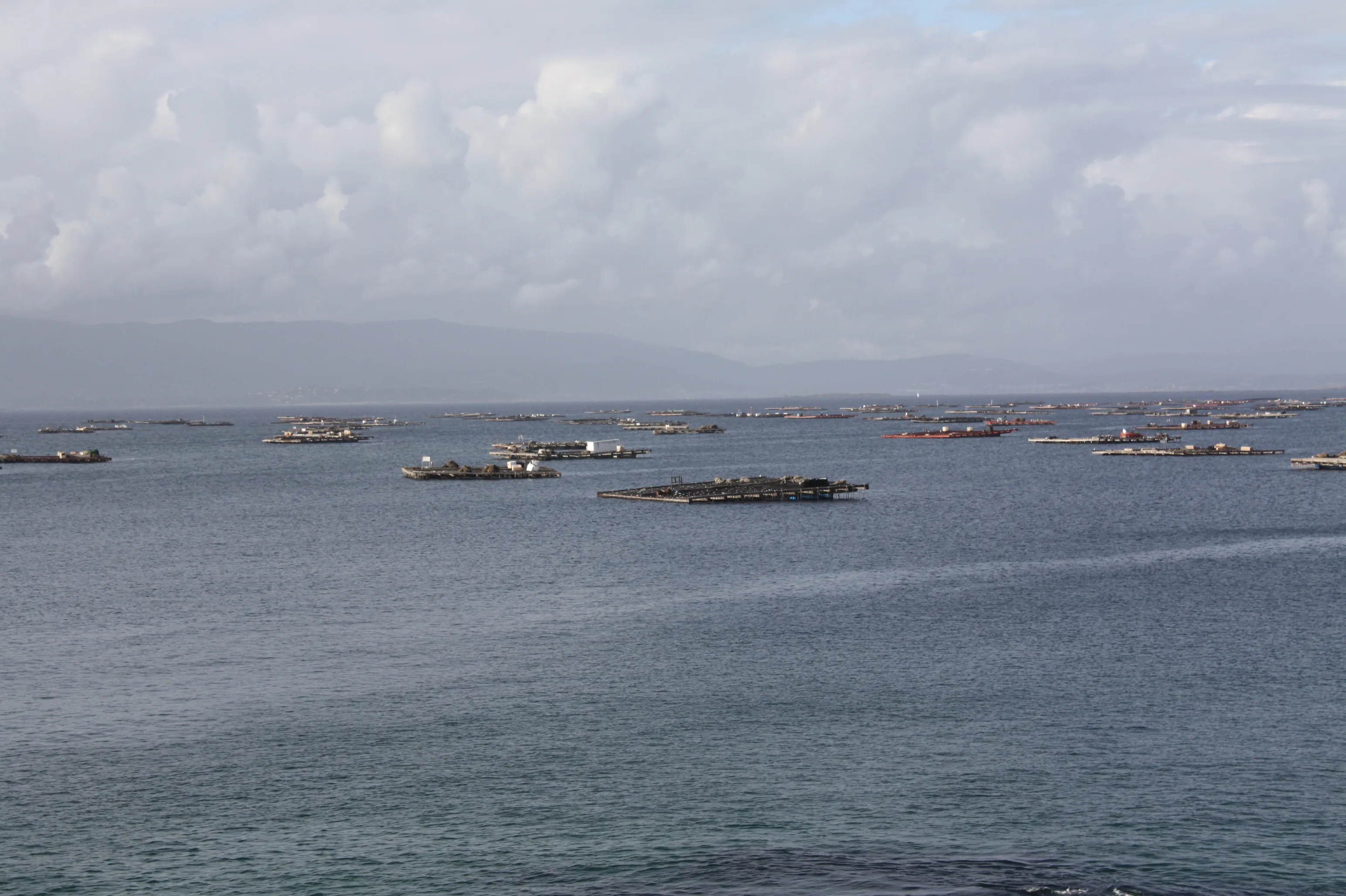
The dark rectangles floating across the Ría de Arousa are bateas, anchored rafts used mainly to cultivate mussels. What looks simple from shore is a working farm. The crop hangs beneath the platform on hundreds of ropes, feeding naturally from plankton carried through the ría.
From Vilanova experiments to a Galician industry
Early attempts at controlled mussel cultivation near Vilanova de Arousa used stakes in the intertidal zone at O Rial. The decisive floating experiment followed in 1945, when the first Galician batea was installed off O Rial using ideas adapted from Mediterranean floating nurseries.
The original structure had a wooden float and a grid of beams. Tarred esparto ropes hung below it, with small cross-pieces to stop mussels sliding down. The system spread quickly. By 1949, new rafts were being moored around Cambados, O Grove, Bueu, Redondela and A Pobra do Caramiñal. Expansion was particularly strong during the 1960s and 1970s.
How a batea works
A modern raft has a wooden working grid, floats, a heavy anchoring chain and a concrete block known as the muerto. As many as 500 cultivation ropes can hang through the grid, with regulated useful lengths of up to 12 metres.
Young mussels, called mexilla in Galicia, are collected under regulated conditions from natural coastal stocks or collectors. They are attached to ropes and held by a biodegradable mesh until they grip with their own byssal threads. As they grow and become crowded, workers lift the ropes and divide the mussels onto additional lines. This stage is called desdoble. At harvest, hydraulic equipment raises the heavy ropes to the boat.
The mussels are not fed from bags or tanks. They filter naturally occurring plankton from the water. Salinity, temperature, currents and food availability therefore affect growth. Monitoring and temporary closures protect public health when marine biotoxins are detected.
Where pilgrims see them
Travelers on the Portuguese Way begin seeing batea country around the Rías Baixas. The strongest connection comes on the Portuguese Spiritual Way. Vilanova de Arousa is the departure point for the boat journey through the estuary and up the Ulla River toward Pontecesures. The cruise passes close enough to appreciate the number and scale of the rafts without entering their working areas.
They can also be seen from Cambados, Vilagarcía, A Illa de Arousa and many coastal viewpoints. Working boats have priority, and private rafts should never be boarded without authorization.
Our Portuguese Spiritual Way Signature journey includes the maritime stage from Vilanova. Ask us about adding a seafood experience or a specialist explanation of the ría.