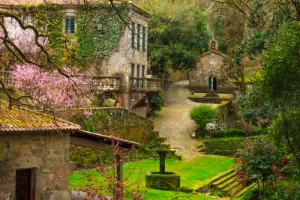
The gardens of Galicia’s pazos were designed to make an entrance. A formal approach displayed lineage and control, clipped box organized terraces close to the house, orchards supplied the household, and wooded walks offered shade and surprise. Owners freely combined French geometry, Italian water effects, English landscape fashion and productive Galician ground instead of following a single gardening school.
Rare plants became part of this competition between estates. The Atlantic ports of Portugal and northwestern Spain placed Galician owners close to maritime trade. Seeds and young plants circulated among diplomats, merchants, nurseries and private collectors. A newly arrived tree demonstrated money, taste and international connections, while Galicia’s mild, wet climate allowed plants from East Asia, the Americas and Australia to grow outdoors.
Many gardens were laid out or enlarged during the eighteenth century. Their celebrated camellia collections expanded mainly in the nineteenth century, and eucalyptus arrived later still. The garden seen today therefore combines several generations of fashion and experiment.
Camellias: winter color from East Asia
Camellias are native to eastern and southeastern Asia. The tea plant belongs to the same genus, while the ornamental species most associated with Galicia include Camellia japonica, C. reticulata and the autumn-flowering C. sasanqua.
Portuguese maritime connections helped bring camellias to the Iberian Peninsula, and Galicia was among the first European regions where they flourished outdoors. Their dense evergreen leaves tolerated Atlantic winters. Their flowers opened when many deciduous trees were bare, giving pazo owners weeks of red, pink, white and variegated color during the quietest gardening season.
At Pazo de Oca, old camellias form walks and rise to tree height. Some are pruned into umbrella shapes. At Pazo de Rubianes, more than 4,000 plants represent around 800 varieties, making the estate a serious living collection rather than a display of one familiar flower. Grafting, collecting and exchanging cultivars became a long-term pursuit among Galician estates.
The flowers also acquired local uses. Camellias are shown at exhibitions, floated in bowls and arranged individually so the geometry of each cultivar can be examined. Their seeds produce a light oil long used in East Asia. Galician producers now incorporate camellia oil into facial oils, soaps, creams and other spa products; Pazo de Rubianes harvests seed from its own collection for cosmetic products.
Camellias are not confined to palace walls. From winter into spring, walkers see them in hotel gardens, village squares and private plots along the Portuguese Way and the final Galician stages. Hydrangeas take over later, lining walls and lanes with blue, violet, pink and white flower heads from early summer. Their colour responds partly to soil chemistry, which is why blue hydrangeas are so common in Galicia’s acidic ground.
Magnolias: older than the bees that now visit them
Magnolias evolved very early among flowering plants, before bees became their principal pollinators. Many species developed sturdy flowers suited to beetle pollination. Their thick petals and prominent central structures still show that ancient relationship.
The evergreen Magnolia grandiflora came from the southeastern United States and entered European cultivation during the eighteenth century. It offered pazo gardens a scale quite different from the camellia: a broad evergreen crown, polished leaves with brown felt beneath, and large cream flowers with a strong citrus-like perfume.
Galicia’s climate allowed individual magnolias to reach monumental proportions. The great specimens at Rubianes are protected in the Galician Catalogue of Monumental Trees. Their value depends on age and form as well as rarity. A tree planted as an exotic ornament can become part of the region’s inherited landscape after two centuries of care.
Deciduous Asian magnolias added flowers on bare branches in late winter and early spring. Together with camellias, they made the pazo garden especially effective outside the conventional summer season.
Eucalyptus: from specimen tree to industrial landscape
Eucalyptus arrived from Australia during the nineteenth century. A solitary specimen in a botanical garden was initially admired for its rapid growth, unusual leaves and aromatic oils. Some historic pazos still contain enormous old examples that belong to the story of nineteenth-century plant collecting.
Planting changed scale in the twentieth century. Eucalyptus globulus became economically valuable because it grows quickly and supplies fibre for the paper-pulp industry. Large areas of Galicia and Portugal were planted with eucalyptus, often where rural abandonment and fragmented private land made fast-growing forestry attractive.
The controversy concerns plantations and landscape management, not the mere existence of an old garden tree. Eucalyptus species are non-native in both Galicia and Portugal. Dense, repeated stands can replace native woodland habitat, simplify the vegetation below and alter soils and water relationships. E. globulus can spread beyond planted plots, especially after disturbance.
Fire makes the debate more urgent. Eucalyptus contains volatile oils and sheds bark and leaves that add combustible material. It can also regenerate strongly after fire. A badly managed continuous plantation therefore creates different fire behaviour from a mixed, well-managed landscape. Eucalyptus is not the sole cause of Iberian wildfires: drought, heat, deliberate or accidental ignition, abandoned land and poor management all contribute. Reducing the question to one tree species hides those interacting causes.
Supporters point to forestry income, jobs and a supply chain important to rural economies. Critics argue that short-term private returns leave biodiversity loss, fire risk and landscape costs to the wider public. The practical argument is now about limits, location, mixed land use and enforcement as much as outright prohibition.
Reading the garden and the countryside separately
An ancient eucalyptus at a pazo, a camellia collection and a commercial plantation all contain imported plants, but they do not have the same ecological effect. Scale, density, location and management decide the consequences.
Winter is the finest season for camellias. Magnolia grandiflora flowers later, usually from late spring into summer, while deciduous magnolias announce early spring. Visiting at different times reveals that a pazo garden is never a fixed eighteenth-century picture. It is a collection shaped by several centuries of experiment, fashion and patient maintenance.
Ultreya Tours can incorporate the gardens of Oca, Rubianes or Faramello into a tailored Camino proposal, choosing the estate according to season, route and confirmed visiting arrangements.