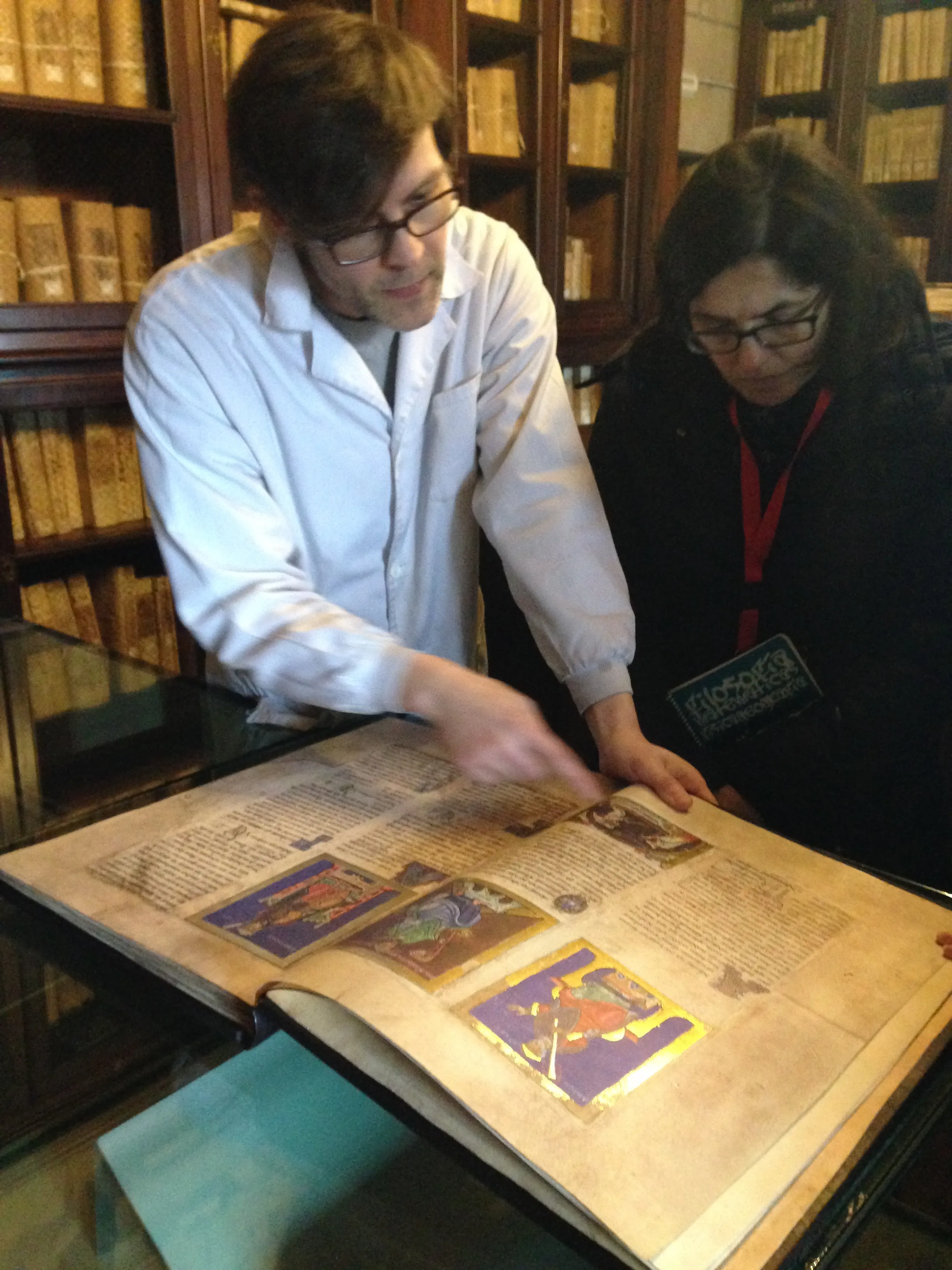
The manuscript known as the Codex Calixtinus is the Cathedral of Santiago’s copy of the broader Liber Sancti Iacobi, the Book of Saint James. Compiled during the twelfth century, it presents itself under the authority of Pope Calixtus II, but scholars do not accept him as its author. Several writers, editors and scribes contributed to the collection.
Five books with different purposes
Book I supplies sermons, liturgy and music for the feasts of Saint James. Book II gathers twenty-two miracles attributed to the apostle, helping pilgrims at sea, rescuing captives and intervening far from Galicia. Book III tells how the saint’s body was carried to Galicia. Book IV is the Pseudo-Turpin Chronicle, an invented account of Charlemagne opening the road to Santiago. Book V describes routes through France and northern Spain.
That last book is often called the first Camino guide. It divides the journey into stages, names rivers and shrines, comments on water and peoples, and describes Santiago Cathedral. Its insults and sweeping ethnic judgements make clear that it records one medieval voice, not neutral travel advice.
Music written for Compostela
The Codex preserves monophonic chant and some of the earliest surviving polyphony associated with western Europe. In polyphony, separate vocal lines sound together rather than everyone singing a single melody. The famous Congaudeant catholici has three notated voices, although scholars debate aspects of its authorship and performance.
The music served liturgy and ceremony. It also projected Santiago as a sophisticated international shrine able to commission, collect and perform ambitious work. Modern ensembles reconstruct it from notation that does not communicate every rhythm or vocal practice automatically.
Miracles, geography and persuasion
Miracle stories reassured travelers that Saint James acted beyond his tomb. They warned against broken vows, dishonest innkeepers and despair. The guide then turned devotion into geography by identifying roads, hospices, relics and dangers. Together, the books promoted the shrine while giving pilgrims a story through which to understand travel.
The disappearance in 2011
On 5 July 2011, Cathedral staff discovered that the manuscript had vanished from the archive. There was no dramatic broken display case: the Codex had been kept in a restricted area, and suspicion eventually focused inside the Cathedral’s working environment.
Police recovered it in July 2012 from a garage near Santiago, wrapped in newspaper and plastic. A former Cathedral electrician was convicted of the theft and of taking money and documents. The manuscript was largely unharmed, but the case exposed serious weaknesses in archive security.
Today the original is preserved under controlled conditions and is not an object visitors should expect to see casually displayed. Facsimiles and digital reproductions allow its pages to be studied without repeated handling.
The Codex deserves attention because its parts disagree productively. It is prayer book and propaganda, musical archive and miracle collection, invented history and practical observation. Few objects explain so clearly how medieval Compostela wanted the wider world to imagine Saint James and the road to his shrine.
Our private Santiago guides can place the Codex, Cathedral archive and medieval city in context at the end of any Ultreya Tours Camino.