Pilgrims reach Santiago carrying objects gathered along the road: a shell, a small pendant, perhaps a ceramic figure that could only have come from Galicia. The best pieces make sense once you know who made them and why their shapes recur in local homes, bars and jewellery shops.
Sargadelos: from factory to Galician design language
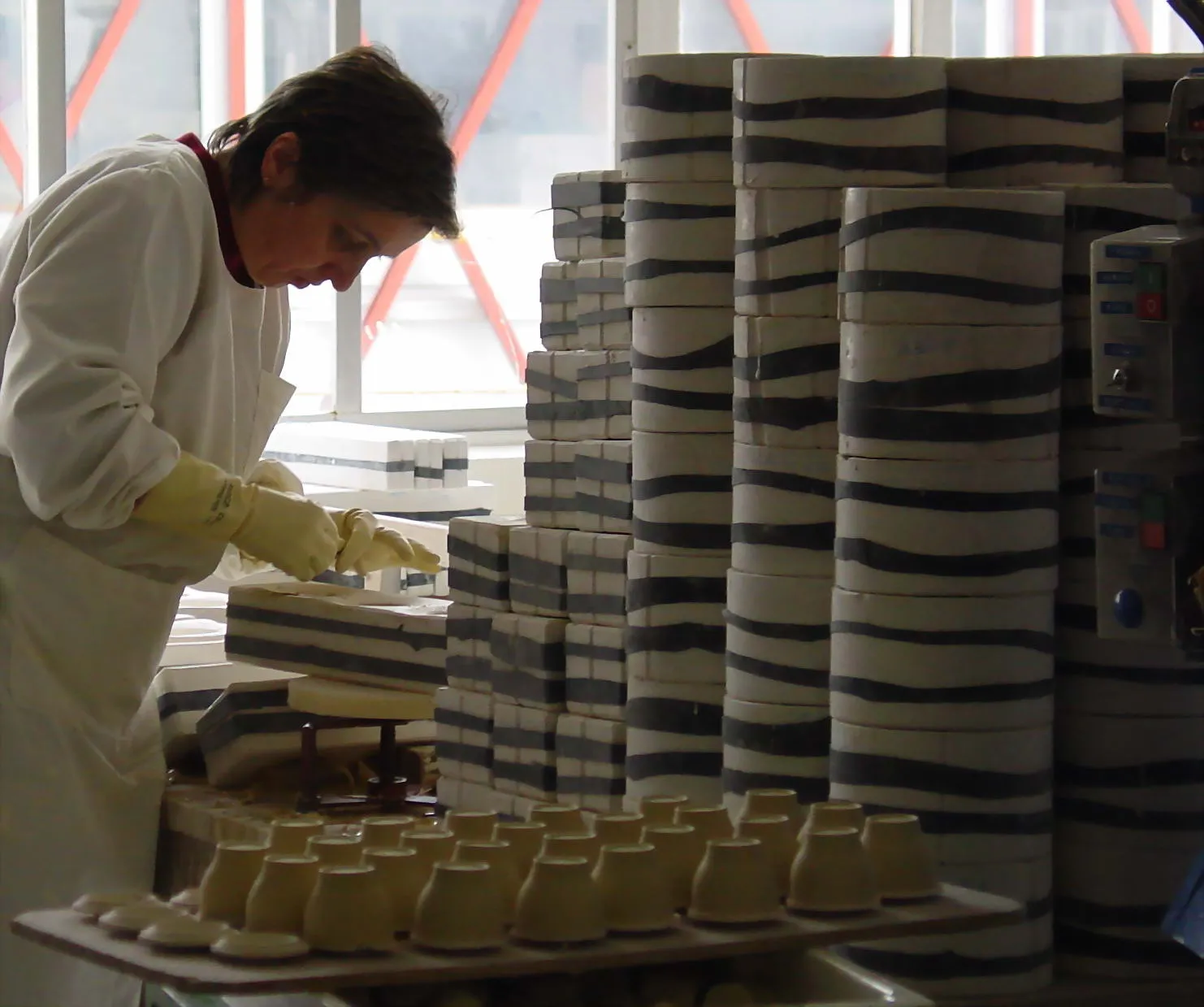
Antonio Raimundo Ibáñez founded the Sargadelos pottery works at Cervo, in Lugo, in 1806. The original nineteenth-century factory used nearby kaolin and developed from practical wares into decorated tableware. It closed in 1875, so an antique Sargadelos piece and a modern blue-and-white figure do not belong to one uninterrupted production line.
The modern revival began in the twentieth century around Isaac Díaz Pardo, Luis Seoane and the Laboratorio de Formas. They treated ceramics as part of a larger Galician cultural project. Geometric borders, cobalt blue, historical characters, popular occupations and forms drawn from Galician visual culture created an immediately recognizable style.
Sargadelos appears in ordinary life as well as display cabinets. Its plates and coffee sets are used at home; ceramic signs identify streets and buildings; figures portray fish sellers, farmers, writers and traditional dress. In bars, one of the most familiar commissions is the sculptural Estrella Galicia beer column. The celebrated earlier design by Díaz Pardo takes the form of a female figure or sphinx, the “lady” many visitors remember holding up the beer tap. Later collaborations continued the relationship between the brewery and Sargadelos, including the modular Génesis column.
When buying Sargadelos, look at the mark on the base and purchase from an official shop or established dealer. “Galician-style blue pottery” is not necessarily Sargadelos. Older pieces need specialist assessment because the factory had several historical periods, marks and patterns.
Azabache on the streets beside the Cathedral
Azabache, called acibeche in Galician, is jet: fossilized organic material polished to a deep black shine. Santiago’s connection with it goes back to the Middle Ages. Pilgrims bought shells, images of Saint James, beads and amulets from craftspeople working close to the Cathedral. The street name Rúa da Acibechería, beside the Cathedral’s north façade, preserves the trade in the map of the city.
Jet is light and warmer to the touch than many stones. Historic Compostela workshops often combined it with silver. The contrast still works beautifully in earrings, rosaries, scallop shells and small pendants. Ask whether a piece is genuine jet, where it was worked and whether the maker carries an Artesanía de Galicia certification. Black glass, resin and dyed materials can imitate its appearance.
The figa: the little closed hand
The figa, or higa, is a closed hand with the thumb pushed between the index and middle fingers. The gesture predates the Camino and appears in different Mediterranean and European traditions. In Spain it became a protective amulet, particularly against the evil eye. Santiago’s jet workers turned it into one of their best-known small carvings.
In Galicia you will often hear that a figa should be given to you rather than bought for yourself. Treat that as a living custom, not a rule enforced by history: families and sellers repeat it because a protective gift carries the intention of the person who chose it. If you want one for yourself, nobody will stop you. If you give one to somebody you love, you participate in the more appealing version of the tradition.
Some old figas were made for children and attached to silver holders, coral or bells. Museum examples show that these objects were worn, handled and repaired. They were personal protection before they became souvenirs.
Silver, shells and crosses
Silver gives Compostela jewellery much of its structure. It frames fragile jet, turns the scallop shell into a wearable emblem and appears in reproductions of the Cross of Santiago. The red enamelled sword-cross is easy to recognize, while a plain silver shell can be discreet enough to wear long after the journey.
Hallmarks matter. In Spain, sterling silver is normally marked 925, indicating 925 parts of silver per thousand. A hallmark does not by itself prove that a design was made in Galicia, so ask the shop about the workshop. A locally made piece should come with a clear description and receipt.
What to look for while walking
Santiago has the greatest concentration of jet and silver work, especially around Acibechería and the old town. Sargadelos has official shops in Galician cities, and its factory complex at Cervo is in northern Lugo rather than on the principal Camino Francés. Along the route, smaller workshops also sell leather, wood, textiles and ceramics. The useful question is always specific: Who made this, where was it made, and what material is it?
A good Camino object does not need to be expensive. A small silver shell, a figa chosen as a gift or a piece of properly identified pottery can hold a place more accurately than a generic souvenir. If craft, workshops and Galician design are important to your journey, tell us when you start planning. We can protect time in Santiago rather than sending you straight from the Cathedral to the airport.