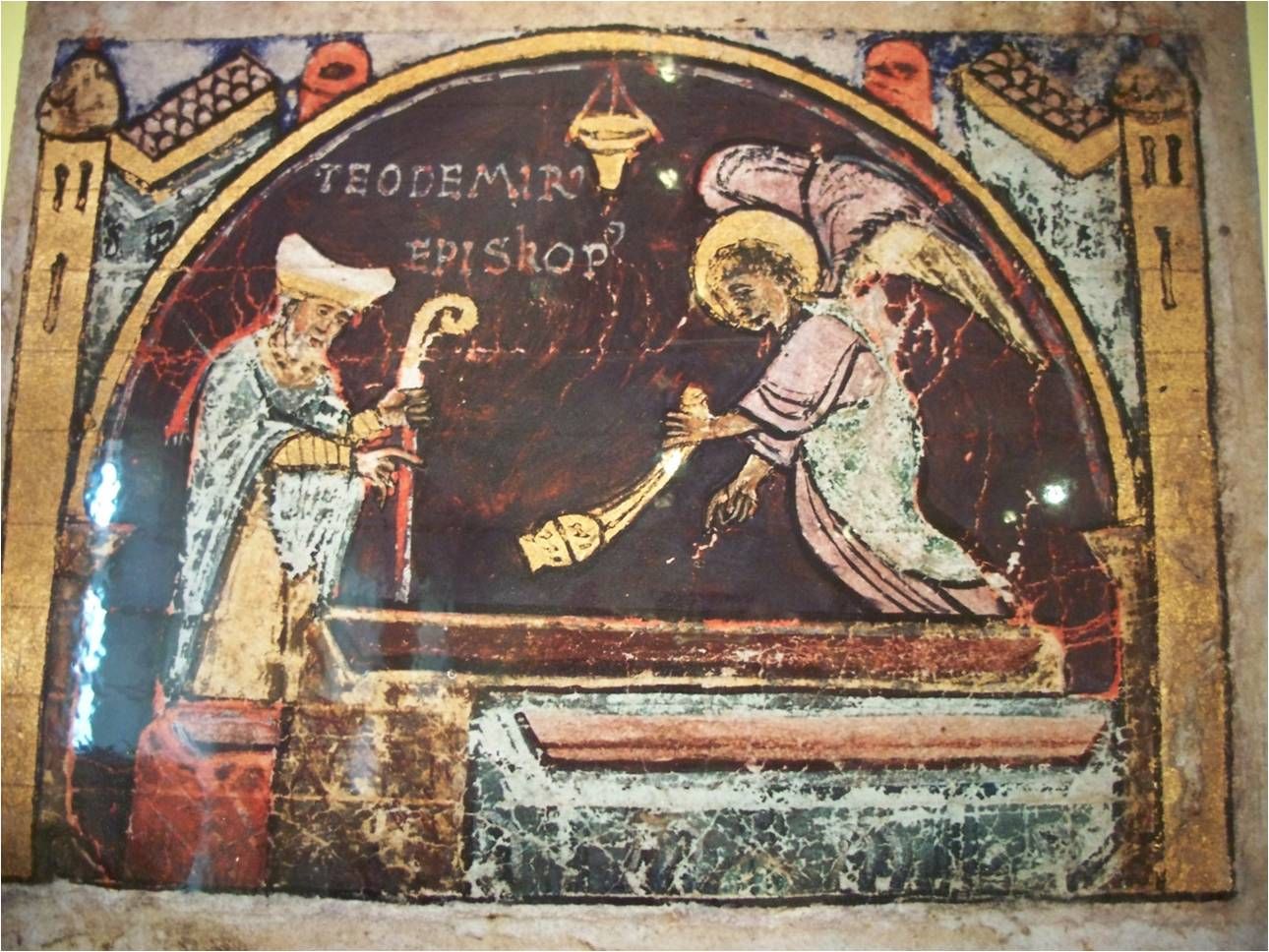
Diego Gelmírez, Xelmírez in Galician, was not the founder of the pilgrimage to Santiago, nor was the Cathedral his work alone. Yet few individuals did more to turn early twelfth-century Compostela into an ecclesiastical center with influence far beyond Galicia.
He is tempting to romanticize: the forceful prelate building a magnificent cathedral at the edge of Europe. The reality is more interesting. Gelmírez operated within dynastic conflict, local resistance, papal politics, reforming currents in the Church, and the practical challenge of sustaining a growing shrine. His achievements and methods belong to that contested world.
From Compostela to archbishopric
Born in the late eleventh century into a family connected with Galician power, Gelmírez became bishop of Santiago in 1100. The shrine already drew pilgrims, and construction of the Romanesque cathedral had begun decades earlier. His opportunity was to expand Santiago’s standing.
Gelmírez cultivated relationships with Rome and pursued greater status for his see. In 1120, Santiago became an archbishopric. That elevation strengthened the city’s position within the Church and made Gelmírez its first archbishop.
Ecclesiastical rank was not an abstract honor. It brought authority, prestige, resources, and political consequence. The history of the promotion involved negotiation and rivalry, and it should not be reduced to a simple reward for piety.
Building the Cathedral and its institutions
The cathedral that greets pilgrims today contains work from many periods, but the Romanesque project advanced substantially during Gelmírez’s leadership. Construction, liturgy, administration, and the reception of pilgrims all required organization. The archbishop supported a cathedral chapter and the institutional life needed to sustain a major sanctuary.
The palace adjoining the Cathedral bears his name, although the surviving complex reflects later rebuilding as well as medieval origins. It shows Santiago as both a devotional destination and a seat of governance where religious authority, hospitality, ceremony and politics met.
Gelmírez also promoted a form of worship and ecclesiastical culture connected with wider European reform. The pilgrimage roads helped carry such influences in both directions. Santiago’s apparent distance from major centers did not make it isolated.
Politics on land and sea
Gelmírez’s career unfolded during instability surrounding Queen Urraca, the young Alfonso Raimúndez, later Alfonso VII, and competing aristocratic interests. He acted as churchman and political leader, forming alliances, facing revolts, and at times enduring direct violence.
Accounts associated with his circle describe unrest in Santiago and conflicts in which Gelmírez’s conduct was far from passive. The Historia Compostellana, a principal narrative source for his career, is invaluable but not neutral; it was produced in an environment favorable to his institution. Historians therefore read it critically, attentive to what it records and how it presents its protagonist.
His attention also extended to Galicia’s coast. Maritime defense and the development of naval capacity responded to threats and supported regional power. This dimension complicates the image of a bishop concerned only with cathedral stone and pilgrim devotion.
Pilgrimage and influence
A prestigious, well-connected sanctuary attracted attention, patronage, and travelers. Gelmírez’s efforts to raise Santiago’s rank, develop its Cathedral, and strengthen its institutions helped create conditions in which the pilgrimage could flourish.
This does not mean he designed the Camino as a modern route network. Pilgrimage grew through many forces: devotion to Saint James, royal and ecclesiastical support, monasteries and hospitals, safer roads, local economies, and movement across Europe. Gelmírez was a powerful organizer within that larger story.
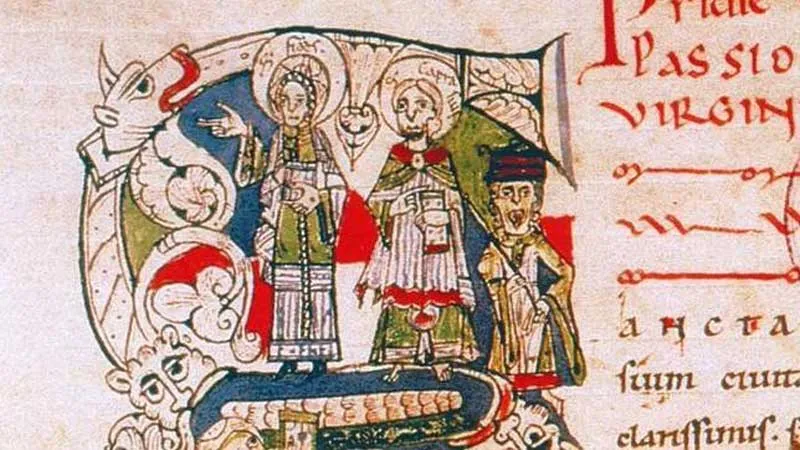
The twelfth century also saw the compilation of material now known as the Codex Calixtinus, with texts concerning liturgy, miracles, Saint James, and the road to his shrine. Its precise authorship and formation are complex, but the manuscript belongs to the world of international aspiration that Compostela cultivated.
Reading Gelmírez in modern Santiago
Today his name appears in the Pazo de Xelmírez beside the Cathedral. The palace forms part of the Cathedral’s museum complex; check current access and ticket information before visiting. Standing there, it is possible to see how physically close worship and power were.
Gelmírez should be remembered neither as a flawless visionary nor only as an ambitious politician. He was a medieval prelate whose religious responsibilities, institutional goals, and political actions were inseparable. He helped give Santiago architectural presence and ecclesiastical reach, but he did so through the contested practices of his time.
For pilgrims, that complexity enriches arrival. The Cathedral grew around the tomb through belief, labor, patronage, rivalry, reform and decisions made by people with mixed motives. Diego Gelmírez stands among the most important of them, a figure whose energy helped make medieval Santiago visible to the wider Christian world.
What to notice in Santiago
Stand in Praza do Obradoiro with the Cathedral ahead and the Pazo de Xelmírez immediately to its left. Their physical closeness is the clearest introduction to a world in which worship, administration, hospitality, and political power occupied the same monumental center. Inside the palace, look for the long medieval ceremonial hall and its carved corbels when that part of the Cathedral museum route is open.
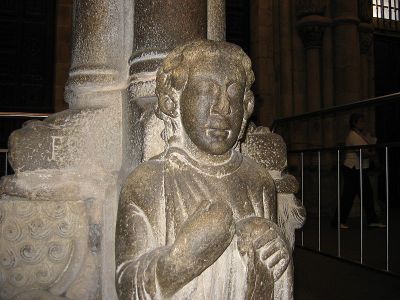
Walk around to the Platerías façade and remember that the Romanesque Cathedral was not created in one uninterrupted campaign. Sculpture, doors, chapels, and later façades preserve different ambitions. Gelmírez’s importance is not a signature on every stone; it is the institutional momentum that allowed Compostela to build, welcome, negotiate, and project itself far beyond Galicia.
Continue with the layered history of Saint James and the practical guide to arriving in Santiago, where Gelmírez’s city can be read square by square.