Most Romanesque churches on the Camino lead the eye along a rectangular nave towards an apse. Santa María de Eunate and the Church of the Holy Sepulchre at Torres del Río work differently. Both are compact, octagonal buildings from the late twelfth century. Their centralized form recalls the great rotunda built around Christ’s tomb in Jerusalem.
Medieval builders did not attempt a measured copy of the Holy Sepulchre. They borrowed the idea of a sacred centre enclosed by a circular or polygonal structure. Similar references appeared across Europe in churches associated with crusading, funerary rites and devotion to Jerusalem.
Santa María de Eunate
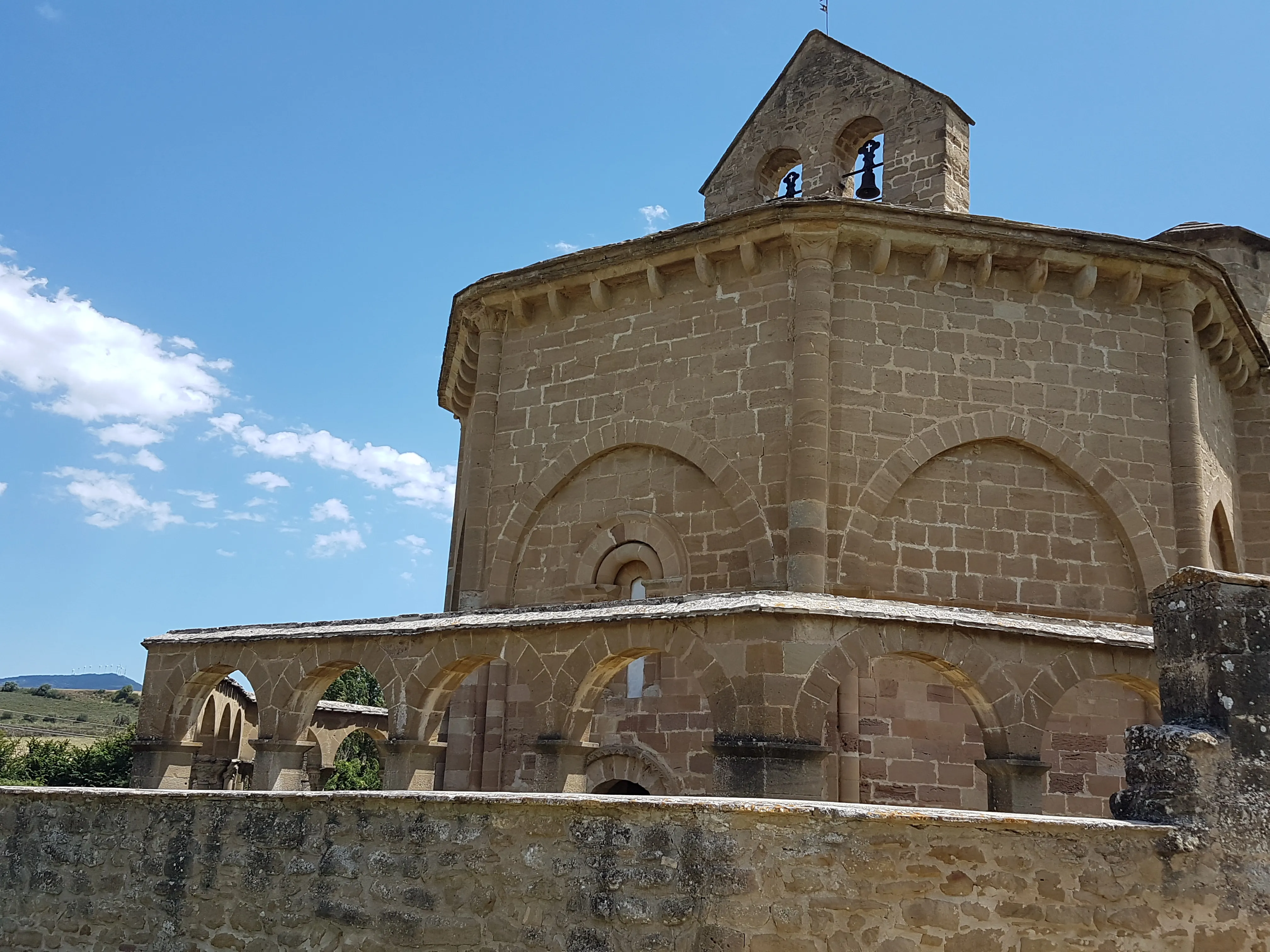
Eunate stands alone in fields near Muruzábal, close to the point where the Aragonese Camino joins the route from Pamplona. Its eight-sided body is surrounded by a freestanding arcade. A pentagonal apse projects from one side, and a small attached tower interrupts the otherwise balanced outline.
The arcade has often been called a cloister, although it does not enclose a monastic courtyard. Burials discovered around the church support its funerary use. The building may also have served pilgrims, but the identity of its founders remains uncertain.
Eunate is often described as a Templar church, although its medieval ownership remains uncertain. Its octagonal form and evocation of Jerusalem are interesting without the later stories of hidden Templar connections.
Torres del Río
Farther west, close to Viana, Torres del Río contains an even stronger reference to the Holy Sepulchre. Its octagonal church rises in three levels beneath a lantern. A cylindrical stair tower gives access to the upper structure.
Inside, heavy ribs cross without meeting at the centre, creating an eight-pointed star. The design resembles vaults from Islamic architecture, especially Córdoba. Christian patrons and builders could invoke Jerusalem while using construction knowledge developed in al-Andalus. The result belongs to the mixed architectural culture of medieval Iberia.
The church probably served a funerary purpose and may have displayed a light from its lantern. Its connection with the Order of the Holy Sepulchre is more persuasive than popular Templar claims, although parts of its institutional history remain debated.
Seeing both churches
Eunate requires a short detour from the standard French Way. Torres del Río stands directly on the walking route. Check opening hours because seeing the vault from inside is essential.
Both can be included on our French Way from Pamplona to Logroño. A private transfer or guided day makes it possible to compare the two without turning Eunate’s detour into an unnecessarily long stage.