The Pórtico da Gloria was the western entrance to the Romanesque Cathedral before the present Baroque façade enclosed it. Master Mateo was directing the Cathedral works by 1168. The inscription on the lintel records that it was set in place on 1 April 1188. His project extended beyond the three arches: it included the crypt that resolved the steep fall of the ground beneath the west end and a stone choir later removed from the nave.
Reading the three arches
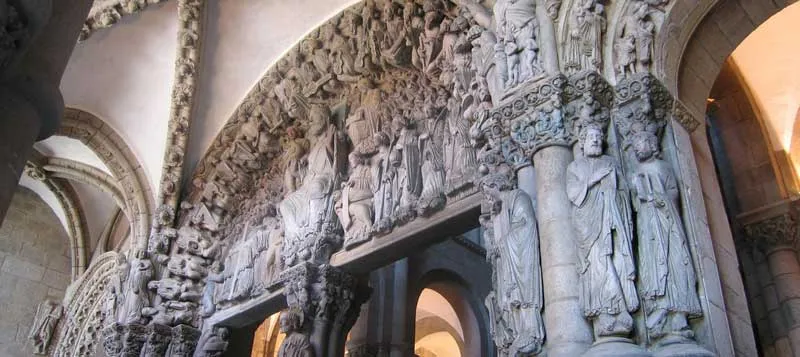
The central tympanum shows the risen Christ displaying the wounds of the Passion. The evangelists write beside him with their symbolic creatures, while angels carry the instruments of the Passion. Below, the jambs place prophets on one side and apostles on the other. Their heads tilt and their faces respond to one another, giving the stone assembly an unusual sense of conversation.
The lateral arches continue the account of salvation rather than serving as decoration around the centre. The left arch represents the people awaiting Christ; the right concerns judgement. On the counter-façade are figures identified with Virgil, Saint John the Baptist, Balaam, the Queen of Sheba and the Eritrean Sibyl, together with angels whose trumpets announce the Last Judgement.
The orchestra of twenty-four elders
Around the central arch sit the twenty-four elders from the Book of Revelation. They are preparing to make music, not posing with generic medieval props. Some tune strings, some turn to confer with a neighbour and others test an instrument.
The carving is detailed enough to distinguish oval fiddles, psalteries, harps and lutes. The large instrument at the centre is an organistrum, an early form of hurdy-gurdy. It requires two players: one turns the crank that moves the wheel against the strings while the other operates the keys. Its central position and the cooperation it demands make it one of the Pórtico’s most memorable details.
Researchers and instrument makers have used the carvings to construct playable wooden reproductions. Those reconstructions help answer questions the stone alone cannot: how the hands sit, how the strings respond and how different instruments might have sounded together in the twelfth century.
The Pórtico was painted
The pale stone seen for much of the twentieth century was never Mateo’s complete visual scheme. Conservation work identified three principal campaigns of polychromy: the original medieval paint, another layer from the early sixteenth century and a seventeenth-century intervention. Documents record that Crispín de Evelino repainted faces, hands and feet in 1651.
Historic images also help conservators understand what disappeared. A painting preserved at the Pazo do Faramello has been used as comparative visual evidence for the earlier appearance of the Pórtico. It is one part of the documentary record, alongside close examination, photography, chemical analysis and the surviving paint itself.
The nineteenth-century plaster cast was made in 1866 for the South Kensington Museum, now the Victoria and Albert Museum, not for the British Museum. During the recent restoration, specialists found plaster residues and even a knife associated with the moulding process. Casting contributed to the deterioration, alongside water infiltration, condensation, accumulated dirt, salts, repeated repainting and earlier treatments.
What the restoration did
The conservation programme ran from 2008 to 2018, led by the Fundación Barrié and the Cathedral Foundation with the involvement of Spain’s Institute of Cultural Heritage. Before cleaning the sculpture, the team studied the building and addressed environmental causes of decay, particularly damp and condensation.
The work was conservation, not a modern repainting. Specialists mapped the surface, analysed pigments and binders, removed deposits under magnification and fixed fragile areas where original material could be saved. Cleaning revealed color that had been hidden beneath dirt, while losses were left legible rather than covered with a newly imagined medieval scheme.
What to notice during a visit
Start with the complete architecture before concentrating on individual faces. Then look for the elders tuning their instruments, the two men sharing the organistrum, the expressions exchanged between prophets and apostles, and small islands of red, blue and gilding.
The kneeling figure behind the central column is popularly known as the Santo dos Croques and traditionally associated with Master Mateo. Generations touched or knocked their heads against it, but that custom damaged the stone. Current barriers and controlled access protect both the sculpture and its stable environment. Check the Cathedral’s official visiting arrangements before going; tickets and access conditions can change.