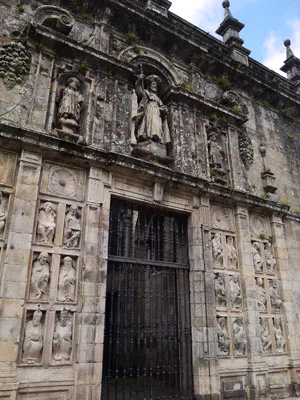
On the eastern side of Santiago Cathedral, facing Praza da Quintana, stands the entrance known as the Holy Door. Most years it is closed. During a Jacobean Holy Year, it becomes a ceremonial threshold associated with pilgrimage, reconciliation, and spiritual renewal.
Next year, 2027, is a Jacobean Holy Year. A Jacobean Holy Year occurs when the feast of Saint James, July 25, falls on a Sunday. The rhythm is irregular because of the calendar: intervals generally follow a pattern of six, five, six, and eleven years. Exceptional ecclesiastical decisions can affect observance, so current Cathedral information should always take precedence over a printed prediction.
The Compostela Holy Year tradition developed over centuries and is sometimes compressed into claims that are more confident than the documentary record allows. For a present-day visitor, the important distinction is that the Holy Year is an ecclesiastical observance centered on pilgrimage and worship, while Santiago and Galicia create a much wider cultural program around it.
What is the Holy Door?
The doorway seen from Quintana belongs to a building shaped by centuries of alteration. Its sculptures and ceremonial use connect the public square to the Cathedral’s liturgical life. Passing through it during a Holy Year may be meaningful for Catholic pilgrims, but the action is not a substitute for the religious conditions associated with receiving a plenary indulgence.
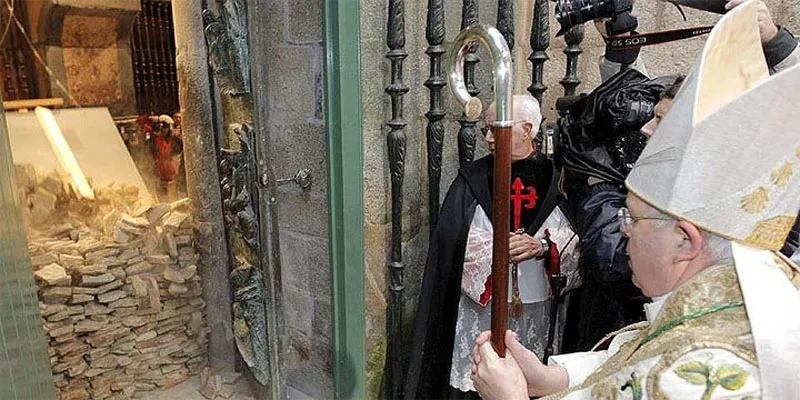
The exterior opening is framed by sculptural figures reused from the Cathedral’s medieval choir and leads through a passage toward the ambulatory. Its ceremonial opening gives physical form to a change in the religious calendar; at the end of the observance, it is closed again. It is therefore better understood as a ritual threshold than as a permanently accessible architectural attraction.
The indulgence is not earned simply by walking a required distance, receiving the Compostela, or passing through the doorway. Those are related but distinct traditions. Catholic travelers seeking the applicable spiritual conditions should consult the Cathedral directly, especially because pastoral instructions may change.
Visitors of every belief are welcome to understand the tradition respectfully. A Holy Year also changes the practical atmosphere of Santiago. More pilgrims, parish groups, religious celebrations, and cultural events can bring extraordinary energy as well as increased demand for accommodations and services.
That energy extends into special liturgies, concerts, exhibitions, institutional pilgrimages, and public programs. It can also mean fuller streets, longer lines, altered access, and greater pressure on transportation and lodging. Travelers who prefer a quieter arrival may choose another year; those drawn to collective celebration may find the additional planning worthwhile.
When will the Holy Door open for the 2027 Holy Year?
The Cathedral has announced that the Holy Door will open solemnly at 5:00 p.m. on December 31, 2026, beginning the 2027 Compostela Holy Year. It will then remain open during the Holy Year, subject to the Cathedral’s worship schedule, security arrangements and any temporary access restrictions. The Holy Year normally concludes, and the door closes again, at the end of December 2027; the Cathedral will publish the precise closing ceremony arrangements nearer the time.
The next five ordinary Jacobean Holy Years are 2027, 2032, 2038, 2049, and 2055. Travelers considering the 2027 Holy Year should plan well in advance. It will bring an exceptional atmosphere to Santiago, but also greater demand for accommodations, transportation and services.
What travelers should expect during a Holy Year
Access arrangements, security, hours, and liturgical use can change. The door may not be available at every moment simply because a Holy Year is underway. Consult the Cathedral’s official information close to travel and follow staff instructions on arrival.
The Holy Door gives visible form to a religious calendar larger than any one pilgrimage. For those who pass through it in a Holy Year, arrival in Santiago becomes part of a tradition of worship and renewal that returns across generations.
What is the Botafumeiro?
The Botafumeiro is Santiago Cathedral’s great thurible: a vessel in which incense is burned during particular liturgical celebrations. Its name is Galician and can be understood as “that which gives off smoke.” Suspended beneath the Cathedral’s central dome, it swings across the transept on a long rope operated by eight attendants known as tiraboleiros.
The brass Botafumeiro normally used today weighs approximately 53 kilograms, measures about 1.5 meters in height and hangs some 20 meters above the crossing. When set in motion, it can reach approximately 68 kilometers per hour. The scale, sound and movement make the ceremony unforgettable, but its purpose remains religious. Like a smaller thurible used at an altar, it carries incense whose rising smoke symbolizes prayer ascending toward God.
It is often said that the Botafumeiro was invented simply to disguise the smell of medieval pilgrims sleeping inside the Cathedral. That explanation is repeated widely, but it should not replace the documented liturgical meaning given by the Cathedral. Incense already had a long-established place in Christian worship, and the great thurible belongs first to that tradition.
When did the Botafumeiro begin to be used?
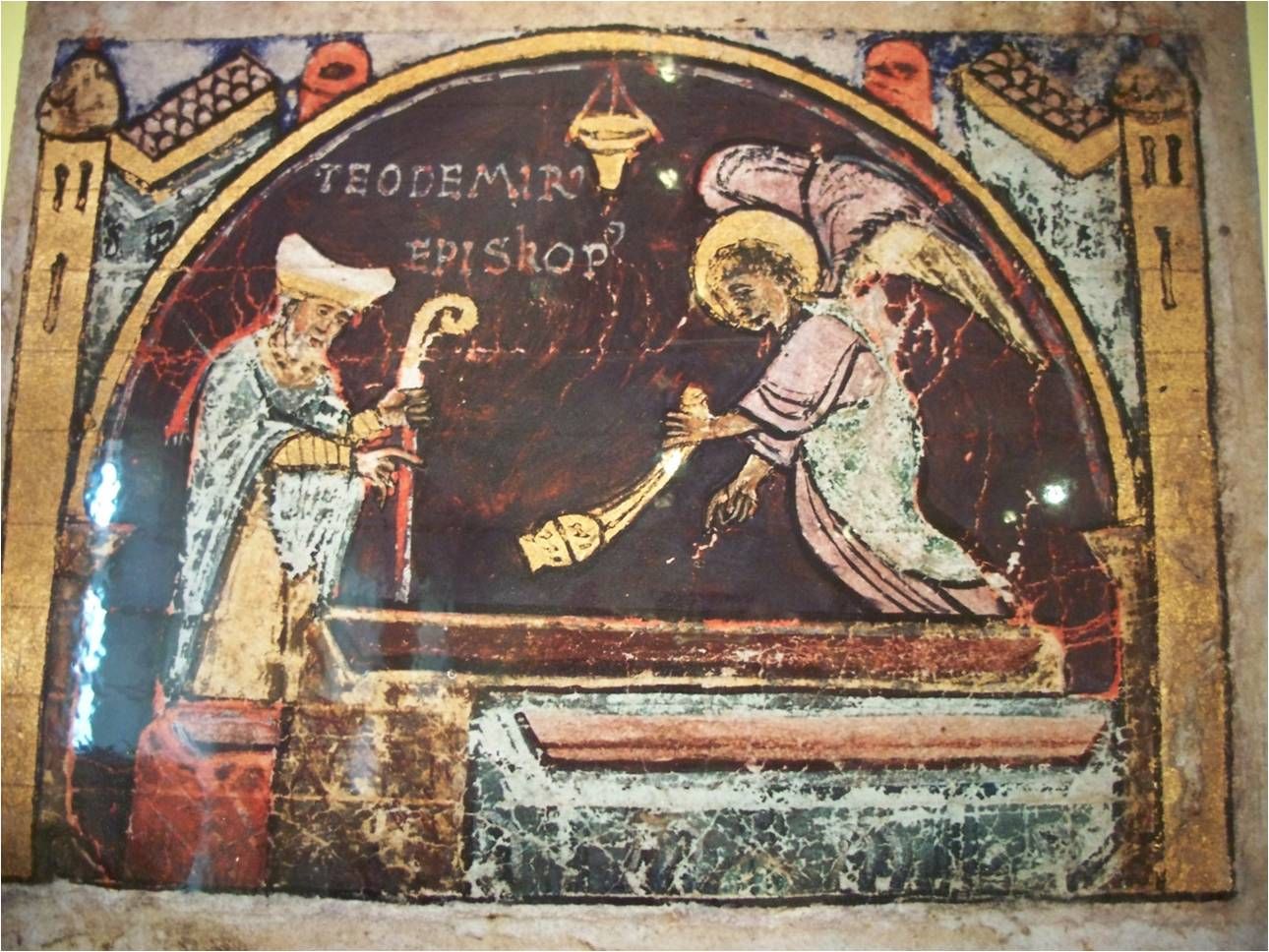
The precise date of the Botafumeiro’s first use is not known. The Cathedral identifies the earliest documentary reference as an annotation on a leaf of the Codex Calixtinus, where a great thurible is called the Turibulum Magnum. The manuscript is associated with the 12th-century world of pilgrimage to Compostela, although the annotation itself does not allow us to assign a simple invention date.
Several great thuribles have existed during the Cathedral’s history. An important silver example was taken during the French occupation in the early 19th century. The brass Botafumeiro used normally today was made by the Santiago silversmith José Losada in 1851. A second example, made in silver as a replica of it, was presented to the Apostle in 1971. When not in use, the Botafumeiro is kept in the Cathedral’s Chapter Library rather than hanging permanently in the transept.
The mechanism above the crossing is itself an important piece of Cathedral heritage. It uses ropes, drums and pulleys to transform the coordinated effort of the tiraboleiros into the Botafumeiro’s broad arc. The mechanism underwent a major conservation project in 2024, when damaged and altered elements were repaired and its structure was stabilized.
When does the Botafumeiro swing?
The Botafumeiro does not operate at every Pilgrim Mass or every Sunday. The Cathedral uses it during specified solemnities, normally during the entrance procession or at the end of the Eucharist. The published calendar includes celebrations such as Epiphany, Easter Sunday, the Ascension, Pentecost, the feast of Saint James on July 25, the Assumption, All Saints, Christ the King, the Immaculate Conception, Christmas and the Translation of the Apostle on December 30. Some of these dates move with the liturgical calendar.
It may also be used for a pilgrimage that has formally requested it through the Cathedral. This should not be interpreted as a guaranteed tourist performance: it remains part of worship, and access, timing and operation are controlled by the Cathedral.
Where to find the Holy Door
The door is on the Cathedral’s eastern side, facing the broad stone expanse of Quintana. Look at the sculpted figures around the portal: several came from Master Mateo’s medieval stone choir and were given a new setting centuries later. The threshold gathers reused medieval sculpture, later architecture, and a living ceremony.
Most importantly, notice the difference between seeing a door and participating in a religious observance. For a Catholic pilgrim it may frame prayer and reconciliation; for another visitor it may reveal how Santiago organizes sacred time. The doorway makes that cycle tangible: closed, opened, crossed, and closed again until another generation returns.
The wider context becomes clearer in Saint James: history, tradition, and legend. For practical orientation around Quintana, Obradoiro, current Mass information and the Cathedral’s surrounding squares, continue with Arriving in Santiago.