Thousands of fortified settlements known as castros survive across northwestern Iberia. Most occupy elevated ground and contain stone houses, lanes, walls and working spaces. They belong mainly to the Iron Age and Roman period, although dates and patterns differ from site to site.
The inhabitants were not one uniform “Celtic people.” Classical writers named several communities in the northwest. Archaeology reveals local variation, Atlantic exchange and gradual contact with Rome rather than a single culture frozen outside history.
Santa Trega above the Miño
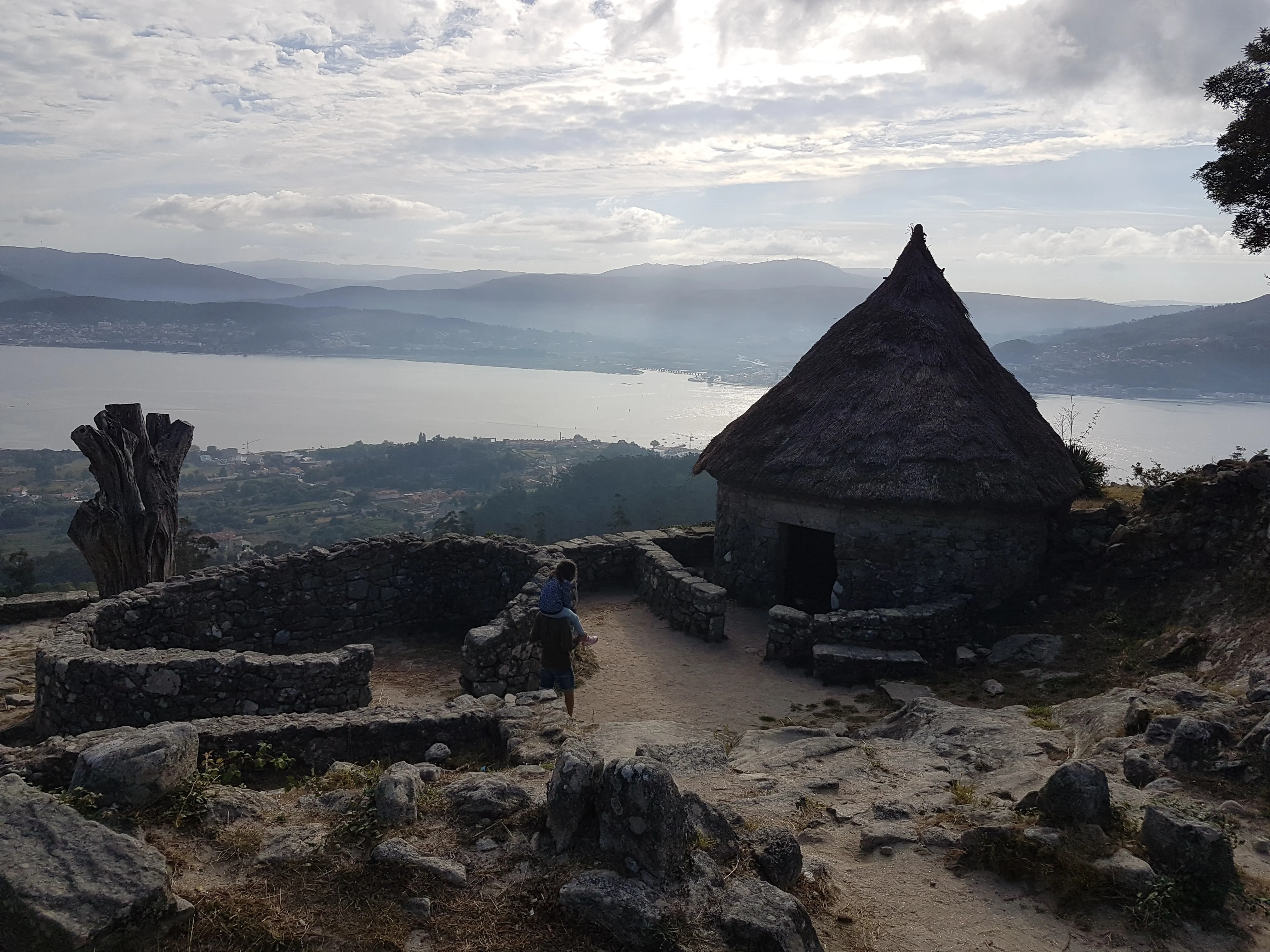
The settlement on Monte Santa Trega, above A Guarda, commands the mouth of the River Miño and the Atlantic coast. Its position allowed residents to observe maritime and river traffic. Thousands of people may have lived across the mountain at the site’s height, although only selected areas have been excavated and reconstructed.
Stone houses were often circular or oval, with rectangular buildings also present. Streets, courtyards, storage and workshop areas show a planned settlement rather than scattered huts. Finds include local pottery, metal objects, glass and imported Roman goods. The community participated in trade well before formal Roman control and continued changing after conquest.
Two reconstructed houses help visitors read the foundations, but their roofs and interiors remain modern interpretations. The archaeological museum near the summit displays finds that make the settlement’s chronology much clearer.
Baroña at the ocean’s edge
The Castro de Baroña, near Porto do Son, occupies a rocky peninsula joined to the mainland by a narrow neck. Defensive ditches and walls protect the landward approach. Inside, groups of circular and oval buildings fit the contours of the rock.
Occupation is generally placed between approximately the fourth century BCE and first century CE. Farming and livestock remained important, while shellfish and fishing exploited the immediate coast. Its dramatic position should not disguise ordinary work: food preparation, repair, craft production and storage filled daily life.
Baroña’s exposed paths become slippery in rain and strong wind. The walls are archaeological structures, not seats or climbing frames. Remaining on established paths helps protect deposits that have not been excavated.
Santa Trega stands close to our Portuguese routes from Baiona and Tui. We can add a guided visit before your Portuguese Camino or arrange a separate coastal day to Baroña from Santiago.