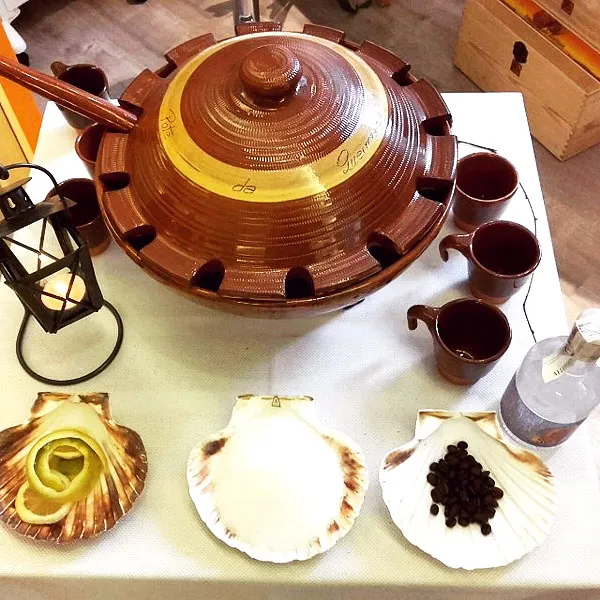
A bowl of orujo, sugar, and citrus peel is set alight. Blue flames run across the surface while the person holding the ladle recites a theatrical catalogue of owls, witches, demons, storms, and spirits. This is the queimada, one of Galicia’s most recognizable shared rituals.
Claims of Celtic antiquity are common, but the famous spoken text has a named author and a documented starting point in Vigo.
What goes into a queimada?
The base is Galician grape-marc spirit, usually called aguardiente de orujo, with sugar. Lemon or orange peel and coffee beans are common additions, although recipes vary. The ingredients are combined in a wide earthenware bowl, then part of the spirit and sugar is ignited in a ladle and introduced to the bowl.
As the mixture burns, the ladle is raised and the flaming liquid is poured back in. The sugar begins to caramelize and the citrus oils perfume the drink. Burn time changes the temperature, sweetness and remaining alcohol.
Who wrote the conxuro?
Mariano Marcos Abalo, a Vigo-born artist, wrote and recited the first version of the conxuro in 1967. It was created for a floral-games gathering held aboard a confiscated vessel moored in Vigo’s port. Marcos Abalo later expanded the text: references to Satan and Beelzebub were among the additions made in 1974, when he performed it at Vigo’s Fausto nightclub.
Copies circulated at gatherings and the author’s name was often lost as the text was recopied. That is why many people came to believe it was anonymous and much older. Marcos Abalo registered the work as intellectual property in 2001, establishing the authorship of the text that had already become famous.
The wider custom of preparing flaming aguardiente communally appears to have developed during the twentieth century. Accounts place group queimadas at celebrations and after meals in the 1950s, while the familiar purpose-made clay bowl is associated with the potter Tito Freire around 1955. None of this makes the ritual less Galician. It shows how quickly a compelling modern creation can become a tradition shared across generations.
What does the conxuro actually say?
The invocation begins:
“Mouchos, coruxas, sapos e bruxas. Demos, trasnos e diaños…”
In English: “Owls, barn owls, toads and witches; demons, goblins and devils…”
You can read the complete conxuro here. In short, this is what it means in English:
- The opening summons the creatures of the Galician night and imagination: owls, toads, witches, demons, goblins, spirits of the mist, ravens, salamanders, and healers’ charms.
- It names dangers that the ritual is meant to confront: the evil eye, black spells, corruption, thunder, lightning and other hostile forces.
- The language then becomes deliberately grotesque and comic, piling up alarming animals, bodies, and supernatural figures. Satan and Beelzebub belong to the expanded 1974 version.
- The speaker raises the flaming ladle. The fire is presented as a purifying force, while the unwanted beings are driven away and the spirits of absent friends are called into the circle.
- The final movement invokes earth, air, sea, and fire and asks that those who drink together be freed from harmful enchantment.
It is therefore not a solemn prayer translated from an ancient source. It is a twentieth-century literary performance: rhythmic, funny, macabre, and designed to become more vivid as the flames rise.
Why does it feel older than it is?
Marcos Abalo drew on imagery that was already familiar in Galician oral culture: meigas, the night, the evil eye, healing women, storms, animals, and the ambiguous boundary between joke and belief. The earthenware, darkness, fire, and communal circle reinforce that impression.
The often-repeated description of queimada as an intact Celtic rite is historically implausible. Distilled grape spirit arrived many centuries after Iron Age Galicia, and the wording of the conxuro has a known modern origin. The meaningful connection is cultural rather than archaeological: its author used recognizable Galician motifs so effectively that people adopted the work as their own.
How is the ritual performed?
The conxuro is normally recited after the liquid has been ignited. The room is darkened enough for the blue flame to be visible, and the preparer stirs or lifts the mixture with a long ladle. Some performers time the text so that the most dramatic passages coincide with a cascade of fire returning to the bowl.
Once the flame is fully extinguished, the warm drink is served in small ceramic cups. Watching is participation too; nobody needs to drink alcohol to be part of the gathering.
The best queimadas are shared after dinner, when the lights can be lowered and everyone gathers around the blue flame. The recitation begins quietly, then gathers force as the ladle rises and the burning spirit falls back into the bowl. By the final lines, the room has become part theatre, part celebration and unmistakably Galician.
Marcos Abalo gave Galicia a ritual people immediately wanted to repeat. Within a few decades, his words had travelled from a boat in Vigo harbour to restaurants, family gatherings and celebrations around the world. Knowing his name makes the tradition richer: the conxuro is a modern Galician creation that became folklore within its author’s lifetime.