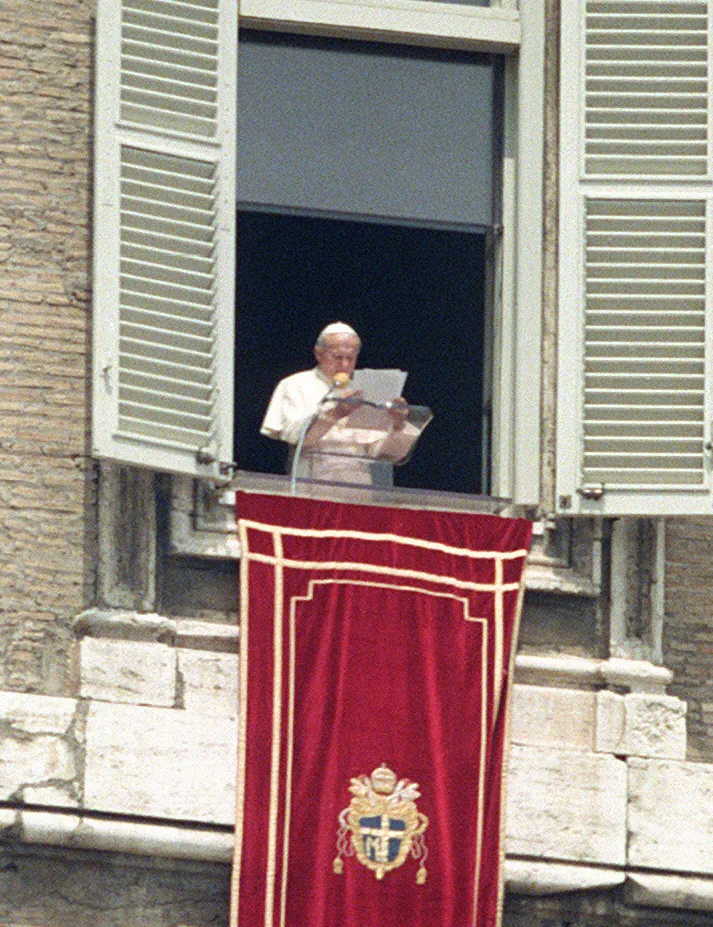
On 9 November 1982, Pope John Paul II stood in Santiago Cathedral at the end of a ten-day visit to Spain and addressed Europe. The speech became known as the European Act.
Its most quoted appeal asked Europe to find itself again and recover its roots. The line survives because it was delivered at a place where European geography can be seen in human movement: roads from different kingdoms and countries meeting at the tomb of Saint James.
Why Santiago was the setting
John Paul II described the Camino as one of the strong elements that helped form the spiritual and cultural unity of Europe. He referred to the routes as channels of communication through which ideas, artistic forms and ways of life travelled.
That claim can be tested along the road. Romanesque churches, monastic networks, hospitals, bridges and urban privileges appear across regions that once belonged to different political worlds. Pilgrims moved between them long before modern European institutions existed.
The Pope did not present Europe as culturally uniform. His address recognised different peoples and traditions while arguing that they shared a history shaped in large part by Christianity.
What was happening in Europe in 1982?
The Cold War still divided the continent. Spain had recently completed its democratic transition and would join the European Communities in 1986. John Paul II was Polish and spoke with the experience of a Europe split between East and West.
From Santiago, at the western edge of the continent, he addressed both sides. His argument joined memory to a political question: what kind of unity could Europe pursue without erasing its peoples or reducing itself to economics?
Why is the speech still quoted?
The address gave religious language to a discussion that has never disappeared. European institutions, Church leaders and Camino organisations continue to cite it when describing the route as a meeting place across borders.
It also helped shape modern public understanding of the Camino during the years before the large revival in pilgrim numbers. John Paul II returned to Santiago in 1989 for World Youth Day, when the image of young people converging on Compostela reached an international audience.
The full address is available through the Holy See source above. Reading it in full is useful because the familiar quotation forms only a small part of a longer argument about history, culture, faith and responsibility.
To follow the story into 1989, continue with World Youth Day at Monte do Gozo. Our Camino collection lets you experience the same routes as living landscapes rather than an abstract European symbol.