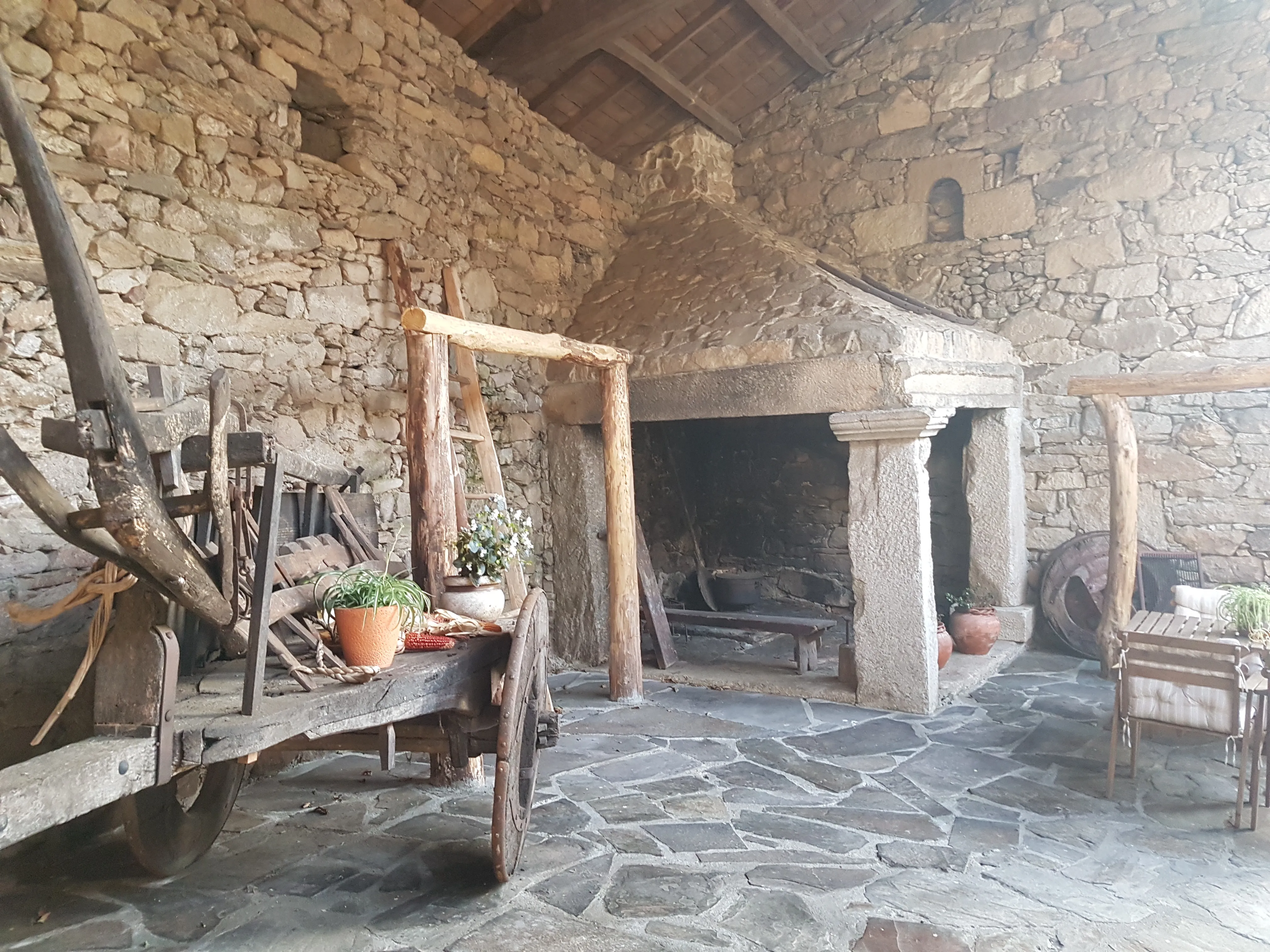
The lareira was the open hearth of a traditional Galician house. It supplied heat, hot water and the fire used for daily cooking. People gathered around it to eat, mend tools, shell maize, tell stories and complete winter work after daylight had gone.
The word can refer to the hearthstone itself and, by extension, the kitchen space organized around it. Pots hung over the fire from an iron chain. Embers heated griddles and supported three-legged pots. Meat and sausages could be cured in the smoke above, while damp clothes and footwear dried nearby.
A house organized around the fire
In many rural houses, the kitchen was the warmest and most frequently occupied room. Benches, storage, the bread oven and work surfaces were arranged in relation to the hearth. Sleeping rooms could remain cold. Thick granite walls stored some heat but also held moisture, and small windows reduced heat loss.
Early open fires did not always have a modern chimney. Smoke escaped through roof material, openings or a hood added above the hearth. Soot blackened rafters and helped preserve timber and food, but smoke also made interiors uncomfortable and unhealthy. Chimneys, enclosed stoves and separate kitchens gradually changed the arrangement.
There was no single Galician house plan. Coastal farmhouses, mountain dwellings and pazos responded to different materials, wealth and climate. The lareira remained a recognizable centre even when the surrounding architecture varied.
Pallozas and the heat of animals
The round or oval houses often described in this context are pallozas, especially associated with Os Ancares and O Cebreiro. Their thick stone walls have few windows, and their high roofs were traditionally covered with rye straw.
People and livestock occupied divided parts of the same building. The animals were not invariably housed on a complete lower floor with the family directly above. Plans varied with the slope and the household. Often both shared one enclosed volume at slightly different levels or in separated zones. The animals’ body heat, together with the lareira, raised the temperature inside.
The thatched roof shed rain and snow while allowing some hearth smoke to filter through. This was a practical response to severe mountain winters, built from stone, timber and rye available nearby.
Pilgrims can enter preserved pallozas at O Cebreiro and visit museum examples in Os Ancares. Treat them as homes shaped by demanding agricultural life rather than as romantic cabins. Our full French Way and selected private itineraries can include time to examine O Cebreiro beyond the main viewpoint.