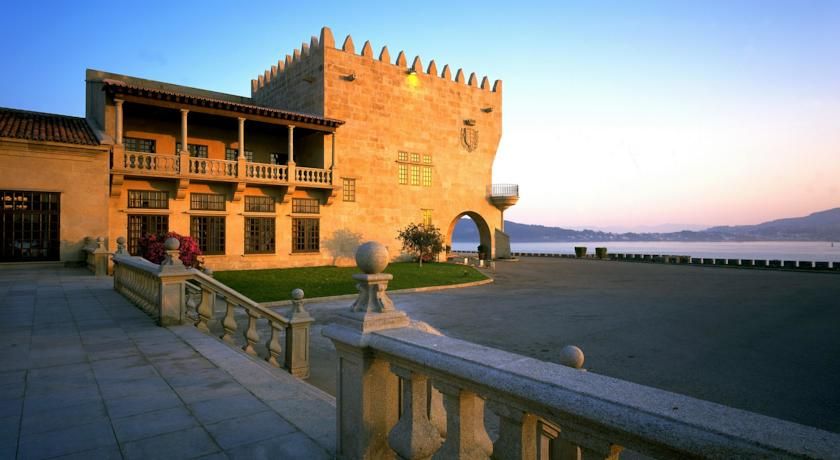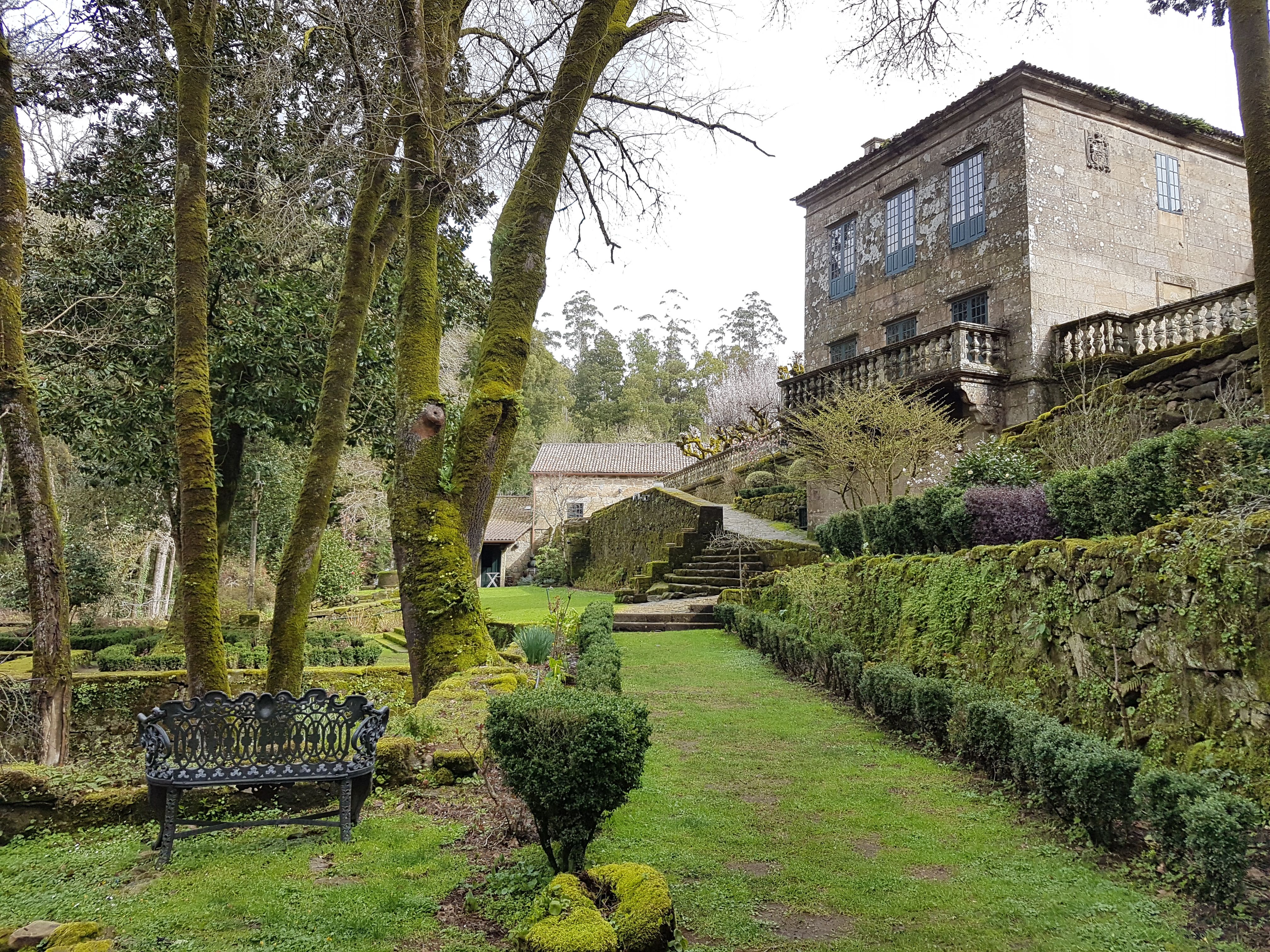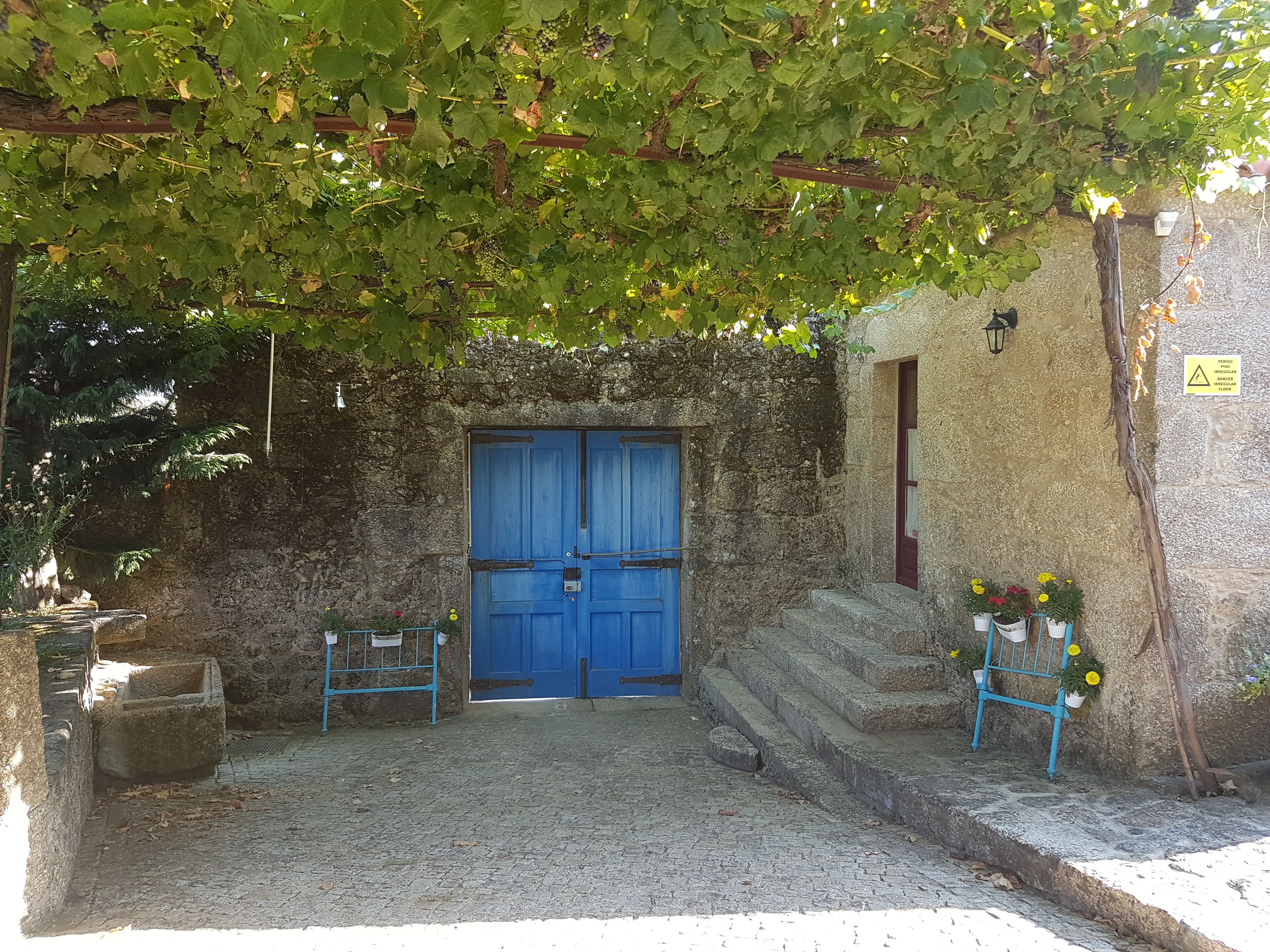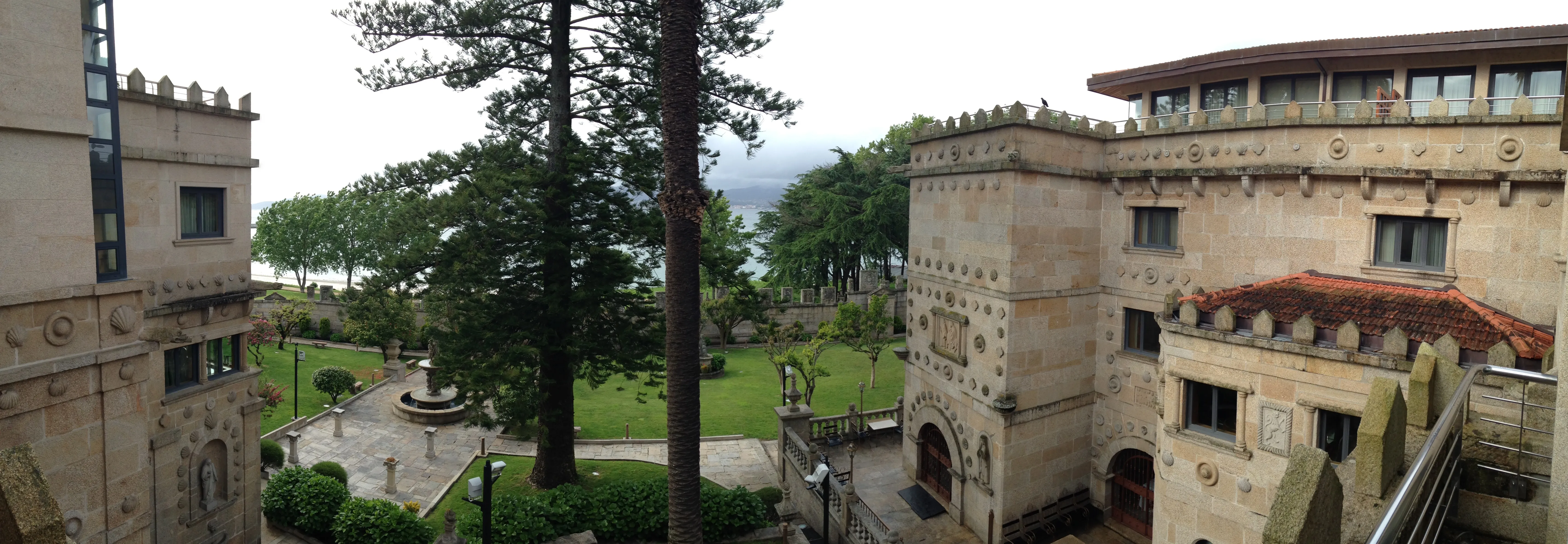
The word pazo comes from the same Latin root as palace, but in Galicia it describes a particular kind of country house. Pazos were the rural seats of noble families and prosperous landowning lineages. They were homes, working estates and visible statements of local authority, usually built or substantially enlarged between the sixteenth and nineteenth centuries.
Their granite façades often display large coats of arms recording the families joined through marriage and inheritance. A chapel allowed the household to hear Mass on the estate. Stone dovecotes, hórreos, wine cellars, mills, presses, stables and farm buildings reveal the land and labour that supported the residence. Some houses grew around an older medieval tower; others were created as increasingly comfortable country retreats within walls, fields and woodland.
The gardens were ornamental and productive at the same time. Formal terraces and clipped box framed the approach to the house, while orchards, vineyards and kitchen gardens supplied it. Springs and rivers fed fountains, ponds, mills and irrigation channels. During the eighteenth and nineteenth centuries, owners added imported plants obtained through Atlantic trade, including camellias, magnolias and later eucalyptus. Galicia’s mild, wet climate allowed many of them to reach an exceptional size.
This relationship between stone, water and planting makes the great pazo gardens distinctive. They do not follow one pure French, Italian or English model. Geometric walks can lead into woodland; a formal pond can sit beside an orchard; an exotic specimen tree can rise above a working vineyard. Winter and early spring are especially beautiful, when mature camellias flower against granite walls.
Famous Galician pazos and gardens
Pazo de Oca, near A Estrada, is the best-known expression of the Galician Baroque country estate. The house, chapel, fountains and two long ponds form a theatrical composition of granite and water. Stone boats sit in the ponds, clipped box defines the formal areas and old camellias rise to tree height. Productive ground, woodland and later Romantic planting remain part of the design, which is why Oca feels like a Galician estate rather than a palace garden transplanted from elsewhere.
At Pazo de Santa Cruz de Ribadulla, near Santiago, camellia walks run into a wooded landscape of fountains, waterfalls and monumental trees. More than 200 camellia varieties flower across the estate, while the long Carreira das Oliveiras creates one of its most memorable approaches. The garden rewards time: formal spaces close to the house gradually give way to paths where water and vegetation shape the experience.
Pazo de Rubianes, near Vilagarcía de Arousa, combines a historic residence with an Albariño-producing estate. Its garden contains thousands of camellias, monumental magnolias and great nineteenth-century specimen trees. The vines and botanical collections belong to the same property, so a visit can connect Galicia’s garden history with the wine landscape of O Salnés.
Pazo do Faramello, between Padrón and Santiago, descends through stone terraces beside the river and the remains of its eighteenth-century paper factory. Its garden follows the slope and watercourses closely, bringing together a lived family house, industrial history and the final approach of the Portuguese Way. Near Santiago itself, San Lourenzo de Trasouto is celebrated for its historic garden and extraordinary centuries-old box hedge.
These estates explain the architectural and gardening tradition behind the word pazo. Their gardens can be added to a private itinerary when visiting arrangements fit the route. The four overnight properties used on our Premium journeys follow below.
Four country stays on our Premium Portuguese Way tours
The four properties we use illustrate how that tradition continued into modern Galician hospitality. Pazo de Lestrove is a genuine former archiepiscopal residence. A Quinta da Auga began as a paper factory, Torre do Río as a textile and milling complex, and Quinta de San Amaro grew from restored village houses. Together they offer gardens, history, food and quiet settings that a standard town hotel cannot reproduce.
A Quinta da Auga, Santiago
On the bank of the River Sar, A Quinta da Auga began as a paper factory around the end of the eighteenth century. Water powered its machinery. The complex later produced textiles, operated as a sawmill and was used for beer and ice production.
Architect and owner Luisa García Gil led a six-year restoration of the ruined industrial buildings with her husband. The surviving stone, waterways and volumes were retained while the site became a hotel, restaurant and spa. Today it belongs to Relais & Châteaux and describes itself as Spain’s first eco-hotel, with geothermal energy, cogeneration and a kitchen connected to local producers.
Its position outside Santiago’s historic centre makes it particularly suitable for a restorative extra night, a spa stay or a Premium finish focused on gardens, food and quiet.
Torre do Río, Caldas de Reis
Torre do Río is an eighteenth-century textile complex beside a meander of the River Umia, just outside the thermal town of Caldas de Reis. Water is still the defining element: the estate has gardens, a waterfall and a natural pool, while the old stone buildings contain only a small number of rooms.
The hotel sits outside the official arrows and requires a short transfer. In return, guests have the peace of the riverside estate after the Pontevedra-to-Caldas stage.
Quinta de San Amaro, Meaño
Quinta de San Amaro grew from a collection of old village houses in Meaño. Nacho Crespo and Julio Oubiña restored buildings more than a century old, with some walls possibly exceeding two centuries. Work began in 2005, and the hotel project opened in 2007.
Its significance lies in the Salnés landscape: vineyards, village architecture, a strong restaurant and access to Cambados and the Albariño-producing countryside. It fits a Portuguese Spiritual journey through a planned transfer, especially when wine and gastronomy are part of the proposal.
Pazo de Lestrove, near Padrón
Pazo de Lestrove is the true episcopal property in this group. The Archbishopric of Santiago constructed the house in the sixteenth century, and eighteenth-century alterations gave it its present Baroque character. It served as a country retreat for Compostela’s archbishops.
The U-shaped building has a chapel dedicated to the Guardian Angel and a monumental fountain crowned by Saint James dressed as a pilgrim. The wider estate once included the practical buildings expected of a great rural house: stables, a press, dovecote and hórreo. A major restoration completed in 2005 adapted the complex for hotel use.
Lestrove lies beyond Padrón on the approach to Santiago. In our Portuguese Way Signature, it can create a gracious final country night before the walk into Compostela.
How these hotels enter a Premium itinerary
We match the properties to the walking stages, dates and room requirements, then arrange the private transfers needed to reach them. That allows a traveler to complete the intended walk and spend the evening beside a river, among vineyards or within a historic estate instead of being limited to accommodation directly beside the arrows.
Explore our Portuguese Way Signature and Portuguese Spiritual Signature journeys, or tell us which gardens and properties you would like us to consider through Start Planning.