The Camino Primitivo links Oviedo with Santiago through the mountains of Asturias and the interior of Galicia. Its modern name means the Original Way. It recalls the journey traditionally made by Alfonso II of Asturias after news reached his court that a tomb attributed to Saint James had been found in Galicia.
It is the most physically demanding of the principal historic routes in northern Spain. The reward is a landscape of high ridges, isolated chapels, cattle country and small towns that still feels closely tied to the first Asturian kingdom. The route covers roughly 320 km before joining the French Way at Melide.
Alfonso II and the first pilgrimage
The discovery is placed in the first third of the ninth century. Alfonso II travelled from Oviedo to confirm the finding, ordered the first church at the site and supported the community serving the new shrine. The exact line of every medieval footstep cannot be reconstructed, but his journey gives this route an unusually specific royal beginning.
His successor Alfonso III traveled the route twice and took part in the consecration of Santiago’s second basilica in 899. The Camino Primitivo was important in the ninth and tenth centuries. As Christian kingdoms expanded south and the safer, flatter corridor through León gained royal and monastic support, the French Way became the dominant international route.
Oviedo itself mattered enormously. The Asturian kings created churches and a sacred treasury in their capital. Pilgrims came to venerate the Sudarium and other relics in the Cámara Santa, giving rise to the saying that a visitor who went to Santiago without visiting San Salvador honored the servant while neglecting the Lord.
Roman roads beneath parts of the route
The route reuses sections of older communication corridors, including Roman roads. Rome had already connected administrative centres, mines and military territory across the northwest. That inheritance is clearest in and around Lugo, whose complete Roman wall still encloses the historic centre.
Calling the whole Primitivo a Roman road would go too far. Mountain tracks shifted, river crossings changed and medieval churches and hospitals drew pilgrims toward new stopping places.
Oviedo, Grandas de Salime and Lugo
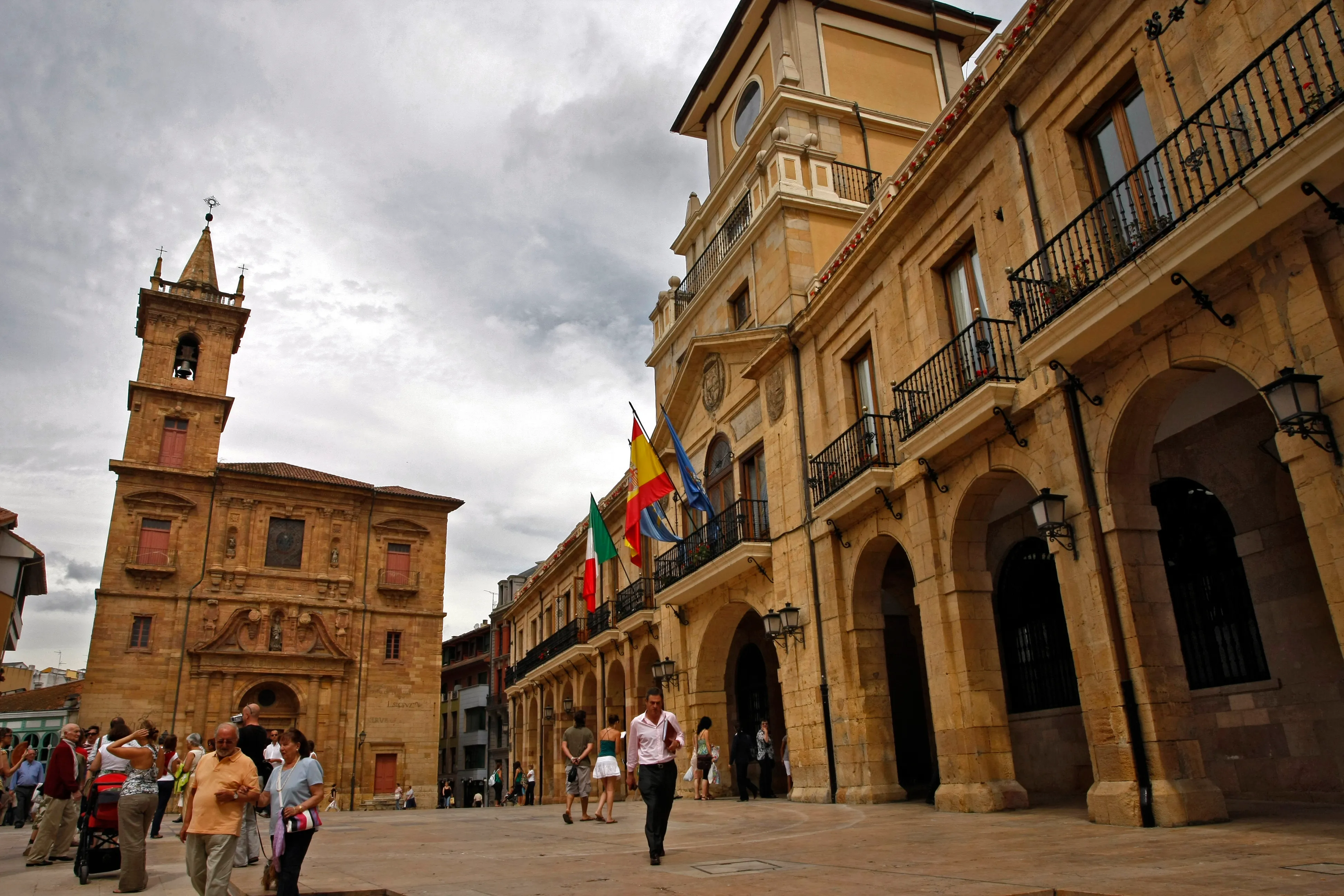
Departure from Oviedo passes the cathedral and climbs quickly into green Asturian countryside. Grado developed as a market town; Salas retains its medieval tower and collegiate church. Beyond Tineo, the route becomes more remote as it approaches the great decision at Borres.
The Hospitales route crosses high, exposed ground named for former pilgrim hospitals. On a clear day, the views extend across layered mountains to the distant sea. In fog, wind or storms it can be disorienting and dangerous, with little shelter or water. The lower route through Pola de Allande is longer but passes through inhabited valleys and gives access to more services. This choice is one reason the Primitivo demands realistic planning.
Both alternatives meet before the climb to Puerto del Palo. The Camino then descends toward Grandas de Salime, first crossing the immense reservoir that flooded the old valley in the twentieth century. The town’s ethnographic museum preserves tools, workshops and domestic spaces from rural western Asturias, making it one of the route’s most revealing cultural visits.
At O Acebo, walkers enter Galicia. The route reaches A Fonsagrada, a mountain town whose name recalls a sacred spring, then crosses quiet upland country through O Cádavo before descending toward Lugo.
Lugo brings together the Roman and Christian histories of the route. Its complete third-century Roman wall runs for more than 2 km and can be walked as an elevated circuit above the old city. Inside are the cathedral, lively food streets and traces of the Roman baths and forum. The cathedral holds the privilege of continuous exposition of the Blessed Sacrament, represented on Galicia’s coat of arms.
West of Lugo, the route becomes gentler through farms and woodland. At Melide, Primitivo walkers merge with the French Way. The sudden increase in pilgrims, cafés and luggage vans can be startling after the quiet mountains, but it also brings the social energy of the final two days to Santiago.
The route for strong walkers
The Primitivo contains steep climbs, rough descents and longer gaps between services. Rain can make stone and mud difficult, while high summer offers little shade on exposed ridges. A traveler who enjoys mountain walking will find it exhilarating; someone choosing it only because “original” sounds more authentic may have a hard week.
Shorter stages and carefully selected stopping points make a considerable difference. The best itinerary also protects time for Oviedo, Grandas de Salime and Lugo instead of using every available hour to cover distance.
How it compares
Its rewards are expansive landscapes, Roman Lugo, Asturian food and a close connection with the earliest royal history of the pilgrimage. Fabada, local cheeses, cider and substantial mountain cooking give way to Galician octopus and inland fare as the route moves west.
Ultreya Tours does not currently organize tours on the Camino Primitivo. If this is the route you want to follow, contact us through the planning questionnaire and we will explore whether a tailor-made itinerary is possible for your dates and requirements.