The Ribeira Sacra lies inland around the final valleys of the Sil and Miño. Vineyards descend in narrow terraces, Romanesque churches appear in wooded country and monasteries occupy sites chosen for seclusion. It is one of Galicia’s strongest day trips, provided the itinerary respects the distances between places.
How far is the Sil Canyon?
The Ponte do Sil jetty, below the Amandi vineyards near Doade, is a useful reference point for the heart of the Sil Canyon. It is approximately 135 kilometres from Santiago, normally close to two hours by road; 60 kilometres from Portomarín, about 1 hour 15 minutes; and 59 kilometres from Ourense, about one hour. From central Monforte de Lemos, the jetty is another 18 kilometres or 25 minutes along the LU-903.
These are one-way driving estimates. A visit from Santiago therefore means around four hours in the vehicle before adding the local journeys between the jetty, winery, lunch and monastery. From Portomarín, Ribeira Sacra works well as a rest-day excursion or as a private transfer that returns to the Camino. Ourense is the closest of the three bases and leaves more of the day for a monastery or a second viewpoint.
A coherent day usually concentrates on one part of the Sil valley. The exact route depends on the winery appointment, cruise departure, restaurant and road conditions.
The Sil Canyon
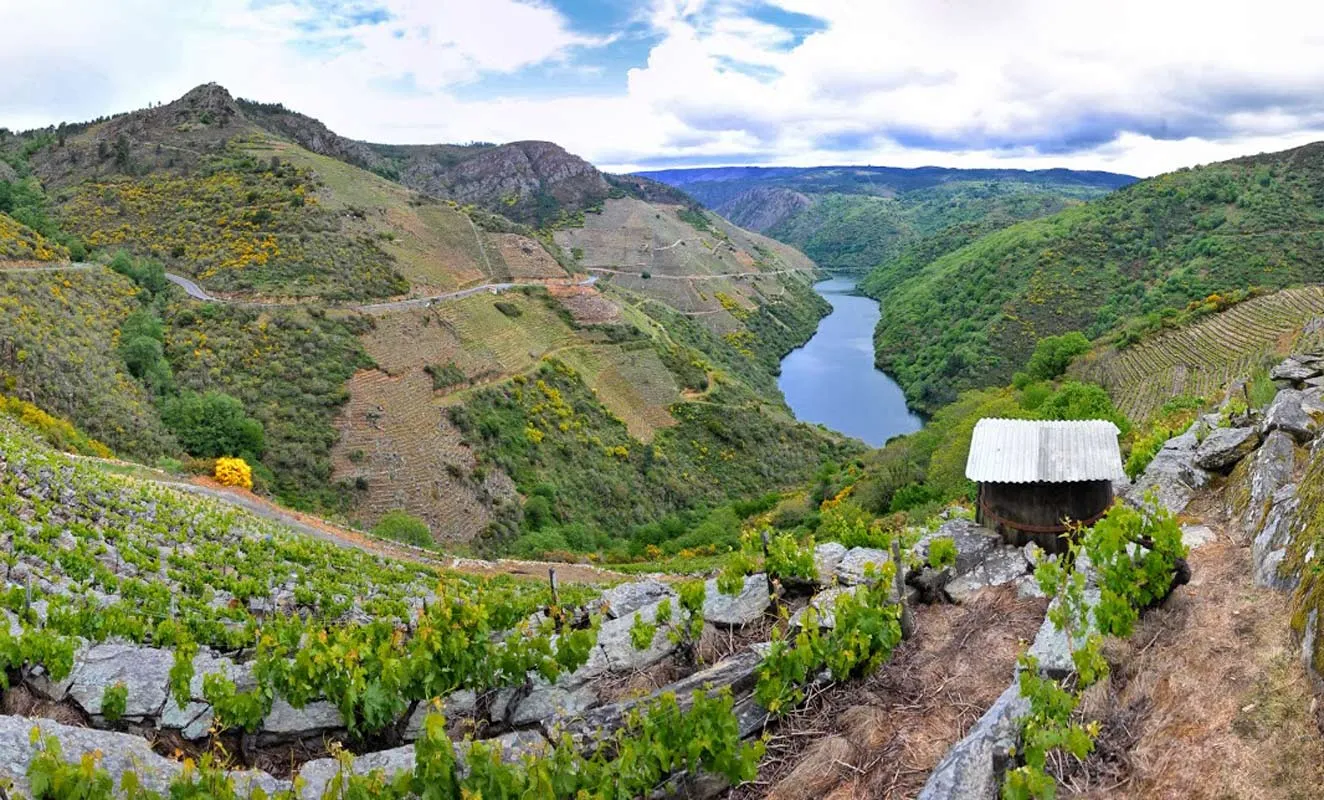
The Sil runs through roughly 25 kilometres of canyon before joining the Miño at Os Peares. Viewpoints look down from the rim, while cruises reveal how sharply the vineyard slopes rise from the water.
The public Sil Canyon cruise from Ponte do Sil takes approximately two hours and travels beneath the Amandi slopes toward Santa Cristina de Ribas de Sil. Passengers are asked to arrive at least 30 minutes before departure. Cruise schedules are seasonal, parking at the jetty is limited and advance booking is essential during busy periods.
Heroic vineyards
Ribeira Sacra growers work steep plots that often permit little or no mechanization. Grapes and equipment may have to be carried along narrow terraces. The term heroic viticulture describes these demanding conditions rather than a particular grape variety.
Mencía is the principal red grape associated with the region, while Godello is increasingly visible among the whites. A winery visit explains the relationship between slope, orientation, river and individual subzones far better than a quick tasting without context.
Two of the most practical visits on the Sil side are close to Doade. Adega Algueira works in the Amandi subzone and offers winery visits, tastings and a restaurant; it also operates river trips from the Abeleda jetty on selected dates. Regina Viarum has a tasting terrace above the canyon and explains the work involved in farming its steep vineyards. Other visitable producers include Rectoral de Amandi, Adegas Petrón and Adega Vella. Visits are by reservation, and the available times and languages should be checked before fixing the rest of the day.
Monasteries and churches
Ribeira Sacra contains what regional tourism describes as the principal concentration of rural Romanesque architecture in Europe. Monastic communities settled around the Sil and Miño valleys from the early centuries of Christianity, and medieval monasteries later organized land, vineyards and agricultural production across the river slopes.
Santo Estevo de Ribas de Sil grew into a powerful Benedictine monastery. Its three cloisters show Romanesque, Gothic and Renaissance work, and the former monastic complex now houses a Parador. San Pedro de Rocas, founded in the early Middle Ages, has a church and tombs cut into the living rock; its former priory contains the Ribeira Sacra interpretation centre. Santa Cristina de Ribas de Sil occupies a chestnut forest above the canyon, with a Romanesque church, surviving monastic rooms and carved decoration that rewards a slower visit.
The smaller churches make the concentration easier to understand. San Miguel de Eiré, Santo Estevo de Atán, San Fiz de Cangas and San Paio de Diomondi preserve different examples of the region’s rural Romanesque. They are spread across the Miño and Sil country rather than grouped into one monument complex, which is why the regional Romanesque route is planned over several days.
On a day trip, one well-chosen monastery is normally more satisfying than rushing between several. San Pedro de Rocas is the natural choice when approaching from Ourense. Santo Estevo fits the western Sil, while Santa Cristina can be paired with the canyon viewpoints on the southern bank. A Doade winery and the Ponte do Sil cruise sit on the northern bank, so adding Santa Cristina involves a longer road circuit than its position across the water suggests.
Our private day from Santiago
Our private Ribeira Sacra Experience brings the landscape together in one generous day: private return transportation from Santiago, an English-speaking driver-guide, a winery visit and tasting, regional lunch and a cruise through the Sil Canyon. The value of the private route is coordination: the departure from Santiago, winery appointment, lunch and boat check-in are planned in the correct order, with somebody else handling the narrow local roads. Prices start from €700 for the day.
Add this private Ribeira Sacra day before or after the Camino when you want to combine a winery, regional lunch and Sil Canyon cruise without changing hotels or driving from Santiago yourself.
This format suits travelers who want the main components coordinated rather than driving unfamiliar rural roads between fixed reservations. It can also be added after a Camino or arranged from Santiago as an independent Experience.
For the wine history behind the scenery, continue with Roman vines and heroic winemaking in the Ribeira Sacra.