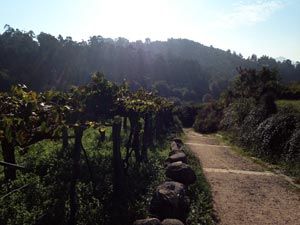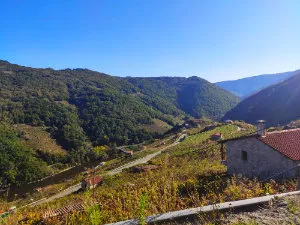
The Sil and Miño cut deep valleys through inland Galicia. Vineyards occupy narrow terraces above the water, with rows fitted into slopes that would be impossible to farm as a conventional field. Ribeira Sacra received its protected denomination in 1996, although its wine history is much older.
Roman settlement expanded viticulture in this part of Galicia. The dramatic terraces visible today developed over many later generations. From the early Middle Ages, monasteries and small religious communities created estates along the rivers, using their land and agricultural organization to keep vines in cultivation.
The name Ribeira Sacra, or sacred riverbank, reflects this dense monastic geography. Santo Estevo de Ribas de Sil, Santa Cristina and San Pedro de Rocas remain among its best-known monuments.
Why the work is called heroic
Some vineyards reach gradients close to 100 per cent: one metre of vertical rise for one metre measured horizontally. Access may be by steep footpath, narrow track or boat. Pruning, tying and picking are performed largely by hand. At harvest, boxes have to be moved to the road or river without damaging the grapes.
International wine organizations use heroic viticulture for places with exceptional slope, altitude, terraces or difficult island conditions. Only a small proportion of the world’s vineyards qualify. The expression describes working conditions. It does not guarantee quality in the bottle.
Terrace walls demand continual maintenance. Abandon one small plot and drainage problems can affect its neighbours. The price of the wine therefore supports labour, masonry and a cultural landscape as well as grapes.
What to drink
Mencía leads red production, with Brancellao, Merenzao, Sousón and other grapes appearing in blends. The best style depends on the site and winemaker: some are fragrant and light enough for a slight chill; others have the structure for roast meat and stews. Whites based on Godello can be brisk or broad and textured.
Look for the subzones on the label: Amandi, Chantada, Quiroga-Bibei, Ribeiras do Miño and Ribeiras do Sil. Comparing two subzones is more useful than expecting one uniform “Ribeira Sacra taste.”
Three strong winery visits
These are established producers with visitor programmes. Opening days, language and tasting formats change, and harvest can restrict access, so make an appointment before travelling.
Adega Algueira is at Doade s/n, 27424 Sober, Lugo. Its position in Amandi makes it a useful place to understand steep Sil terraces and compare Mencía from individual sites. The winery runs tastings and also has a restaurant; reserve both separately.
Regina Viarum is at Doade s/n, 27424 Sober, Lugo. Its terrace looks directly over the Sil canyon. Guided visits explain the winery and usually conclude with a tasting. English-language visits must be requested in advance through its enotourism department.
Abadía da Cova, Adegas Moure receives visitors at its vineyard estate in A Cova, 27548 O Saviñao, Lugo. This is the Miño side of the denomination, with a different landscape from Doade and Amandi. Confirm the meeting point when booking because the producer also has administrative premises in Escairón.
These names are recommendations for a useful visit, not a definitive ranking. Small estates such as Guímaro and specialist producers can be fascinating, but many are working cellars with limited public access.
Adding Ribeira Sacra to a Camino
Ribeira Sacra can be arranged as a private day from Ourense, an excellent addition to the Camino Sanabrés, with a winery, one of the historic monasteries and viewpoints over the Sil. From Portomarín, it works best on a rest day or as a planned private transfer rather than after a walking stage. From Santiago de Compostela, allow a full day.
The Sil and Miño sides cannot both be explored properly in a hurried visit. We choose the circuit around the travelers’ overnight location, winery availability and interest in wine, monasteries, river scenery or food. Ultreya Tours can arrange it through our private Ribeira Sacra experience or incorporate it into a custom Camino.