On a dark Galician road, the first warning may be a bell. Then comes the smell of hot wax, although no candle is visible. The air turns cold. Prayers sound somewhere ahead, low enough that the words cannot be understood.
This is the approach of the Santa Compaña, the Holy Company: a procession of the dead said to leave the churchyard at night and walk the lanes of the parish. It is one of Galicia’s most persistent legends, and one that belongs naturally to the Camino. Both the living and the dead move along old paths, pass stone crosses and seek the next church. The difference is that meeting the wrong procession could oblige a person to join it.
Who walks in the Santa Compaña?
There is no single authorized version. The stories changed from parish to parish and from one storyteller to the next. The company might consist of souls from Purgatory, the dead of the parish or the ancestors of a person about to die. They could wear white shrouds, carry lights or remain almost invisible. In some accounts they surround a coffin; in others, their purpose is to visit the house where a death will soon occur.
The most frightening member is alive.
Jesús Rodríguez López described the belief in his 1895 book Supersticiones de Galicia y preocupaciones vulgares. A living person leads the procession carrying a cross and a cauldron of holy water. The guide cannot look back. Night after night the same person is called out again, often with no clear memory the following morning. Neighbors may notice only that the unfortunate leader is becoming thinner, paler and more exhausted.
The burden ends when the guide dies or manages to hand the cross to somebody encountered on the road. The person who accepts it becomes the next leader. This detail turns the story into more than a ghost sighting: the danger is transferable. Curiosity can become an obligation.
What announces its arrival?
The procession is often sensed before it is seen. Stories mention a handbell, murmured prayers, footsteps, small lights and a sudden current of cold air. The smell of candle wax is especially common. Rodríguez López wrote that the souls’ lights could not be seen, yet the wax burning could be smelled clearly.
Dogs may howl or fall silent. A person with a particular sensitivity might see the company while companions see nothing. In another version, children who received the wrong oil during baptism retain the ability to perceive it as adults. Such differences are part of oral tradition rather than mistakes in it. A story survived because each community could place it on its own road and name somebody who had heard the bell.
The procession moves through the places where rural Galicia feels least certain at night: the edge of a wood, a sunken lane, the wall of a cemetery and, above all, a crossroads. The cruceiro standing there is both Christian monument and practical protection. It gives the frightened witness a cross to approach when the road itself offers several dangerous directions.
How were you supposed to escape?
The recommended response depends on who tells the story. One method is to draw a circle on the ground, step inside it and mark a cross or the Seal of Solomon. Another is to lie face down and refuse to look. Holding on to a stone cross, praying or keeping both hands occupied could prevent the leader from passing over the cross and cauldron.
The instructions are wonderfully specific because they make the supernatural feel manageable. A listener leaves the story knowing where not to stand, what signs to notice and what to do if the bell is already close. They also explain ordinary behavior. Do not wander the parish lanes at midnight. Treat crossroads, churches and the dead with respect. If someone calls from the darkness, think before answering.
Santa Compaña, Estadea and local names
Estadea is often used as another name for the procession, particularly in Ourense, but the words do not always mean exactly the same thing. In some accounts, the Estadea is the larger spectre at the head of the company. It may carry a cross or a scythe and resemble Death itself. Elsewhere, Estadea, Estantiga, Hoste and Compaña refer to variations of the same nocturnal company.
Related processions and wild hosts appear in Asturias, León, northern Portugal, Brittany and other parts of Europe. The Santa Compaña’s Galician character comes from the way the story settled into the parish landscape: church, cemetery, farmhouses, woodland and paths used by neighbors every day.
Those paths also belong to other beings. Meigas may heal, curse, advise or cause trouble, depending on the woman and the tale. Mouras guard springs, caves, hillforts and treasure, sometimes appearing as beautiful women and sometimes with serpentine qualities. The black dog known as the Urco comes from the sea or the underworld and announces misfortune. These figures do not form one tidy Galician mythology. They come from different places and periods, preserved in stories that absorbed Christian teaching, older fears and the personality of individual narrators.
The fiery queimada and its famous incantation draw playfully on this world of meigas, owls, ravens and harmful forces. The Santa Compaña is less playful. It speaks directly about death, remembrance and the uncomfortable possibility that the boundary between the parish and its cemetery is not closed at night.
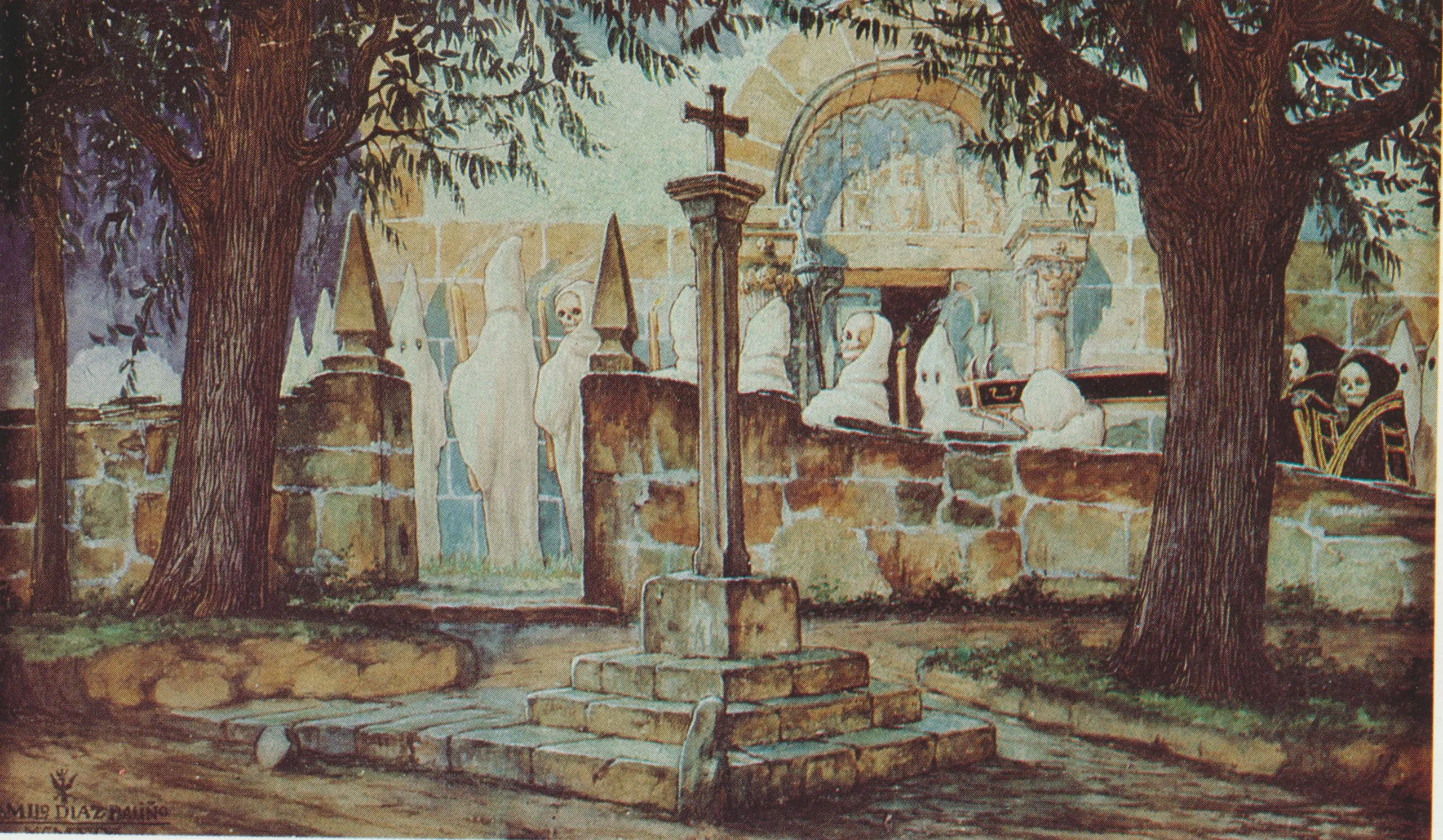
A procession painted in 1919
The image above was painted by Galician artist Camilo Díaz Baliño in 1919. The setting is recognizable rather than fantastical: a small Romanesque church, a walled burial ground, trees and a stone cross. Pale shrouded figures crowd around the graves while darker clerical forms watch from the edge.
Díaz Baliño understood why the legend works. The dead have not appeared in an imaginary castle. They occupy the familiar churchyard at the center of local life. The painting was made more than a century ago, yet its figures resemble the shapes that still emerge when fog catches between eucalyptus trunks or white cloth moves beyond a cemetery wall.
O Apóstolo: when a false pilgrim takes the wrong road
Fernando Cortizo’s 2012 film O Apóstolo gives this folklore a Camino setting. It is a stop-motion feature made in Galicia, with characters modeled on and voiced by actors including Carlos Blanco, Celso Bugallo, Luis Tosar, Geraldine Chaplin and Paul Naschy. The Filmoteca de Galicia describes its mixture of terror, humour and carefully constructed atmosphere.
Its protagonist is not seeking enlightenment. He is a recently escaped prisoner who disguises himself as a pilgrim and returns to recover loot hidden near Santiago. Leaving the proper route, he reaches an isolated village where the elderly residents are remarkably interested in keeping visitors overnight.
The joke is dark and particularly Galician. The Camino promises movement, but this village is trapped. A pilgrim expects hospitality, yet accepting a bed and a meal may be the worst possible decision. Catholic imagery, Purgatory, parish secrets and the fear of what walks after dark all become part of the same story.
The film builds its village around an old agreement between the living and the dead. That makes the escaped prisoner’s modern scheme look almost innocent. He believes the hidden money is the important secret; the village has been guarding something much older.
Why the legend still belongs beside the Camino
Walkers see a different Galicia in daylight. The lane is green, the cross is a useful landmark and the churchyard is a quiet place to refill a bottle nearby. After sunset, the same arrangement can feel older. Houses are scattered rather than gathered behind one brightly lit center. A turn in the path removes the previous village from view. Bells travel farther than voices.
The Santa Compaña grew in that landscape, but it also says something about how communities remember their dead. The souls do not disappear to a distant Gothic ruin. They continue using the parish roads. They pass the homes where they once lived and return to the church where their names were spoken.
That is why O Apóstolo understands the legend so well. On the Camino, every road seems to lead somewhere. In Galician folklore, some roads are also used by those who have already arrived.