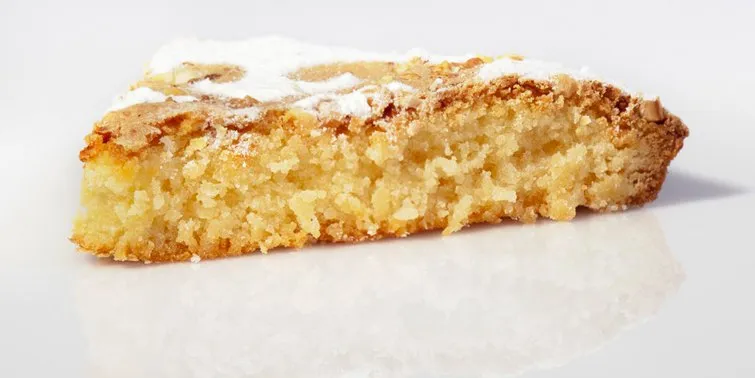
After days organized around distance, arrival in Santiago returns the traveler to appetite without urgency. Tarta de Santiago is the city’s most recognizable sweet: a low almond cake, fragrant with citrus and often cinnamon, finished with powdered sugar around the silhouette of the cross of Saint James.
Its apparent simplicity is part of its character. Almonds, sugar, and eggs do most of the work. The protected recipe defines the cake more closely than the many commercial variations found across the city, while individual bakers still create differences in texture, depth of color, and balance.
A symbol created in sugar
The cross on top is made by placing a stencil over the cooled cake before dusting it. Lift the stencil and the emblem remains in negative space. The image feels ancient, but its widespread association with the cake is more recent than the long history of almond confectionery itself.
Try the cake in more than one place if you are curious. A slice served after lunch may be soft and restrained; a bakery version may be denser or more aromatic. It is naturally made without wheat flour under the protected formulation, but anyone with allergies or celiac disease should still ask about ingredients and cross-contamination rather than assume.
A traditional home recipe
This straightforward version makes one 9-inch cake. It follows the familiar almond, sugar, and egg structure rather than adding a pastry base.
Ingredients
- 250 grams finely ground blanched almonds
- 250 grams granulated sugar
- 5 large eggs
- finely grated zest of 1 unwaxed lemon
- 1/2 teaspoon ground cinnamon
- powdered sugar, for finishing
- a little butter or neutral oil for the pan
Method
- Heat the oven to 350°F / 180°C. Grease a 9-inch round springform or cake pan and line the base with parchment.
- Mix the ground almonds, sugar, lemon zest, and cinnamon in a bowl.
- Beat the eggs separately just until evenly combined. Stir them into the almond mixture until no dry pockets remain. Do not try to aerate the batter like a sponge cake.
- Pour into the prepared pan and level the surface. Bake for about 30 to 35 minutes, until the top is golden and the center is set. Ovens vary, so begin checking early and avoid drying the cake out.
- Cool completely before removing it from the pan. Place a cross of Saint James stencil in the center, dust generously with powdered sugar, and lift the stencil straight upward.
The finished cake should be low, moist, and unmistakably almond-forward. Lemon zest and cinnamon should frame the almonds rather than overwhelm them. It keeps well covered for several days, and many people prefer the texture after it has rested overnight.
Almonds and eggs are essential allergens in this recipe. A flourless ingredient list does not guarantee a cake is safe for someone with celiac disease because the kitchen, ground almonds, pan, or powdered sugar may be exposed to gluten. Ask the individual baker when that distinction matters.
Sweets from the convents
Santiago’s confectionery story does not end with tarta. Religious communities have long prepared sweets for sale, using recipes connected to feast days, available ingredients, and the economics of convent life. Buying them can feel unusually quiet: a bell, a turnstile or serving window, a brief exchange, and a carefully wrapped box.
Across Spain and Portugal, convent confectionery often relies on egg yolks, almonds, sugar, and recipes developed when religious houses received ingredients from surrounding farms or used yolks left after egg whites were needed for other work. Santiago shares in that broader Iberian tradition rather than possessing one fixed list of convent sweets.
Depending on the community and season, a visitor may encounter almond pastries, biscuits, small cakes, or sweets based on egg yolk. Names can travel between regions while recipes remain local. The most respectful approach is to buy what is actually available, ask briefly if guidance is offered, and avoid treating the exchange as a performance.
Offerings and hours vary. Some products are seasonal, and a convent is not a shop obliged to remain open for a visitor’s schedule. That uncertainty is part of encountering a living community rather than a staged attraction.
These sweets invite a slower kind of tasting. They connect the celebratory public face of Santiago with enclosed courtyards, inherited recipes, and work carried out beyond view. Take them to a square, share them with companions, or bring a box home, small edible reminders that pilgrimage has always been accompanied by hospitality.
Continue the table with Galician food beyond Tarta de Santiago, or return to the practical daily rhythm in Eating on the Camino.