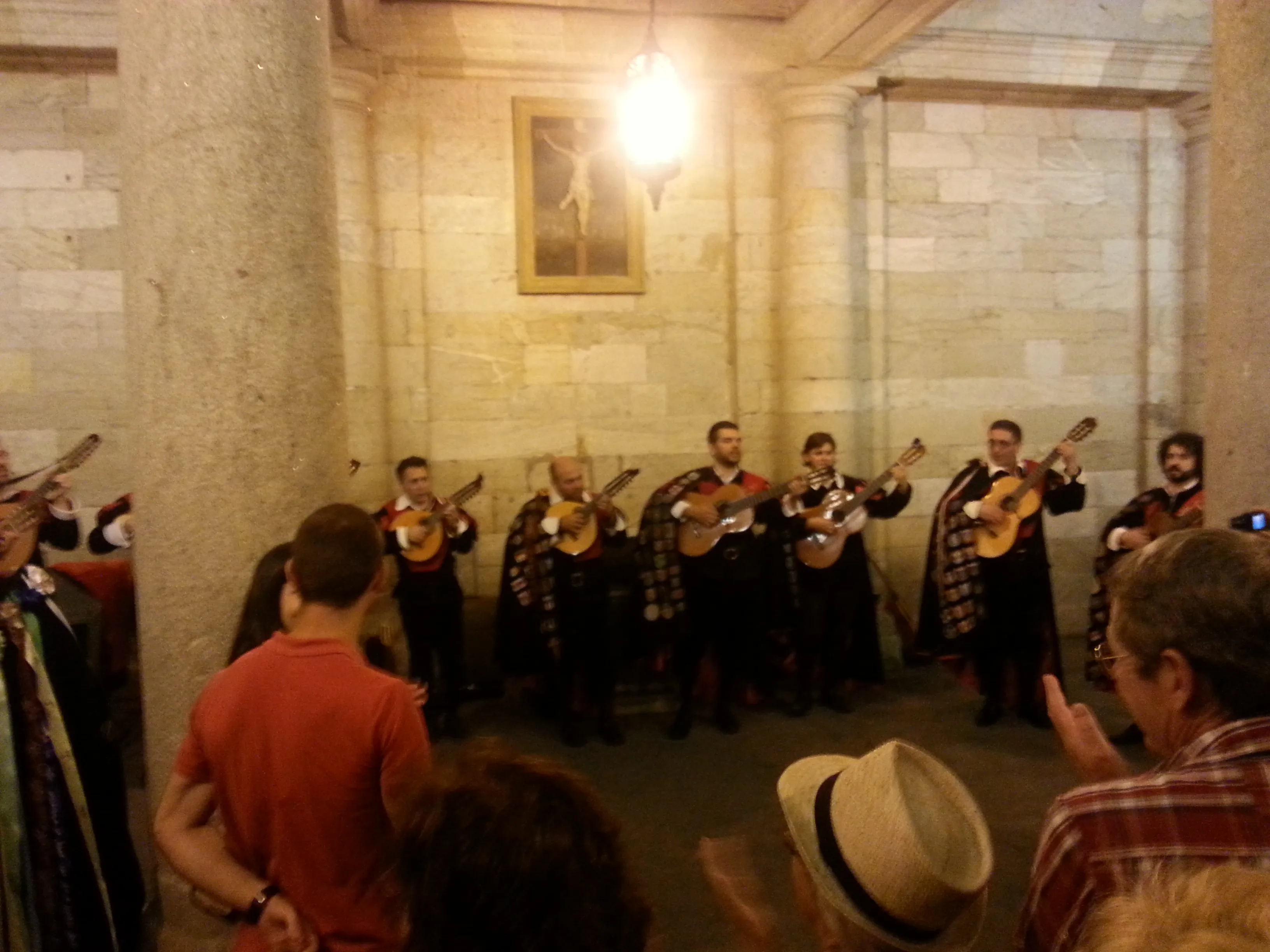
In summer, the Tuna de Derecho de Santiago de Compostela announces its performances for the arcades of Praza do Obradoiro, normally from 10 pm until midnight when the weather allows. There is no theatre door and no formal seating. People gather in a loose semicircle while the musicians sing, swing their capes and bring a tambourine into the centre of the crowd.
Times can change, especially outside summer, so treat the performance as a Santiago pleasure rather than a fixed appointment. If you hear guitars after dinner, walk toward Obradoiro and look beneath the arches of the Pazo de Raxoi.
What is a tuna?
A Spanish tuna is an association of university musicians. Its history is often wrapped in colourful stories about medieval students singing for their supper. The documented tradition changed over centuries: groups of students played and sang, adopted recognizable dress and eventually formed the university cultural associations known today.
The black costume recalls early modern student and theatrical clothing rather than preserving one unchanged medieval uniform. The cape carries ribbons and shields connected with travels, friendships and performances. Instruments commonly include guitar, bandurria, lute and tambourine, with voices arranged for songs that must carry across a square without amplification.
Spain began the formal process of recognising the university tuna as representative intangible cultural heritage in 2025. The official heritage document emphasizes that the tradition has never been static. Repertoire, organisation and public perception have all changed.
A particularly old relationship with Santiago
Night-time student music in Santiago predates the present Tuna de Derecho. University disciplinary testimony from 1594 complained about students devoted to guitars, nocturnal rounds and gaming. The Consello da Cultura Galega traces the stable, organised Tuna Universitaria Compostelana to the Carnival procession of 1876.
Santiago’s university was founded at the end of the fifteenth century, and student life still occupies the old town. That is why the music feels unusually at home here. Obradoiro is the end of an international pilgrimage and also a civic square in a university city.
The current Tuna de Derecho records more than thirty years of performances, competitions and travel. Its own history is deliberately comic, full of exaggerated adventures and “Ribeiro gas,” but its chronology documents appearances in Spain and across Europe from the 1990s onward.
Songs you may recognise
The programme changes, but several titles are closely associated with tuna performances in Santiago:
- Tuna Compostelana, the obvious local anthem, written as a pasacalle and built around the image of the tuna passing through Santiago.
- Fonseca, whose refrain about the old university college is one of the pieces audiences most often request.
- Clavelitos, composed by Genaro Monreal with words by Federico Galindo and absorbed into the standard tuna repertory.
- A Santiago voy, immediately recognizable in Galicia and particularly suited to a crowd that has just arrived in the city.
- Cielito lindo and Canta y no llores, reminders that tuna repertoires extend far beyond Spain and have long incorporated music from Latin America.
- Galician pieces such as A Rianxeira or the Muiñeira de Chantada.
Do not expect a museum reconstruction. A current performance may move between local songs, boleros, Mexican standards and comic audience participation.
Watching respectfully
Leave a clear passage through the arcades and avoid standing so close that the performers cannot move the capes or tambourine safely. Photographs are normal, but a full concert watched through a raised phone blocks everyone behind you. Contributions are welcome when the group passes a hat or instrument case.
The performance makes an excellent final evening after completing the Camino. Add an extra Santiago night to your Ultreya Tours journey if you want time for Obradoiro after dark as well as the Cathedral visits during the day.