Between Portomarín and Palas de Rei, the Camino Francés crosses a Galicia of pasture, villages, and deep lanes. Near Castromaior, a short detour climbs toward ground where banks and stone lines reveal a fortified settlement occupied long before the pilgrimage to Compostela existed.
The Castromaior hillfort is one of the most evocative archaeological sites close to the Camino. From the hill, ancient enclosures and present-day pilgrims can be seen within the same landscape.
What is a castro?
In northwestern Iberia, castro generally describes a fortified settlement of the Iron Age. Such communities often occupied high or naturally defensible ground. Walls, ditches, banks, and terraces organized and protected the inhabited space.
“Hillfort culture” does not identify one unchanging people. It covers different communities and developments from the late Bronze Age and Iron Age through the transformations brought by the Roman world.
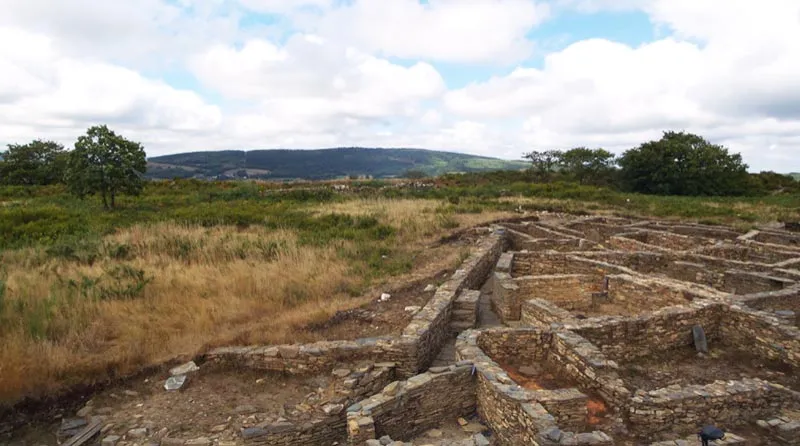
At Castromaior, successive enclosures follow the contours of the hill. Their complex organization remains monumental even though the walls no longer stand at their original height. Excavation has helped identify structures and phases of occupation.
Was it Celtic?
The question is compelling because modern Galicia feels a strong cultural affinity with Celtic identity. Archaeologists nevertheless use the term cautiously.
Northwestern Iberia participated in Atlantic and European exchanges, and ancient authors used categories connected with Celts and Celtiberians. Metalwork, names, art, and weapons may indicate broad cultural relationships. But “Celtic” can misleadingly suggest one uniform identity, language, or institution across Europe.
Castromaior’s inhabitants left no account of how they defined themselves. The most responsible description is therefore an Iron Age hillfort of northwestern Iberia, followed by an explanation of the debate. That caution makes the site more interesting, not less: it belongs to a local history connected with wider networks without needing to illustrate a modern myth.
A community in its landscape
Hillforts were places of daily life. Their inhabitants grew crops, kept livestock, made tools, and worked different materials. A commanding position helped with defense, but it also shaped relationships between homes, shared spaces, fields, and routes.
The northwest possessed sought-after mineral resources and important metalworking traditions. Finds from hillforts testify to technical skill and exchanges beyond each settlement.
Rome gradually transformed this world. Settlements, economies, and political structures changed at different speeds. A story of sudden disappearance would be too simple; communities adapted, sometimes moved, and incorporated new material and administrative practices.
Making the detour
Castromaior rewards slow attention. The ground may be uneven and exposed to sun, wind, or rain. Visitors should respect protected areas, move nothing, and avoid climbing on structures. Access arrangements can change, so current local information should be checked.
Look first for the lines of the terrain rather than spectacular objects: the successive defenses, the hilltop position, and the relationship with the surrounding countryside. Then look down toward the Camino.
The Camino passes the excavated settlement between Portomarín and Palas de Rei. Its stone walls, lanes and house foundations are visible without a museum reconstruction, so the plan of the hillfort can be read directly from the ground.