Modern pilgrims often cross into Santiago’s old city without realizing they have passed a former gate. The medieval wall is largely gone, absorbed into later buildings and streets, but imagining it changes the scale of the destination.
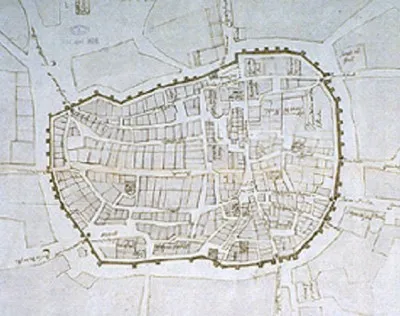
The enclosed city grew around the shrine of Saint James. Walls provided defense and controlled entry, while gates organized roads, markets, taxes, processions, and the daily meeting between town and countryside. Seven principal gates are traditionally associated with the circuit.
Entering with the Camino
The seven principal gates traditionally associated with Santiago’s medieval wall are easier to understand as a set:
- Porta do Camiño was the significant arrival for pilgrims coming along the French Way. Its name survives in the urban landscape east of the Cathedral.
- Porta de San Francisco opened toward the monastery and northern approaches.
- Porta da Pena served the road associated with A Coruña.
- Porta Faxeira connected the city with roads leading toward Pontevedra and the Portuguese routes.
- Porta da Mámoa faced the southern road.
- Porta da Trinidade formed another western entrance to the enclosed city.
- Porta de Mazarelos was a commercial threshold through which goods entered Santiago, and is the only gate with a surviving arch.
From these entrances, streets tightened and unfolded toward the sacred center. The gates were not ceremonial labels on a tourist circuit: they regulated the movement of people, animals, produce, and merchandise. Names and descriptions can vary across periods and sources, but the remembered set still helps explain how Santiago met the roads beyond its walls.
Mazarelos is exceptional because its arch survives. Standing beneath it makes the lost enclosure tangible. It also recalls the movement of goods into Santiago; gates were commercial thresholds as well as defensive structures.
The surviving arch is traditionally connected with wine entering the city from the Ulla and Ribeiro areas. Whether arriving with a mule train, a market basket, or a pilgrim staff, a medieval traveler met a city whose entrances made origin and purpose visible.
Following a wall that is no longer there
A walk around the approximate circuit reveals changes in grade, curved streets, and place names that outlasted the masonry. Do not expect a continuous ruin. The interest lies in reconstructing relationships: gate to road, wall to suburb, market to entrance, Cathedral to the dense protected city around it.
Begin near Porta do Camiño, follow the eastern and southern edge toward Mazarelos, and continue around the old center rather than trying to trace every meter exactly. Street names such as Virxe da Cerca preserve the memory of the enclosure, while the contrast between narrow interior lanes and later streets suggests how the city expanded beyond it.
The wall declined as a defensive necessity and was progressively dismantled as Santiago changed. Stone was absorbed, routes widened, and buildings occupied its line. Archaeological evidence and historical plans therefore matter as much as visible masonry. The missing wall is not an absence to apologize for; it is a way to read urban change.
The vanished wall also corrects a common impression of Santiago as a collection of monuments floating outside ordinary life. Medieval arrivals entered a bounded, crowded city with smells, regulations, workshops, animals, lodgings, and negotiations. Pilgrimage depended on urban infrastructure.
Today the historic center is open and porous, but the old gates still give each arrival a direction. Walk through Mazarelos, find the former Porta do Camiño, and then approach the Cathedral again. The destination will feel less like a façade and more like a city pilgrims have been entering for centuries.
A short walk for seeing the lost wall
Start at the surviving Arco de Mazarelos, where Ribeiro wine and Castilian grain once entered the city. From there, follow the curve of Virxe da Cerca toward Porta do Camiño, the arrival associated with the French Way. Continue through streets whose names preserve gates even where masonry does not: Porta da Pena, Porta de San Francisco, and Porta Faxeira.
The complete circuit was about two kilometers and enclosed roughly 30 hectares, according to Santiago’s tourism authority. You will not see a continuous ruin. Instead, look for curved alignments, changes in level, the contrast between lanes inside the former enclosure and broader roads beyond it, and the single arch that survived because later buildings incorporated the wall. Absence becomes legible once the street plan is allowed to speak.
Place that circuit beside the Cathedral squares in Arriving in Santiago, then look more closely at the city’s great historic institution of welcome, the Hostal dos Reis Católicos.