Santiago has enough museums for several days, but their subjects are distinct. A pilgrim with two free hours should make a different choice from a traveler interested in Galician ethnography or contemporary art. These are the collections we would consider first.
Museum of Pilgrimage and Santiago
The Museo das Peregrinacións e de Santiago, at Praza das Praterías 2, is the clearest introduction to the Camino after arrival. Its displays examine pilgrimage as a worldwide practice before concentrating on Saint James, the routes to Compostela, the medieval pilgrim and the development of the Cathedral and city.
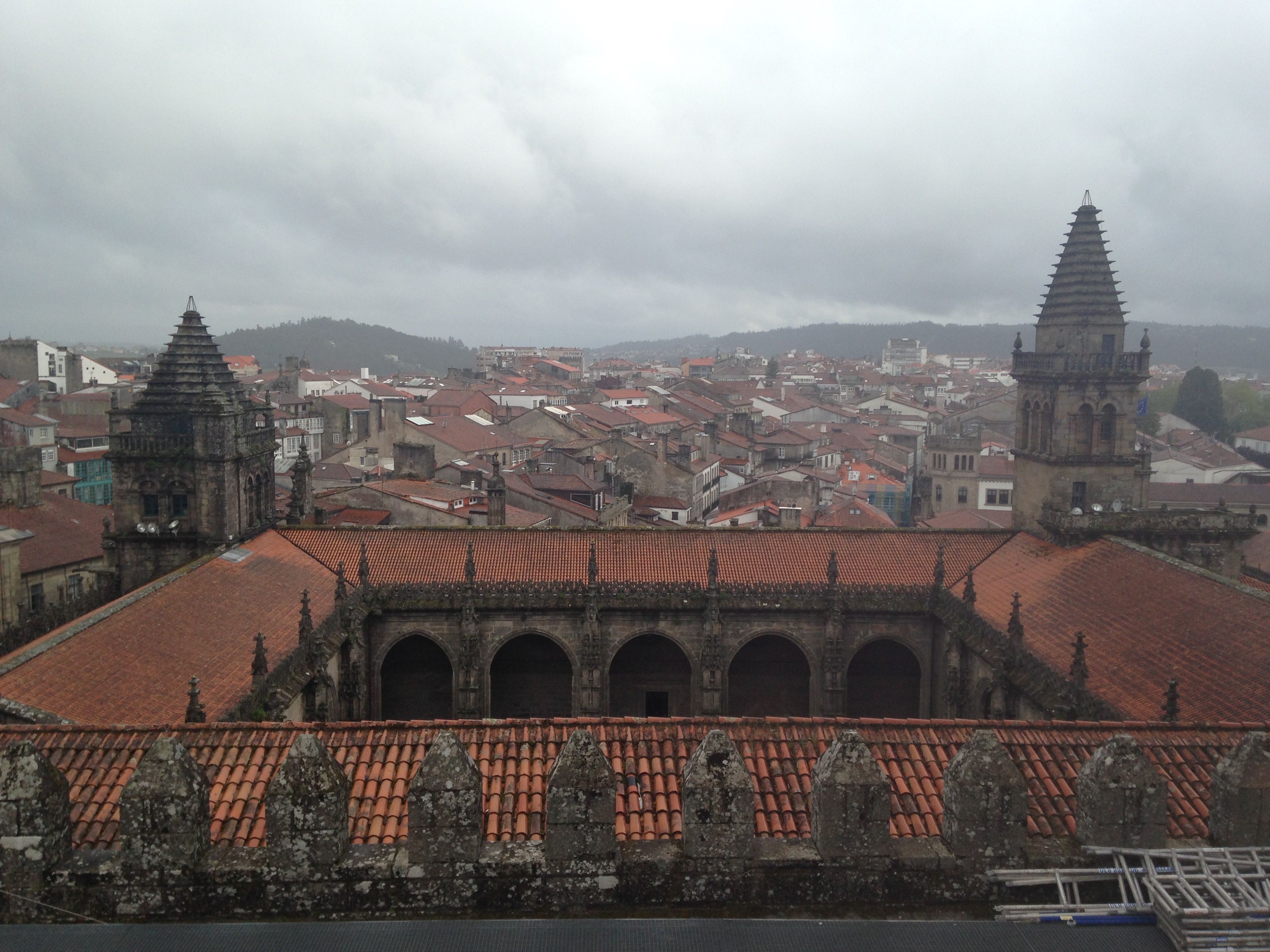
Look for the large Cathedral model, historical representations of Saint James and reconstructions of the instruments carved on the Pórtico da Gloria. The upper floor also gives an unusually close view of the Cathedral’s southern side and the Berenguela tower.
This is our first recommendation when someone has completed the Camino but still has questions about how the pilgrimage developed. Admission is currently free. The museum closes on Mondays; check the official schedule before going.
Cathedral Museum
The Cathedral Museum is not a single gallery. Its permanent route passes through the cloister, the Treasury and Chapel of Relics, rooms containing sculpture and tapestries, and the Pazo de Xelmírez, the medieval archbishop’s palace beside Obradoiro.
It is also the starting point for several separately timed Cathedral visits, including the Pórtico da Gloria and the roofs with the Carraca tower. The collections make more sense when you want to understand how the Romanesque church was built, altered and furnished over centuries. Read our guide to the official ways to visit Santiago Cathedral before choosing a ticket.
Museo do Pobo Galego
The Museo do Pobo Galego occupies the former convent of San Domingos de Bonaval at Costa de San Domingos 3, close to the street used by French Way pilgrims entering Santiago. Its galleries cover fishing, farming, trades, dress, music and vernacular architecture. Objects are arranged around the work and domestic life that shaped Galicia, so this is the strongest museum for understanding the villages crossed during a Camino.
The building deserves time in its own right. Domingo de Andrade’s extraordinary triple spiral staircase carries three separate flights around the same central space. The adjoining Gothic church contains the Panteón de Galicia, where Rosalía de Castro, Castelao, Ramón Cabanillas and other important Galician figures are buried.
The museum normally closes on Mondays and offers free admission on Sundays, although current hours and tariffs should be confirmed on its website.
CGAC: Galician Centre for Contemporary Art
The Centro Galego de Arte Contemporánea, or CGAC, stands beside the Museo do Pobo in a building designed by Portuguese architect Álvaro Siza. The pale granite exterior responds to the stone of Bonaval without imitating the old convent.
There is no single permanent display that defines every visit: temporary exhibitions and installations change. Go for contemporary Galician, Spanish and international art, and allow time for the building, its staircases and views. Combining the CGAC, Museo do Pobo and Bonaval park makes a coherent half-day outside the busiest Cathedral streets.
Eugenio Granell Foundation
The Fundación Eugenio Granell is housed in the Pazo de Bendaña on Praza do Toural. Granell was a Galician surrealist artist, musician and writer who went into exile after the Spanish Civil War. The collection places his work alongside that of other surrealists and artists connected with his life abroad.
This is a manageable museum for travelers who want art without committing half a day. The central location makes it easy to combine with the Alameda, the market or a private guided tour of Santiago.
Casa da Troia
At Rúa da Troia 5, this narrow house recreates the student boarding-house life described by Alejandro Pérez Lugín in his 1915 novel La Casa de la Troya. Rooms, furniture and photographs evoke Santiago’s university world at the turn of the twentieth century. The lower part also deals with the city’s tuna student musicians.
Opening is more seasonal than at the large public museums, so verify the dates rather than assuming it will be open. Continue with our article about the Tuna de Derecho and Santiago’s student serenade.
Natural History Museum of the University of Santiago
The Museo de Historia Natural da USC, on Parque de Vista Alegre, holds zoological, botanical, geological and mineral collections assembled through the university. It is particularly useful for families and for anyone interested in the landscapes and species encountered while walking across Galicia.
It lies outside the historic centre but can be reached on foot. Check university opening hours, especially around holidays and academic closures.
Cidade da Cultura and the Museo Centro Gaiás
The Cidade da Cultura rises on Monte Gaiás, southeast of the old town. Peter Eisenman’s complex is as much an architectural visit as a museum destination. The Museo Centro Gaiás hosts large temporary exhibitions rather than one unchanging collection, so consult the current programme before making the journey.
It is too far from the centre to add casually between Cathedral appointments. Give it a separate half-day and use a bus or taxi unless you specifically want the uphill walk. Our guide to the City of Culture explains the project and what to expect.
Which museums should you prioritize?
For a first Camino visit, choose the Museum of Pilgrimage and the Cathedral Museum. For Galicia itself, choose the Museo do Pobo Galego. Art lovers can pair the Museo do Pobo with the CGAC, while families may prefer the Pilgrimage Museum and the Natural History Museum.
Museum schedules change and several close on Mondays. Check the official site on the day, especially for smaller collections and temporary exhibitions.