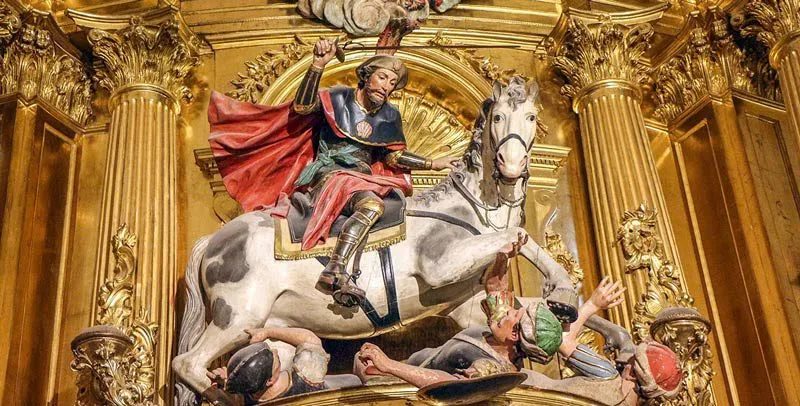
The Camino’s familiar Saint James wears a pilgrim’s cloak and carries a staff. In churches and museums, however, travelers may meet another figure: a mounted knight with raised sword, traditionally called Santiago Matamoros, Saint James the “Moor-slayer.”
The image is rooted not in the life of the biblical apostle but in medieval legend. A much later tradition claimed that Saint James appeared miraculously in battle to aid Christian forces. As kingdoms expanded during the long and uneven processes conventionally called the Reconquista, the warrior saint became a symbol of military legitimacy.
The battle most closely attached to the legend is Clavijo, traditionally dated to 844 and associated with King Ramiro I. Historians do not treat the legendary account as a reliable record of an event described at the time. The story entered written and institutional memory later, gaining force through texts, privileges, ritual, and images that connected victory with the apostle’s supernatural intervention.
Even the term Reconquista needs care. It can describe centuries in which Christian-ruled kingdoms expanded over territories governed by Muslim powers, but it risks making a long, discontinuous history sound like one unified national campaign. Alliances often crossed religious lines; communities included Christians, Muslims, and Jews; and identities changed through migration, conversion, law, marriage, and violence.
Image, legend, and power
Art both illustrates history and helps produce the story a society tells about itself. Sculptures and paintings of the mounted saint placed sacred authority beside conquest. Later, the same iconography traveled into imperial settings beyond the Iberian Peninsula and acquired new political uses.
The mounted figure often appears on a white horse, sword raised, with defeated Muslim bodies beneath him. Those details turn hierarchy into a visual fact: sanctity and power above, a dehumanized enemy below. Repetition in altarpieces, processions, prints, royal ceremony, and local chronicles helped make a legendary battle feel like inherited history.
In the early modern period, the image could be adapted to new conflicts. Research published by the Universidade de Santiago de Compostela follows transformations of the warrior apostle in the Americas, where variants were invoked against Indigenous people, political enemies, and other groups. The icon did not carry one stable meaning across the Atlantic; it became a flexible instrument of conquest and authority.
The word attached to the image is explicitly hostile toward Muslims. Historical explanation should not turn that violence into picturesque folklore. Medieval Iberia contained conflict, alliance, trade, coexistence, conversion, and shifting identities that a single triumphal legend cannot represent.
That matters in contemporary Spain, where the image sits within debates about memory, identity, religion, and relations with Muslim communities. A label that explains only the costume and date is incomplete. Responsible interpretation names the violence represented, distinguishes legend from evidence, and shows how later patrons used the image.
How to look at it now
Encountering the image does not require either silent acceptance or erasing the object from view. Ask where and when it was made, who commissioned it, whom it places above and below, and how its meaning changed. Museum or church interpretation may reveal as much about present choices as the sculpture reveals about the past.
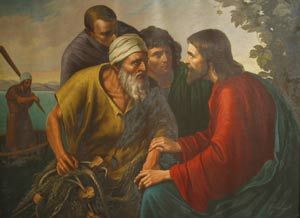
Compare it with other representations nearby. Saint James may appear as an apostle holding a book, a seated figure in authority, or a pilgrim with staff, shell, hat, and traveling cloak. Each visual type uses distinctive clothing and objects to emphasize a different claim: witness, patron, traveler, or warrior.
For modern pilgrims, the contrast is particularly sharp. The Camino is now walked by people of many religions and none, and its best moments often come through hospitality across difference. The warrior image belongs to the route’s history, but it does not need to define its future.
Saint James has never had only one visual identity. Apostle, martyr, pilgrim, and knight each emerged from particular needs. Learning to distinguish them makes the Camino’s cultural landscape more honest, and allows welcome, curiosity, and shared travel to answer an inherited image of division.
What to notice when the image appears
First identify the visual type. A shell, staff, broad hat, and traveling cloak usually present Saint James as pilgrim; a book emphasizes the apostle; a horse, sword, and defeated bodies signal the martial legend. Then read the museum label or church context for date and patron. A medieval claim, an early modern imperial image, and a later nationalist use are not interchangeable.
Finally, look at who has been given individuality. The mounted saint is often named and elevated while the figures beneath him are reduced to anonymous enemies. Recognizing that visual choice is not an attack on historical study. It is the beginning of understanding how images create power, and why this one requires more than a picturesque explanation.
Compare the warrior with the apostle and pilgrim in Saint James: history, tradition, and legend. The wider sacred landscape appears in our guide to Camino churches and monasteries.