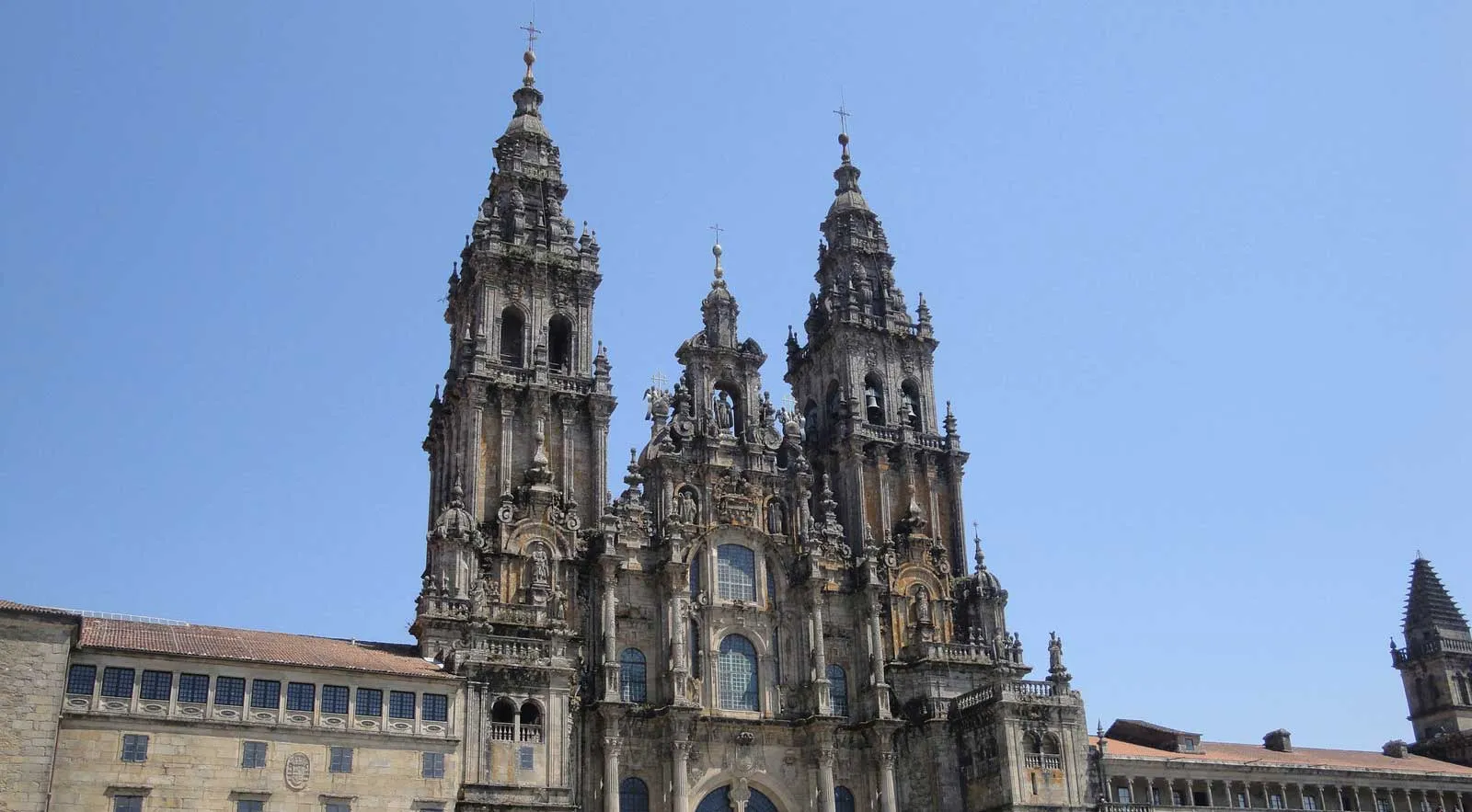
A Romanesque doorway in a village and a great monastery in Santiago belong to the same Camino landscape, but they ask for different kinds of attention. One may be open only briefly; another may contain a museum, church, guest accommodation, or active religious community.
Churches helped define settlements and the sacred geography of pilgrimage. Monasteries maintained worship, land, libraries, hospitals, and hospitality. Former pilgrim hospitals remind us that welcoming travelers once included shelter and care in a broader sense than the modern word “hospital.”
A route written in stone
The French Way
Monumental buildings punctuate the French Way without telling only one architectural story:
- The Collegiate Church at Roncesvalles belongs to the high Pyrenean threshold of the route.
- Burgos Cathedral and León Cathedral turn two major Camino cities into sustained encounters with Gothic architecture, stained glass, chapels, and centuries of patronage.
- Santa María la Real in O Cebreiro is tied closely to its mountain settlement and pilgrim traditions.
- The Monastery of Samos, on the alternative route through Samos, creates a striking contrast between secluded valley and immense Benedictine presence.
- The Church of San Nicolás in Portomarín was dismantled and rebuilt stone by stone when the old town was flooded by the Belesar reservoir.
Between these landmarks, smaller churches and former hospitals show how worship and hospitality extended far beyond royal foundations. Each building expresses a different relationship between pilgrimage and place.
The Portuguese Ways
The Portuguese routes have their own sequence of sacred architecture:
- Oporto Cathedral marks a powerful urban departure.
- The Romanesque Church of São Pedro de Rates recalls the route’s older religious landscape.
- Tui Cathedral stands above the Miño at the crossing into Galicia.
- The Monastery of Santa María de Oia faces the Atlantic on the Portuguese Coastal Way.
- The Church of the Pilgrim Virgin in Pontevedra makes the scallop shell part of the building’s plan as well as its decoration.
The Sanabrés, Winter, and Finisterre Ways
- The Monastery of Oseira can form part of the Sanabrés route variant through Cea before the approach to Ourense.
- The Winter Way passes the monasteries and Romanesque churches of the Ribeira Sacra before joining the final approach to Santiago.
- Santa María das Areas in Finisterre and the Sanctuary of Nosa Señora da Barca in Muxía place Christian devotion beside the Atlantic edge.
Staying inside history
Some historic buildings now operate as hotels or guesthouses. The Hostal dos Reis Católicos on Praza do Obradoiro is the most famous example, transformed from a royal pilgrim hospital into a Parador. Elsewhere, pazos, monasteries, convent buildings, and carefully restored houses allow travelers to encounter regional architecture through an overnight stay.
Other Paradores along the broader French Way occupy buildings with similarly layered histories, including the former pilgrim hospital of San Marcos in León and the hospital founded by Santo Domingo de la Calzada. A night in a converted monastery or pazo can offer cloisters, masonry, gardens, and a tangible sense of continuity. It can also mean an irregular floor plan or protected structure that cannot behave like a newly built hotel.
That distinction matters when comparing Classic and Premium arrangements. Classic and Premium journeys use different accommodation selections, but historic character alone does not determine the category. Setting, room character, hospitality, and suitability for the traveler matter alongside the formal hotel classification.
Historic character does not create one standardized comfort level. Thick walls, protected layouts, stairs, room sizes, heating, elevators, and accessibility can differ significantly. Ultreya Tours considers the actual property and room arrangement rather than assuming an impressive façade answers every practical question.
Visiting respectfully
Many churches remain active places of worship. Check current opening information, dress appropriately, keep voices low, and do not interrupt a service for photography. Flash, tripods, backpacks, and access to chapels may be restricted. A locked church is not necessarily neglected; a small community may simply be unable to staff it throughout the day.
Look for the details that connect architecture to movement: worn thresholds, scallop shells, saints dressed as pilgrims, hospital courtyards, bridges aligned with gates, and streets that lead toward a west-facing tower.
The Camino becomes richer when you pause to understand its buildings instead of treating them as a list of attractions. Each one offers clues about the pilgrims who arrived, the communities that welcomed them, and the journeys these places have supported over centuries.
The former royal hospital on Obradoiro deserves its own closer look in our history of the Hostal dos Reis Católicos. To place these buildings along the journeys themselves, compare the main Camino routes.