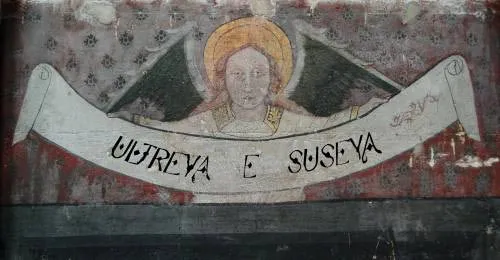
“Ultreya!” appears in Camino conversations, on signs, in the names of pilgrim gatherings, and in songs connected with the Way. It is often translated as “onward” or “keep going.” Sometimes it is paired with “suseya,” interpreted as “and upward” or “higher.” These renderings express the word’s modern emotional use, but its linguistic history does not reduce perfectly to a slogan.
That openness is part of why the name matters to Ultreya Tours.
A word with medieval roots
Forms related to ultreia appear in medieval material associated with the pilgrimage, most famously in the twelfth-century manuscript collection known as the Codex Calixtinus. The texts bring together liturgy, stories of Saint James, miracles, and material concerning the pilgrimage road. Within that world, the word functions as an acclamation connected with movement toward Santiago.
Medieval spelling was not standardized in the modern sense. Readers may encounter variants including ultreia, ultreya, and forms paired with suseia or suseya. Language moved across Latin and the evolving vernaculars spoken by travelers from different regions. A single modern spelling should not be projected backward as though every pilgrim used it in the same way.
The familiar explanation connects the word with Latin ideas of going beyond or farther. That relationship is plausible and widely repeated, but precise etymological claims vary. Rather than present one disputed derivation as settled fact, it is safer to say that the historical acclamation has come to carry the sense of onward movement and encouragement.
Encouragement on the road
On the modern Camino, Ultreya can be a greeting, a farewell, or a small act of support. It does not need a long explanation when offered to somebody climbing slowly or setting out again after a break. The context gives it meaning: continue, courage, farther still.
The word does not demand speed. “Onward” can mean one more step, a shorter stage, a day of rest, or the decision to adapt a plan. Camino encouragement is most useful when it respects the traveler rather than turning persistence into pressure.
That distinction matters because pilgrimage language can easily become sentimental. Not every difficult moment contains a lesson, and not every person needs to be urged through pain. The best meaning of Ultreya is companionship in movement: recognition that somebody is on a road and an expression of hope for what lies ahead.
Suseya and upward interpretation
The paired expression often rendered “Ultreya, suseya” has acquired spiritual interpretations, onward and upward, beyond and higher. These can be meaningful to pilgrims, particularly within Christian understandings of the journey. They should be named as interpretations rather than exact, uncontested translations used identically in every medieval context.
The Camino has always gathered languages. Words change when spoken by people who inherit them from texts, songs, associations, and one another. Modern usage is part of the word’s history too, even when it cannot prove the original etymology.
Why Ultreya Tours carries the name
Ultreya Tours associates the word with movement supported by care. A Camino is made of forward progress, but also of preparation: choosing a route, finding a sustainable pace, connecting accommodations and luggage transfers, and understanding what a traveler wants from the journey.
The company is based in Galicia, where the routes converge and where Santiago’s pilgrimage history remains part of daily cultural life. The name links that local foundation with the international travelers who arrive speaking many languages and carrying different reasons for walking or cycling.
It also suits a personalized journey. “Onward” does not specify one route, distance, or travel style. One traveler may walk the final French Way; another may cycle from Oporto; a private group may combine selected stages with guiding and support; somebody who has reached Santiago may continue to Finisterre. The direction is shared while the shape remains personal.
A meaning lived rather than owned
Ultreya Tours did not create the word and does not claim it as private Camino language. It belongs to a much older tradition and to the communities that continue to use it. Choosing it as a name creates a responsibility to treat that tradition with accuracy and humility.
There is no need to reproduce a song lyric or force a single poetic definition. The word is strongest in use. It acknowledges distance already traveled and points gently toward what remains.
When you hear Ultreya on the Way, you can receive it simply: encouragement from one traveler to another. Onward. Farther. Continue when it is right to continue, and let the road ahead become your own.
Listen for the word in Santiago
The most concrete historical encounter with ultreia comes through the musical world of the Codex Calixtinus, preserved by Santiago Cathedral. In the refrain associated with Dum Pater Familias, the word appears beside suseia. Hearing the music makes an important point that dictionary glosses miss: this was an acclamation shaped by breath, rhythm, and a community of voices.
Modern pilgrims may encounter different pronunciations and spellings in songs, pilgrim associations, parish groups, or conversation. That variety is evidence that the word has continued traveling, carrying its medieval association with Santiago while gathering the personal meaning of each new departure.
Hear that history in Music for the Way, then meet the manuscript’s powerful Compostela context through Diego Gelmírez.