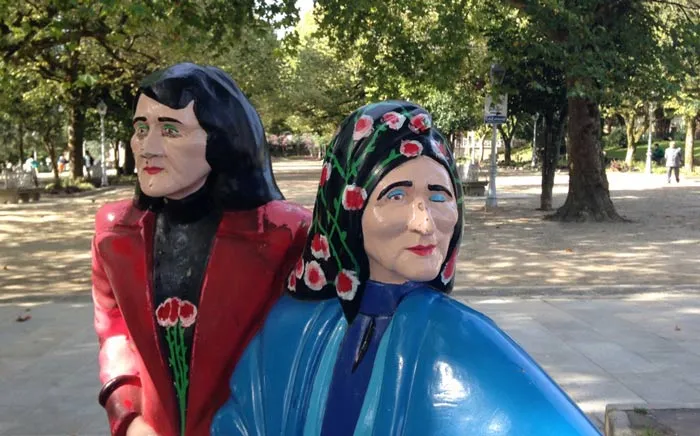
In Santiago’s Alameda, a sculpture of two women stands near one of the city’s most photographed viewpoints. They are Coralia and Maruxa Fandiño Ricart, remembered as Las Marías and Las Dos en Punto, the Two O’Clock Women. The names refer to the sisters’ habit of walking together through central Santiago in the afternoon, dressed with unmistakable care and color.
It is easy for a visitor to see only charm: two eccentric local characters preserved in bronze. Their story asks for more attention. The sisters’ public presence emerged from a family history marked by political persecution after the Spanish Civil War, economic hardship, and social cruelty. Remembering them respectfully means holding the brightness and the suffering together.
The Fandiño Ricart sisters
Coralia and Maruxa belonged to a large Santiago family. Several of their brothers were connected with anarchist activism and labor politics during a period of deep conflict in Spain. After the military uprising of 1936 and the establishment of Francoist repression in Galicia, the family became a target.
Accounts of the sisters’ lives describe harassment, searches, intimidation, and pressure intended to locate or punish their brothers. Details are sometimes repeated in popular retellings with different wording or uncertain precision, so it is important not to turn every anecdote into established fact. The broader reality is clear: repression extended beyond named political actors to families and communities, and women could be subjected to particular forms of humiliation and control.
The family’s circumstances deteriorated. Poverty and marginalization shaped the sisters’ later lives. Discussions of their mental health also require care. Retrospective labels can flatten two people into diagnoses that cannot be responsibly made from tourist stories. What can be said is that trauma, exclusion, and public treatment formed part of the world in which they lived.
The two o’clock walk
Coralia and Maruxa became known for appearing in Santiago at about two in the afternoon, when many people were leaving work or study for lunch. They walked together through familiar streets, wearing vivid colors, makeup, and outfits that contrasted sharply with the subdued expectations around them.
Their clothes have been interpreted as defiance, self-expression, performance, or a way of preserving dignity. These interpretations may illuminate the image, but they should not replace the sisters with a symbol convenient to later viewers. They were real women living under difficult conditions, not characters created for the city’s amusement.
People responded in different ways. Some greeted or protected them; others mocked them. Over time, their walk became woven into Santiago’s daily awareness. Their visibility was itself remarkable. In a society that had tried to shame and silence their family, the sisters continued to occupy public space on their own terms.
How Santiago remembers them
The sculpture by César Lombera, installed in the Alameda, depicts the sisters arm in arm. Its location places them in a park that belongs to everyday Santiago as much as to visitors: a place for walks, festivals, conversation, and views toward the Cathedral.
The figures have become beloved, and photographs beside them are common. Affection is not necessarily disrespectful. The risk appears when the image is detached from the history, when bright dresses become a picturesque anecdote and persecution disappears.
Public memory is rarely simple. A statue can restore visibility while also smoothing a painful life into an approachable landmark. Pause long enough to learn whom the sculpture represents. Coralia and Maruxa’s story opens questions about how cities treat difference, how political violence enters private homes, and how later generations transform marginalized people into civic icons.
Seeing more than a landmark
When you encounter Las Marías, notice their stance together. The sculpture emphasizes companionship: two sisters moving through the city side by side. Their walk can be read as courage, but that word should not force suffering into an uplifting conclusion. Endurance does not make what happened acceptable.
Santiago is often approached through medieval stone, the Cathedral, monasteries, arcades, and pilgrimage. Las Marías bring the twentieth century into the city’s visible story. Local culture also lives in remembered people, contested histories, humor, injustice and the meanings attached to ordinary streets.
Their place in the Alameda is therefore more than a colorful pause between monuments. It is an invitation to look again: at the sisters, at the society around them, and at the responsibility involved in turning another person’s life into memory.
When you meet Las Marías
The sculpture stands on the Alameda promenade, close to the celebrated viewpoint toward the Cathedral. Notice first that the sisters are not posed as isolated monuments: they are arm in arm, mid-walk, dressed in colors that hold their place against Santiago’s gray granite. The city’s affection is visible in the way residents and visitors approach them, but affection becomes more meaningful when their names, Maruxa and Coralia Fandiño Ricart, remain attached to the image.
After seeing the sculpture, turn toward the Cathedral skyline. The view contains two kinds of Santiago memory at once: the monumental city built around pilgrimage and the twentieth-century city that lived through repression. Las Marías belong fully to the second story, not as a charming footnote to the first.
For the monumental skyline facing the sisters, read Arriving in Santiago. The guide to Santiago’s medieval wall reveals another layer of the city that survives mainly in streets and memory.