Camino shelves contain guidebooks, memoirs, novels, spiritual reflections, art history, and works whose connection to Santiago is more imaginative than factual. Reading across those forms is more rewarding than looking for one definitive account.
Practical orientation
A current route guide helps explain stages, services, terrain, and waymarking. Publication dates matter: accommodations close, paths change, and official procedures evolve. Treat any printed guide as orientation rather than live confirmation, and use official sources for current Compostela and Cathedral information.
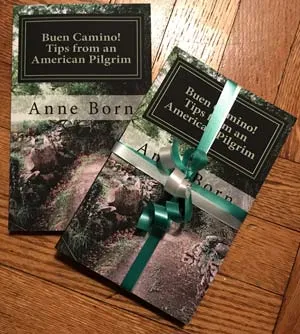
Anne Born’s Buen Camino! Tips from an American Pilgrim belongs to the conversational, practical tradition: one walker helping another think about the experience ahead. Her writing about the Cathedral also encourages travelers to look more carefully when they reach Santiago rather than treating arrival as the end of attention.
For route orientation, choose the newest edition available for the Camino you will actually travel. John Brierley’s guides introduced many English-language walkers to stage planning, while Bethan Davies and Ben Cole’s Walking the Camino de Santiago is another established practical companion to the French Way. A guidebook is most useful when its assumptions match your direction, mode, and route; a French Way walking guide cannot quietly become a cycling guide to the Portuguese Coastal Way.
Memoir and personal experience
Memoirs can offer companionship, particularly when the author is honest about discomfort, doubt, and imperfect encounters. But another person’s revelation is not an itinerary. Read several voices, including writers from Spain and Portugal when translations are available, and notice whose perspectives are absent.
For memoir and personal encounter, consider Hape Kerkeling’s I’m Off, Then, a candid and often funny account that became especially influential in Germany; Shirley MacLaine’s The Camino, a highly personal spiritual narrative; and Robert Ward’s All the Good Pilgrims, which pays close attention to the community formed along the route. Jean-Christophe Rufin’s The Santiago Pilgrimage brings a French writer’s skeptical, observant voice to the Northern Way. These books disagree in tone and interpretation, which is exactly why reading more than one is useful.
Joyce Rupp’s Walk in a Relaxed Manner is attentive to companionship, fatigue, and the interior life of a long walk. Kevin A. Codd’s To the Field of Stars, written by a Catholic priest, follows the French Way with warmth and close attention to its people. Bill Bennett’s The Way, My Way offers a direct, self-questioning Australian voice and suits readers who do not want pilgrimage polished into certainty.
Laurie Lee’s As I Walked Out One Midsummer Morning is not a Camino memoir, but its account of crossing Spain on foot offers a literary counterpoint to contemporary pilgrimage. Read it for landscape, historical moment, and the alertness of slow travel, not for current practical guidance.
History and cultural context
Historical reading provides useful counterweight. Look for scholarship on medieval pilgrimage, the cult of Saint James, Iberian history, and the development of Santiago. Good history distinguishes evidence from tradition and explains why legends mattered without presenting every legend as fact.
Two substantial starting points are David M. Gitlitz and Linda Kay Davidson’s The Pilgrimage Road to Santiago: The Complete Cultural Handbook and Nancy Louise Frey’s Pilgrim Stories: On and Off the Road to Santiago. The first is a broad cultural companion to the French route; the second is an anthropological study of how modern pilgrims understand departure, walking, arrival, and return. Neither should be rushed like a stage-by-stage checklist.
Book V of the Codex Calixtinus is often described as a medieval pilgrim guide. In a scholarly translation with notes, it reveals the routes, shrines, anxieties, hospitality, and prejudices of its twelfth-century world. It is a historical source to interrogate, not advice for present-day travel.
Literary and spiritual interpretations
Paulo Coelho’s The Pilgrimage helped introduce many international readers to the Camino through a symbolic quest. Its exercises and encounters belong to Coelho’s literary vision; choose it for spiritual fiction, not as a documentary account or modern guide.
Let Santiago have its own books
The Cathedral, the Codex Calixtinus, Archbishop Diego Gelmírez, Galicia’s literature, and the city’s architecture deserve attention beyond the final stage. A compact architectural guide can transform a walk around the four Cathedral squares. Poetry and fiction from Galicia reveal a place that exists independently of pilgrimage.
Anne Born’s If You Stand Here: A Pilgrim’s Tour of the Cathedral of Santiago de Compostela is designed for that moment of arrival. For a deeper historical voice, Walter Starkie’s The Road to Santiago records journeys made through Spain in an earlier twentieth-century context. It is valuable partly because its era and assumptions are visible; historical travel writing should be read critically as well as appreciatively.
Galicia beyond pilgrimage
Rosalía de Castro’s Cantares gallegos (Galician Songs in English) opens a different door into Galicia: language, migration, homesickness, landscape, humor, and dignity. English translations are less widely stocked than Camino memoirs, but a bilingual or translated selection helps place Santiago inside a living culture larger than the route that arrives there.
A concise shelf to begin with
- Buen Camino! Tips from an American Pilgrim, Anne Born
- I’m Off, Then, Hape Kerkeling
- All the Good Pilgrims, Robert Ward
- The Santiago Pilgrimage, Jean-Christophe Rufin
- The Pilgrimage, Paulo Coelho
- Pilgrim Stories, Nancy Louise Frey
- The Pilgrimage Road to Santiago, David M. Gitlitz and Linda Kay Davidson
- If You Stand Here, Anne Born
- Walk in a Relaxed Manner, Joyce Rupp
- To the Field of Stars, Kevin A. Codd
- The Way, My Way, Bill Bennett
- Book V of the Codex Calixtinus in a scholarly translation
- Cantares gallegos, Rosalía de Castro, in translation
This is a starting shelf, not a canon. Check the edition and translation before ordering, and remember that a compelling book can still contain an author’s subjective experience rather than a universal Camino truth.
Choose one book for preparation and leave room in your bag, or on your e-reader, for a discovery made along the way. After returning, read again. Details dismissed before departure may suddenly hold emotion, while confident promises about transformation may feel less persuasive.
A reading list should open the Camino rather than explain it away. The route remains larger, stranger, and more personal than any shelf built around it.
If history is the thread you want to follow next, begin with Saint James: history, tradition, and legend and Diego Gelmírez. Before arrival, the guide to Santiago Cathedral and its squares gives those books a place in the present city.